
The author is a 3rd year MBBS student, NHLMMC, Ahmedabad
It was on a cold evening that she lost her husband. So now instead of the two cups of tea that she used to stir, she poured just one and gulped it down before moving away from reality. This is what her daughter noticed everyday, denied the cup of tea that she deserved too. But she never got one and eventually there was no tea to be brewed in the house. There was no emotion to be shared or expressed……
As I write this on my plywood desk, lighting a dim lit aroma scented candle, I think of all the emotions that we suppress. The untalked grief that we gulp down our throat. The emotions that we fold and tuck under the pile of old memories thinking as if they are too much. But what is too much? Is there a limit? Do we as humans have to limit ourselves to express, so that we are not blamed for being too sensitive or too chalant?
Perhaps somewhere along the way, we started confusing emotional silence with emotional strength. We learnt to swallow the lump in our throat before anyone could notice it, to wipe our tears before they could ask questions, to say “I’m fine” before anyone could ask us twice. We became so accustomed to carrying things quietly that eventually we forgot that carrying something and healing from it are two very different things.
Suppressed emotion is an actively used coping mechanism these days. The emotion that you might be feeling yet you prevent the outward display of it through facial expressions, words or behaviour. You feel the anger but keep your face still. You feel the grief but continue with your work. You feel disappointed but tell yourself that it is not a big deal. You feel lonely but convince yourself that you are enough. The emotion is present, but its expression is denied.
Research on emotional suppression has repeatedly pointed towards differences in how men and women are socialised to express emotions. Men, in particular, are often taught from childhood that vulnerability is incompatible with strength, while women may be more permitted to express sadness but simultaneously labelled as “too emotional” when their feelings become inconvenient. The problem is not simply whether men or women express more. The larger problem is that society has created an entire vocabulary of emotions that we have learnt to police according to gender, age, profession and circumstance. Somewhere between “boys don’t cry” and “don’t be so sensitive”, we have made emotional expression feel like something that needs permission.
But shouldn’t we be afraid that this segregation has left us as humans to be deprived of having & feeling emotion which is the core of our existence?
This act of emotional suppression occurs due to fear of judgement, rejection and so as to feel safe and more accepted among the society. Sometimes the fear is not even of the emotion itself, but of what expressing that emotion might cost us. We fear being perceived differently. We fear becoming a burden. We fear that someone will use our vulnerability against us. We fear being called dramatic, weak, immature or incapable. And sometimes, we simply grew up in environments where emotions were never discussed, so we never learnt how to discuss them.
Our environment plays an enormous role in this. Upbringing and parenting teach us, often without words, which emotions are acceptable. Cultural and social expectations dictate how a “strong” person should behave. Performance pressure teaches us that there is always something more important than how we feel. Academic pressure, professional expectations, relationships, social media and the constant need to appear functional can make emotional processing feel like an unnecessary luxury. Add to this the fear of rejection and judgement, and suppression becomes an easy coping mechanism. You don’t have to explain yourself if you never tell anyone what you are feeling.
But the brain does not necessarily understand emotional suppression in the same way that society does.
When we experience an emotionally significant event, the amygdala and other interconnected brain regions help detect and process emotional salience, particularly when something is perceived as threatening or important. At the same time, regions of the prefrontal cortex are involved in cognitive control and regulation. This allows us to decide what we do with an emotion. We can experience anger without immediately acting aggressively. We can experience fear without running away. We can experience sadness while still completing what needs to be done. This ability to regulate our responses is an important part of being human. Neuroimaging research has shown that expressive suppression recruits regions involved in cognitive control while emotional regions, including the amygdala and insula, may remain active. In other words, the brain may be working harder to control the expression of an emotion without necessarily making the emotion itself disappear.
We think emotional suppression makes us stronger or maybe helps us control ourselves more but rather it’s the other way around. This little act is a form of self betrayal.
One of the foundational insights into this paradox comes from the work of social psychologist Daniel Wegner. In a series of experiments conducted in the 1980s and 1990s, Wegner demonstrated what he termed ironic process theory. In his well-known study, participants were instructed not to think about a white bear. The result was that thoughts of the white bear increased in frequency, particularly under cognitive load. Wegner suggested that when we try to suppress a thought, one part of the mind deliberately tries to keep it away while another monitoring process continues scanning for the unwanted thought to make sure it has not returned. The irony is that in looking for the thought we are trying to avoid, we keep bringing it back into awareness.
Try it yourself. Don’t think about a white bear.
You probably just did.
The same principle can be applied, with caution, to our relationship with emotions. The more we repeatedly tell ourselves that we must not feel something, the more attention we may inadvertently give it. “Don’t think about what happened.” “Don’t cry.” “Don’t be angry.” “Just forget it.” These instructions seem simple, but they require us to keep checking whether the thought or emotion is still there. And under cognitive strain, when we are tired, multitasking or already overwhelmed, our ability to maintain that suppression becomes weaker. Hence it rather leads to its amplification.
This is the spring effect. The more you push the spring down, the greater the potential force when it is released. Emotional suppression can work in a similar way. What has been pushed away is not necessarily gone; sometimes it simply waits until our cognitive resources are depleted or another trigger comes along.
This is why the person who seemed completely fine throughout the day can suddenly break down at night. This is why someone can react disproportionately to a small comment, a particular song, a smell, a place or a seemingly ordinary conversation. Sometimes the trigger is not carrying the entire weight of the reaction. It is simply the last thing that touched a wound that had never really been processed.
James Gross and Richard Levenson’s research makes this distinction even more interesting. In their controlled experiment, participants watched emotional films while either allowing their emotional responses to occur naturally or deliberately suppressing their outward expressions. The people who suppressed their expressions were able to appear more controlled externally, but their physiological responses told another story. Suppression was associated with increased cardiovascular activation, suggesting that the body could remain emotionally aroused even when the face appeared calm.
This may explain why emotional suppression can become exhausting when it turns into a habitual way of living. Imagine having an emotion, immediately pushing it down, continuing with your responsibilities, encountering another difficult situation, suppressing that too, and repeating the cycle until the act of suppression itself becomes another full-time job.
When suppression becomes our primary and almost automatic response to everything uncomfortable, it can prevent us from understanding what the emotion is trying to tell us.
And perhaps that is the part we often miss.
An emotion is information. It tells a lot about ourselves. Anger may tell you that a boundary has been crossed. Sadness may tell you that something mattered. Fear may tell you that you perceive danger. Loneliness may tell you that you need connection. Grief may simply tell you that you loved something deeply enough for its absence to hurt.
There is a popular idea that unresolved emotions are literally stored deep within our tissues. The metaphor points towards something real: emotions are embodied experiences. Our brains communicate with our autonomic nervous system, endocrine system and muscles, and emotional states can influence our breathing, heart rate, muscle tension, sleep, appetite and perception of pain. When we suppress fear or anger or even love, we eventually let those emotions travel through the channels of our body and let them reside deep into our tissues. The emotions would always find a place to feed and simultaneously alter our breathing, tense our muscles and maintain a state of physiological arousal. The body participates in what the mind is trying to manage.Thus, the global epidemic of depression is fueled — not by one suppressed emotion or one difficult day, but by complicated lives in which people often have little space to process what they are carrying.
In the process of suppressing our emotions, one hopes we learned how unreliable this defense mechanism is. When the next trigger event comes along, these unresolved emotions push themselves back to the surface, often as inappropriate reactions. We snap at the person who did nothing wrong. We cry over something that seems insignificant. We become numb when we should be feeling. We withdraw from people who are trying to reach us. We become irritated, restless or exhausted without understanding why.
And sometimes, instead of feeling sadness, we feel nothing at all. Emotional numbness can be another face of suppression.
The irony is that when we continuously suppress the emotions we consider unpleasant, we may gradually become less connected not only to sadness and anger but also to joy, intimacy, excitement and love. If we repeatedly teach ourselves that feeling deeply is dangerous, inconvenient or embarrassing, we cannot expect the mind to neatly separate the emotions we want from the emotions we don’t.
If suppressing our emotions suppresses our being, the reverse is also true — suppressing any aspect of our being suppresses our emotions.
One of the foundational insights into this paradox comes from the work of social psychologist Daniel Wegner. In a series of experiments conducted in the 1980s and 1990s, Wegner demonstrated what he termed ironic process theory. In his well-known study, participants were instructed not to think about a white bear. The result was that thoughts of the white bear increased in frequency, particularly under cognitive load. Wegner suggested that when we try to suppress a thought, one part of the mind deliberately tries to keep it away while another monitoring process continues scanning for the unwanted thought to make sure it has not returned. The irony is that in looking for the thought we are trying to avoid, we keep bringing it back into awareness.
Mental and Emotional Effects
Habitual suppression has been associated with increased anxiety, depressed mood, emotional numbness, chronic stress and reduced emotional awareness. When we repeatedly avoid acknowledging what we feel, it can become increasingly difficult to identify the actual emotion underneath our discomfort. Anger may appear as irritation, sadness as withdrawal and fear as constant overthinking. Instead of processing the original emotion, we may find ourselves reacting to its consequences.
Suppression can also affect our relationships. When emotions are consistently hidden, people around us may not understand what we need, what has hurt us or what we are struggling with. This can create misunderstandings, emotional distance and resentment. In the long run, suppressing what we feel may make us feel disconnected not only from others but also from ourselves.
Physical Effects
Emotions are not purely psychological experiences; they involve the body as well. Emotional suppression can be accompanied by increased physiological arousal, including changes in heart rate, breathing, muscle tension and cardiovascular activity. Chronic stress and prolonged emotional strain may also contribute to disturbed sleep, fatigue, headaches and other physical symptoms. It elevates blood pressure, cortisol and CRP levels which in turn increases the chances of having cardiovascular diseases in the long run. Certain studies also show that suppressing emotions may lead to decreased immune function.
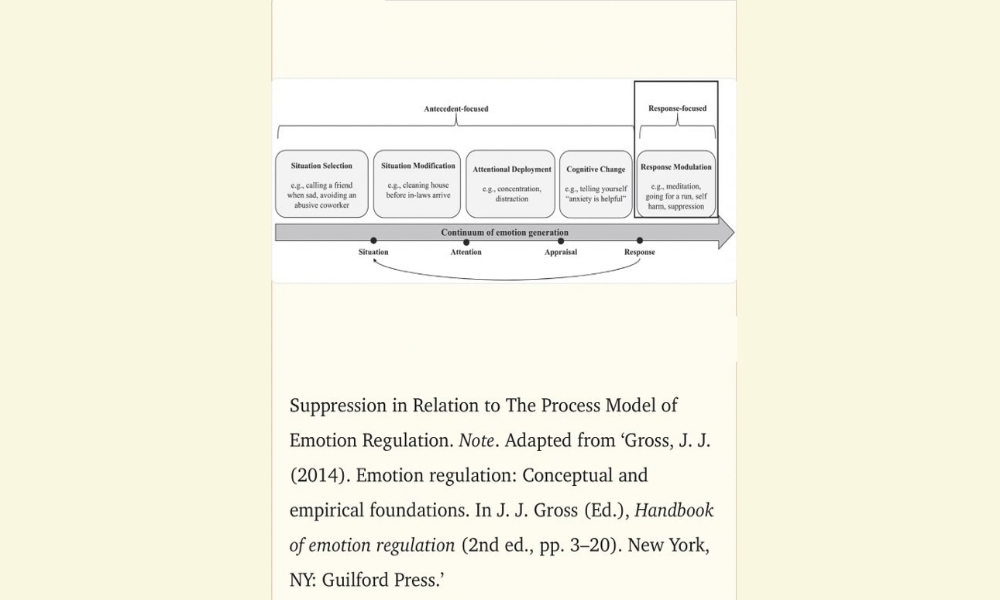
Psychologist James Gross proposed the process model of emotion regulation, which explains that we can intervene at different points in the emotional process. We can select or avoid certain situations, modify situations once we are in them, direct our attention elsewhere, change the way we interpret what is happening and, finally, modulate our emotional response. Emotional regulation therefore does not mean that we have to eliminate the emotion. It means that we can acknowledge what is happening internally while choosing how we respond externally.
More than a century ago, Rainer Maria Rilke wrote a letter to a young poet, Franz Xaver Kappus, who was struggling with sadness and uncertainty. Instead of asking him to escape these feelings, Rilke said: “Why do you want to shut out of your life any uneasiness, any misery, any depression, since after all you don’t know what work these conditions are doing inside you? Why do you want to persecute yourself with the question of where all this is coming from and where it is going? Since you know, after all, that you are in the midst of transitions and you wished for nothing so much as to change. If there is anything unhealthy in your reactions, just bear in mind that sickness is the means by which an organism frees itself from what is alien; so one must simply help it to be sick, to have its whole sickness and to break out with it, since that is the way it gets better.”
How Can We Process Our Emotions Instead of Suppressing Them?
1. Name the Emotion
The first step is often simply identifying what is happening inside us. Instead of saying “I feel bad,” try asking whether you feel angry, rejected, lonely, disappointed, afraid, overwhelmed or hurt. Naming an emotion can make it easier to understand rather than allowing it to remain as an undefined sense of heaviness. Sit with them and try understanding what they are conveying to you. The aim of their arrival and ask them how they’d go without harming you.
2. Allow It Without Immediately Reacting
Feeling an emotion does not mean that we have to act on it immediately. You can be angry without sending the message you may regret later. You can feel hurt without turning that hurt into an accusation. You can be sad without making a permanent decision in the middle of your sadness. Feel the emotion first; decide what to do with it afterwards.
3. Journal What You Cannot Say
Writing can give an emotion somewhere to exist. Write what you are actually feeling without worrying about whether it sounds reasonable or beautiful. Write the things you cannot say aloud, the questions you keep repeating and even the emotions you feel guilty for having. The purpose is not to produce good writing. It is to make the invisible visible to yourself.
4. Talk to Someone Safe
Not every emotion needs an audience, but every person needs somewhere they can be honest. A trusted friend, family member, mentor or therapist can sometimes provide the space that suppression never could. Sometimes being heard without being judged is itself a form of relief.
5. Move Your Body
Walking, stretching, exercising or simply changing your physical environment can help regulate physiological arousal and provide a healthy outlet when emotions feel overwhelming. Movement does not literally “release stored emotions from the tissues,” but it can help the body move from a state of heightened activation towards regulation.
6. Give the Emotion a Creative Language
Sometimes an emotion is too complicated to explain directly. That is where creativity can become another language. Write poetry. Paint. Bake. Make music. Photograph. Read. Sit by the sea. Watch the sunset. Not because creativity magically cures emotional pain, but because it can give shape to something that words alone may not be able to hold.
7. Professional Help
There is a difference between experiencing difficult emotions as part of ordinary life and being persistently overwhelmed by them. If emotional distress begins interfering with sleep, studies or work, relationships, daily functioning or the ability to care for yourself, professional help can be important.
Different forms of psychotherapy can help depending on the individual’s difficulties.
Cognitive Behavioural Therapy (CBT)
Acceptance and Commitment Therapy (ACT)
Dialectical Behaviour Therapy (DBT)
Psychodynamic Therapy
EMDR and Trauma-Focused Therapies
Seeking therapy does not mean that we have failed to control ourselves. Sometimes it simply means recognising that something we have been carrying alone needs to be understood with someone who knows how to help us carry it.
And I keep thinking about that woman with the cup of tea.
She did not stop loving her husband because she stopped talking about him. She did not stop grieving because she learnt how to make one cup instead of two. Her silence did not mean that the emotion had disappeared. Perhaps it simply meant that she had run out of ways to express something that was too large for words.
And her daughter watched.
Everyday, she saw her mother pour one cup instead of two. She saw the grief that was never spoken about, the memories that were never opened, the questions that were never asked. Eventually, there was no tea to be brewed in the house.
But perhaps healing would have begun with something as ordinary as making two cups again.
Not because the second cup would bring him back. It wouldn’t. Not because grief disappears when we talk about it. It doesn’t. But because perhaps one evening, the daughter could sit beside her mother and let the silence become a conversation. They could talk about him. They could cry. They could laugh about something he used to do. They could sit quietly and finish their tea without saying anything at all.
There would still be grief. But there would also be somewhere for the grief to go. Maybe that is what emotional expression really gives us. Not an escape from pain, but a place to put it. Because emotions are not interruptions to our existence. They are evidence that something mattered to us. That we loved, lost, hoped, feared, cared, belonged. And perhaps we were never meant to live without them. Perhaps we were only meant to learn how to feel them without drowning in them.
So make the second cup.
Sit with the sadness.
Name the anger.
Write the grief.
Let yourself cry.
Talk when you can.
Seek help when you cannot carry it alone.
Healing does not begin when the pain disappears.
Sometimes it begins when, after years of trying not to feel, we finally allow ourselves to feel what was there all along.
Beautiful one ❣️
Ma Sha Allah very nicely written
Great ❣️
Mashallah Very well written article
Well written and well expressed ✨