
The author is a renowned journalist
Periodically, people, groups and even constitutional authorities opposed to affirmative action for the welfare of Scheduled Castes (SCs) and Scheduled Tribes (STs) come out in the open, not realising that reservation in jobs and educational institutions is a permanent feature of the Indian Constitution. It is reservation in Parliament and State Legislatures which was, at the beginning of the Republic, time-bound. Even that is now extended from time to time, and it is unlikely that this provision will ever be repealed.
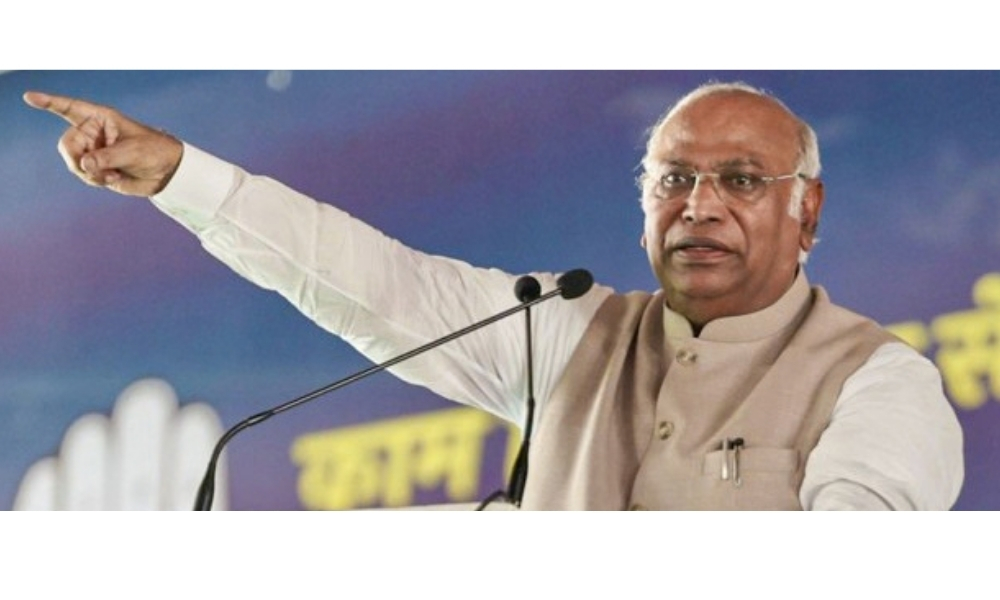
In this context, the statement of Congress President Mallikarjun Kharge on 24 August on reservation assumes great significance.
The Union Government, led by Narendra Modi, Kharge accused, is trying to end reservation in government and public sector organisations ‘through the backdoor’. Kharge said that more than 8.2 lakh sanctioned posts are lying vacant across Union Government establishments. This is a clear indication that the Bharatiya Janata Party-led NDA government is conspiring to end the constitutional rights of the disadvantaged communities in the country. Kharge made the serious charge amidst an agitation launched by a group of right-wing students who organised a protest at Delhi’s Jantar Mantar demanding an end to reservation in jobs and educational institutions. Though the agitation has fizzled out without any widespread support, the ministry-wise data of vacancies cited by the Congress President is really alarming.
The Railways had 2.40 lakh vacancies, the Defence Ministry 2.41 lakh and the Home Ministry had another 1.10 lakh vacancies. Kharge also pointed out that 5.1 lakh permanent jobs had been eliminated in public sector undertakings in the 12 years of Prime Minister Modi’s rule. During the same period, the percentage of contractual workers increased from 19 per cent to 49 per cent. Keeping government posts vacant effectively denies employment to the youth, which adversely affects, especially, the disadvantaged sections of society, that is, the Scheduled Castes and the Scheduled Tribes. Also, the sale of Public Sector Undertakings and appointing employees on contract have further reduced employment prospects for the Scheduled Castes and Scheduled Tribes, Kharge pointed out. “To end reservations, it is not necessary to amend the Constitution — just eliminating jobs where reservations are mandatory is enough,” Kharge said.
While the Union Government used brutal force to suppress the protest led by the Cockroach Janata Party (CPJ) and agreed to discuss its demand only after a month-long agitation, it strangely very quickly met the representatives of the anti-reservation agitationists. One wonders whether the BJP-led NDA Government has concluded that reservation, affirmative action for the welfare of the marginalised communities, is ‘negotiable’.
Reservation, or positive discrimination in India, is designed to correct historical injustices heaped on marginalised sections of the population for thousands of years. It seeks to establish social justice by providing adequate representation in educational institutions, public employment and legislatures. Article 15 prohibits discrimination on the grounds of religion, race, caste, sex or place of birth and mandates the State under clauses 4, 5 and 6 to make special provisions for the advancement of Scheduled Castes (SCs), Scheduled Tribes (STs), Socially Backward Castes (SBCs) and Economically Weaker Sections (EWSs). Article 16 guarantees equality of opportunity in public employment, with clauses 4, 4A, 4B and 6 allowing reservations in appointments, promotions and backlog for unrepresented backward classes and EWS. Articles 330 and 332 provide for reservation of seats for SCs and STs in the Lok Sabha and State Legislative Assemblies. Articles 243D and 243T mandate seat reservations for SCs and STs and women in Panchayati Raj institutions and Urban Local Bodies.
In a landmark judgment in Indra Sawhney v. Union of India (1992), the Supreme Court capped total reservations at 50 per cent, except in extraordinary circumstances. Further, the Supreme Court also introduced a Creamy Layer concept, which required advanced or economically well-off segments within the backward classes to be excluded from reservation. Further, the 103rd Constitutional Amendment Act (2019) introduced a 10 per cent reservation for Economically Weaker Sections outside the SC, ST, OBC groups, which has been upheld by the Supreme Court of India. However, the Supreme Court recently, by staying the University Grants Commission Promotion of Equity in Higher Education Institutions Regulations 2026, showed its bias against the promotion of social equity in higher education institutions, which have witnessed widespread discrimination and even persecution against SC and ST students, leading to a number of suicides among them.
The notification of the UGC Regulations had followed a rise in complaints of caste-based discrimination and cases such as those of Rohith Vemula and Payal Tadvi, which highlighted gaps in existing redress mechanisms. The opposition to the Regulations came from BJP-ruled states of Uttar Pradesh, Bihar and Rajasthan. It is pertinent to point out that there was no opposition to the Regulations in the majority of the states, including BJP-ruled states of Maharashtra and Gujarat and the southern states of Andhra Pradesh, Telangana, Karnataka and Kerala.
0 Comments