
The author is a freelance writer with a background in content writing. After writing in niches like tech, finance and digital marketing, she has now pivoted towards social and political
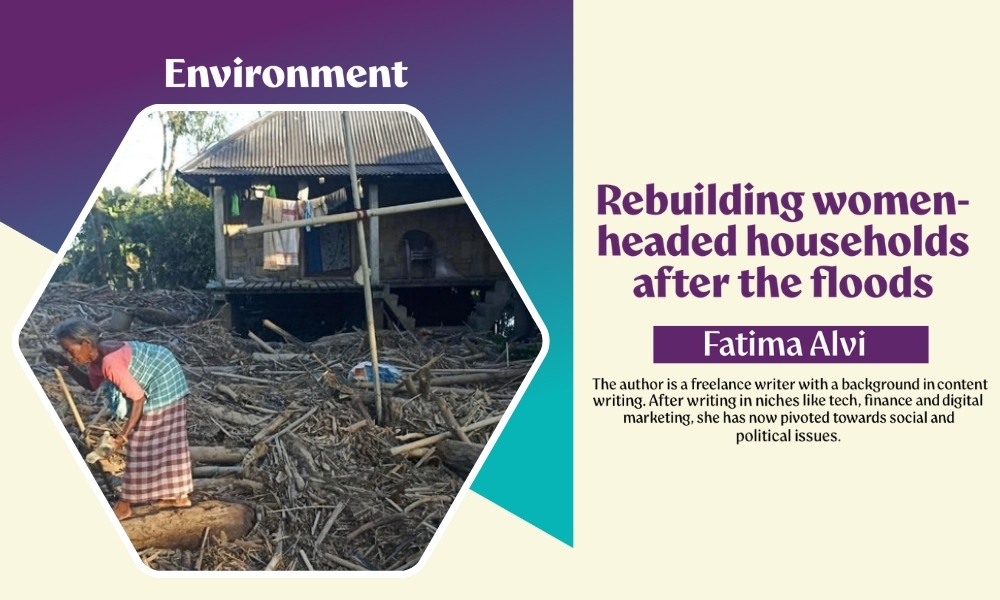
An elderly woman searches through debris outside her home for anything that can be salvaged.
Bornali Baruah is 40 and has been living in Charing village in Assam’s Sivasagar district since birth. Her family has been living there for generations. In 2016, Baruah left journalism and opted for animal husbandry. In 2019, she was named Assam’s best livestock farmer.
She owned around 300 goats, 1000 chickens, 500 ducks and fish. It was the devastating
night of 19th July, 2026, that changed everything for Baruah and her family. As floodwater pushed through the village,
Baruah and her family had to flee. Baruah had heard of a great flood in 1950 but had never witnessed anything like this in her lifetime. The flood took away years of her hard work. Only sixty goats survived. She lost 300 chickens, 300 ducks, most of her fish, furniture, her feeding machine, vehicles, laptops and the family’s books. The livestock wasn’t insured. In fact, no insurance product is available locally for goats to begin with.
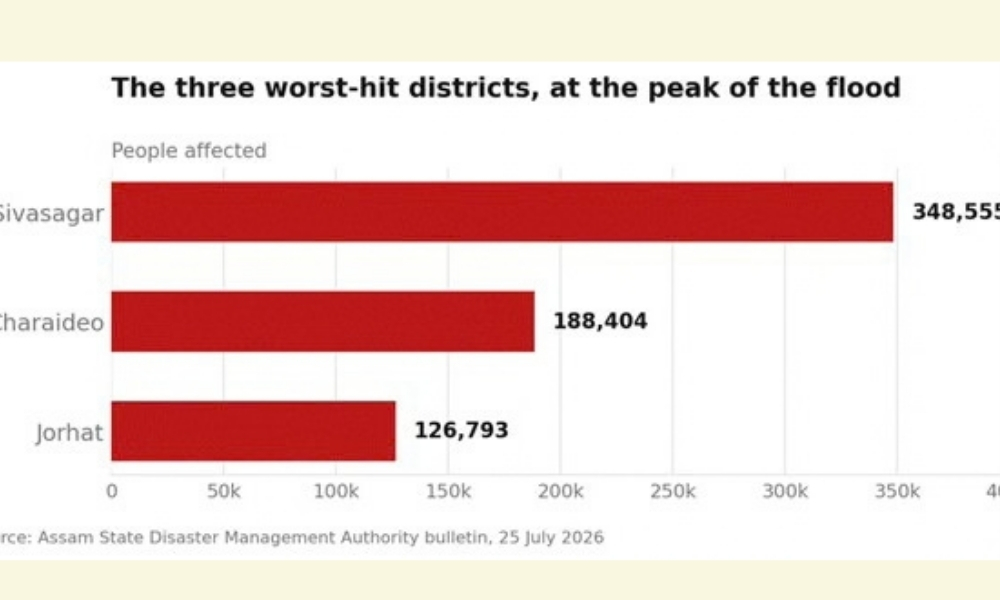
According to the reports by the Assam State Disaster Management Authority(ASDMA), 10 districts and 456 villages have been recorded as flood-affected, with Golaghat (145 villages) and Sivasagar(110) being the worst hit. Other affected districts include Hojai, Darrang, Lakhimpur, Jorhat, Karbi Anglong, Charaideo, Nagaon and Biswanath. More than 7,00,000 people have been displaced and 119,000 hectares of cropland submerged. As of 10th August, 2026, the death toll had reached 100, as reported by ASDMA. As for the people sheltered in relief camps, the figures moved daily. While some agencies quoted cumulative displacement, the ASDMA quoted people currently sheltered. On August 9, the ASDMA counted 8,000+ people in 52 camps; the wire reporting the next day claimed nearly 3,00,000 people had passed through the camps, with 49,000 still sheltered in them. This is not a contradiction, but rather current occupancy versus cumulative shelter. At the peak, Sivasagar alone accounted for more people affected than Charaideo and Jorhat combined.
As floodwater receded and families returned, they found their houses buried under two to three feet of silt. Road connectivity had been damaged, the transport network and rural infrastructure disrupted, the wells and ponds contaminated by floodwater and fields that will not yield crops this season. In Nepalikhuti, a Sivasagar village, around 5,000 cattle were reportedly swept away in a community that depends on dairy. A doctor at Demow Model Hospital who treated snakebite cases on the phone during the floods has seen around 150 patients with insect bites, driven by the mud left behind. The state announced ₹15,000 in interim relief per affected family, with a further ₹10,000 for households in Sivasagar and Charaideo and a waiver of July electricity bills up to 300 units in those two districts. Around 50,000 people have received interim compensation by 10 August. As important as it is, the amount is nowhere close to the cost of rebuilding a goat farm or a dairy herd. The second disaster begins when the flood is over. The waters may have receded, but the families are left to deal with the cost of rebuilding their lives.
To complement the state-led effort in emergency relief, many organisations came forward. Their focus of work was largely on emergency rations, clean drinking water and sanitation, emergency shelters, urgent medical care and hygiene and dignity kits for women. However, in situations like these, humanitarian needs often exceed available resources. Despite these efforts, many flood-affected households remained without adequate shelter materials, access to safe drinking water, hygiene supplies and essential household items. While emergency relief is important in providing immediate, life-saving aid during the first days and weeks of a flood, communities have to deal with the larger question of long-term recovery. Food kits and safe water matter in week one; seed, fodder, silt clearance and livestock replacement determine the solvency of a family in a year. While relief work may last for days to weeks after a flood, long-term recovery in the form of repairing damaged roads, restoration of livelihood, rebuilding homes and infrastructure, replacing livestock and work equipment extends over months and years.
Natural disasters like floods affect women disproportionately in India. Women-headed households without secure land rights and access to formal credit face severe consequences and hardships in post-flood recovery. Women comprise a significant share of the agricultural sector’s workforce. In 2021-22, 57.3% of working-age women were engaged in agriculture, in sharp contrast to only 34.4% of men. Rural women have been unable to take up jobs in non-agricultural sectors due to limited resources and mobility restrictions. As only 14% of women in India own land, this restricts their ability to adapt and respond to climate change. What makes the situation worse for women is the constraints imposed by social norms, where they are responsible for taking care of children and the elderly, thereby making it difficult for them to move to other occupations. It reduces their access to warning information, which increases their vulnerability to disasters like floods. As men migrate to cities in search of jobs or due to losses from recurrent floods, the women in villages are left even more vulnerable. The primary responsibility for disaster management, including disbursal of flood compensation,n rests with the concerned State Governments. In the wake of a natural disaster, the State Governments undertake relief measures from the State Disaster Response Fund(SDRF) in accordance with Government of India approved items and norms. The steps followed in disbursal of compensation can be enumerated as follows:
1. Before initiating any formal compensation process, the local, state, or federal government must officially declare a state of calamity or disaster for the said region. It activates the emergency disaster funds such as the SDRF and establishes the legal framework for relief distribution.
2. After a state of disaster is declared for a region, preliminary and ground-level assessment is undertaken by revenue department officials, local municipal teams and village authorities in the affected zones.
After assessing the extent of damage, officials ask residents to provide critical proofs like ID cards, land/property tax receipts, ration cards and bank account passbooks.
3. Data collected on the ground is compiled and cross-checked to avoid duplicate or fraudulent claims. Local magistrates or sub-divisional committees evaluate the claims against ground verification reports before finalising the list of beneficiaries.
4. Once the beneficiary list is compiled, they undergo a system of tiered approval beginning from local block officers to District Magistrates. Budget allocations are made as per standard government norms – for example, specifying amounts for rebuilding houses.
5. Funds are transferred directly to the victim’s bank account. In places where the banking system is temporarily down, physical counters are set up to distribute cash, debit cards or relief kits.
The process of receiving flood relief compensation is a long and tedious one. From the declaration of a state of disaster till the transfer of funds, there is a time lag. Even a single link in the chain can sometimes take weeks or months. In the meantime, responsibilities for children and elderly relatives continue even when the income has disappeared, savings are gone, and the relief compensation hasn’t arrived. Indian women face major hurdles in receiving flood compensation as relief systems rely on male-dominated property records and official paperwork. Officials who interview women for compensation often demand land deeds or property papers to process housing or crop compensation claims. As the majority of women do not hold legal titles to land or property, it becomes difficult for them to access government relief, insurance claims or reconstruction loans. To access institutional aid, women must negotiate through a male relative. Such negotiations are rarely conducted on equal terms. While farmers receive state compensation for their losses, women who work for them do not get such support. Most disaster relief programs link financial aid to official household headship papers—Bank accounts and registration forms list only the male head of the family. Due to low literacy rates in rural areas, women often experience difficulty in applying for government aid and in navigating the bureaucratic process in government offices. Also, the cultural norms and traditional caretaking duties often restrict women from travelling to relief distribution centres.
As flood compensation takes time to arrive and household expenses cannot be put on hold, women rely heavily on the informal credit sector for their survival. Here too t, they face recovery gaps and debt traps due to financial exclusion. In the aftermath of floods, women take loans from relatives, local moneylenders and self-help groups to procure basic food and medicine. Unlike the formal banking sector and microfinance institutions (MFIs), which do not issue loans without adequate paperwork or in lieu of physical collateral, the informal credit sector relies on trust and social capital. Self-help groups play a pivotal role in supporting women to meet the post-flood challenges by providing pooled contributions to meet immediate needs like medical care or crop losses. However, due to a lack of financial education and ability to engage with formal institutions, they continue to depend on the informal sector. This hinders their ability to grow their assets or build long-term financial security. Local moneylenders often charge exorbitant rates of interest. Dependence on informal loans for daily survival rather than investments often pushes households into deep debt spirals. As a result, women often face harassment at the hands of their creditors.
The existing gendered vulnerabilities in society become even more pronounced in the event of a catastrophe like a flood. Its effects are not only limited to the emergency period but extend to the post-recovery phase. Women bear the double burden of labour, where they have to balance gruelling paid work outside the home with extensive unpaid domestic labour, and as per a yet-to-be-peer-reviewed study by Jheelum Sarkar published by Cambridge University Press, married women in affected districts increased their unpaid household work by 10 to 12 hours per week compared to those in unaffected districts post-floods. In the case of paid labour, women increased their participation by 4 to 5.6 hours a week. Also, women spend 8.9 to 18.1 hours on unpaid care work for other household members. As floods trigger water-borne illnesses, vector-borne diseases and malnutrition, it increases the demand for unpaid healthcare within the household. Women and girls often bear the responsibility of fetching water and cooking fuel. As clean water becomes scarce in flood-affected areas, they have to walk long distances for these tasks, leading to time poverty where their ability to engage in education or paid work becomes severely restricted. They perform the heavy physical labour of clearing mud from homes, desilting the fields and salvaging belongings, as men often migrate to cities after floods in search of jobs. Post-disaster formal reconstruction jobs display a strong male bias in recruitment, leaving women trapped in low-paying, informal, gruelling agricultural jobs.
The disproportionate impact of floods on women-headed households is a direct consequence of gender bias embedded within land tenure systems, emergency protocols and post-disaster governance frameworks. Gender sensitive flood recovery addresses the specific needs, safety risks and economic role of women in the rebuilding phase. This approach recognises that women face unique challenges during disasters and there is a need to recognise the unpaid and often invisible work that women do to support the communities after the floodwaters recede. The flood relief compensation procedure should be made faster and simpler with direct benefit transfers and special assistance for women-headed households. All loan repayments should be placed under an automatic moratorium for directly and secondarily affected borrowers without any penal interest charges. This will give families the breathing space to rebuild their lives. Recognising women as housing and property beneficiaries will ease the process of claiming flood compensation. Including women in disaster planning ensures more comprehensive responses, from prioritising safe shelters and water access to the care of the children and the elderly. Resources and training for women-led disaster committees can improve relief distribution and build community trust. The disparities that make women more vulnerable to floods need to be addressed with the same urgency as the disaster itself, they will continue to reflect and amplify the inequalities that already pervade their daily lives.

References:
0 Comments