
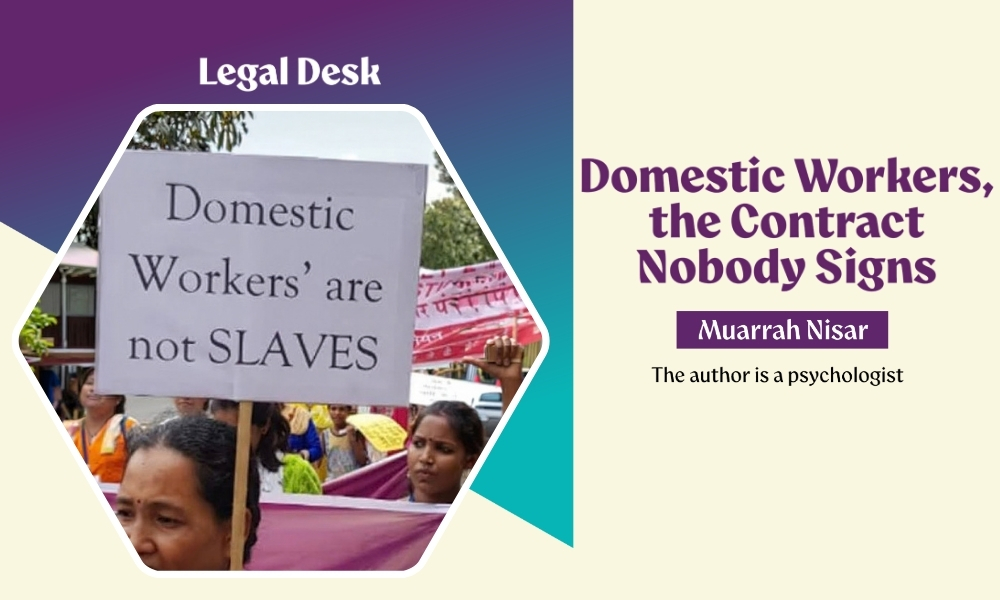
The author is a psychologist
Wages, weekly offs and job security, through conversations with the people who work in our homes.
We know when the person who works in our house is supposed to arrive. We know what she is expected to finish before she leaves, how much we pay her and, usually, what happens if she does not come for a day. There is an understanding between the household and the person who works in it, even when nobody has sat down to write it down. We may not call it a contract, but there are terms, expectations and responsibilities on both sides. The interesting part is how easily those terms can change when one side has more power than the other.
Domestic work is hardly a new phenomenon. People have worked in other people’s homes for generations, although the words used to describe them have changed. In India, domestic service has long been shaped by caste, class and gender, with household work often understood through the language of servants and service rather than employment. Today, “domestic worker” is the more formal term used for people employed to work in or for households. It covers much more than the familiar idea of a “maid”, cleaning, cooking, washing, childcare, caregiving, driving, gardening and several other forms of household work.
Perhaps the change in language matters because it asks us to look at the person differently. “House help” can make the work sound like something happening around the edges of a household. “Domestic worker” makes us stop and consider the work itself, what it involves, how long it takes, what it is worth and what the person doing it should reasonably be able to expect. The ILO’s Domestic Workers Convention, adopted in 2011, was an important step in establishing international standards for the protection of domestic workers. But perhaps what changes on paper is easier than what changes inside a home.
We expect a lot from people who work in our homes. We want the house cleaned properly, the dishes washed properly, the clothes handled carefully, the food prepared the way we like it and the work completed within the time we consider reasonable. We notice when something has not been done properly. We may even expect someone to remember the small things without having to be told every time.
There is nothing wrong with expecting someone to do the work they have been hired to do. The question is what happens when the work quietly becomes more than what was originally agreed upon. A few more dishes because guests came. Another room that needs cleaning. Clothes that need to be washed that day. Staying back because there is more work than usual. One additional task does not seem like much when we are asking for it. But when one additional task keeps getting added, the question changes from “Can you do this today?” to “Why has this become part of your job without changing anything else?”
This is where our understanding of work becomes interesting. At our own workplaces, we know that an extra hour is an extra hour. If our employer asks us to stay back, we may expect an incentive or overtime. If our responsibilities increase, we may ask for a raise. If we are repeatedly asked to do work that was never part of what we were hired for, we know enough to question it.
We know our time has value. Why is it so much easier to forget that when it is someone else’s time?
One of the women I spoke to has experienced very different ways of being treated across the households where she works. In one house, being even a little late can mean being yelled at. A task not being done according to the household’s expectations can invite anger. These may appear to be small incidents when looked at from the outside, but they reveal something about the relationship between the person giving the instructions and the person who has to receive them.
In another house, that relationship looks very different. She is treated more like another member of the family. There are jokes with the children, food is offered, and when there is work to be done, the people in the house help rather than simply sitting back and instructing her. The work itself has not disappeared. The house still needs to be cleaned, the dishes still need to be done and the responsibilities remain. The difference is in how the person doing the work is treated while doing it. That contrast is worth sitting with.
Fairness does not mean that a household cannot have expectations from a domestic worker. It means that having expectations does not give us a licence to take away someone’s dignity. It means that the person working in our home can be corrected without being humiliated, and that a relationship of employment does not have to become a relationship of command.
The same woman also spoke about what happens when she misses work. A day’s absence can mean a cut in her pay, even when there is a genuine reason for not coming. For someone already managing a household on a limited wage, that deduction is not necessarily a small amount.
We often think of salary as something that belongs to the month as a whole. But for someone whose income is already limited, each day’s wage can have a direct place in the family’s expenses. And then there is the uncertainty of knowing how long that income will continue.
Another woman I spoke to described being suddenly asked not to come back because the household had found someone else, or because they were no longer satisfied with her work. For the family, replacing a domestic worker may feel like a practical decision. For the worker, it can mean that a part of her income disappears almost overnight.
This is one of the easiest things for us to overlook. We may think of changing a house help as changing a service. But for the person who comes to work every morning, it is employment.
We understand job security when we talk about ourselves. We understand why people ask about notice periods before accepting a job. We understand the anxiety of not knowing whether there will be an income next month. We understand why a sudden dismissal can disrupt rent, school fees, bills and plans.
The workplace does not stop being a workplace because it is a home. Perhaps the weekly off shows this most simply.
The first woman I spoke to does not really have a weekly off beyond Sunday. Even that Sunday is not always hers. If something is happening in the household, she is expected to come in. Asking for an additional day of leave is often met with refusal or scolding. She has gone to work even when she was unwell because staying at home meant not going to work, and not going to work was not always treated as an option. There was, however, one household that responded differently when she was sick. They gave her medicine and sent her home.
It is a small difference, but perhaps that is precisely why it matters.
For many of us, a weekly day away from work is so ordinary that we barely think of it as something that needs to be negotiated. It gives us time to rest, take care of our families, attend appointments, run errands or simply do nothing. Yet for domestic workers, rest can become something that depends on how much flexibility an individual household is willing to give.
International labour standards recognise weekly rest as part of decent work. The ILO’s Convention 189 calls for at least 24 consecutive hours of weekly rest for domestic workers, along with clear terms of employment, regular payment and protections around working time and leave.
It is worth noticing how ordinary these things already feel when we think about our own employment. There is another phrase that comes up often when we talk about domestic workers: “She is like family.”
Sometimes, she genuinely is important to the family. She may have been there for years. She may have watched the children grow up, known the family’s routines and become someone the household trusts deeply. There can be genuine affection in these relationships, and there is no reason to deny that. But being treated warmly and being treated fairly are not always the same thing.
Perhaps the better question is what we mean when we say someone is “like family”. If it means that we care when she is unwell, that we notice when she needs rest, that we speak to her with respect and that we do not treat her livelihood casually, then the phrase carries some meaning. But if it mainly means that we expect her to understand our emergencies, stay back when guests arrive or take on an extra task without complaint, then the relationship begins to look different. Affection cannot replace clarity.
And maybe this is why domestic work is such an interesting place to examine our understanding of power. We do not usually think of ourselves as employers when someone works in our home. We think of ourselves as a family that has hired someone to help. But if we decide the wage, decide the working hours, decide what work needs to be done and have the power to end the arrangement, then we are, in fact, the employer. That does not make the relationship cold. It simply makes the responsibility more visible.
We already know what we want from our own employers. We want our work to be valued. We want our time to matter. We want clarity about what is expected of us. We want to be paid on time. We want a day to rest. We want to know before our job disappears.
It is worth asking whether these expectations become less reasonable simply because we are now the ones on the other side of them. The contract may never be written down. But the agreement is there every morning when someone walks through the door to begin work.
Hence, the real question is not whether we have been kind to the person working in our home. It is whether we have been fair. Because sometimes, without noticing it, we become the employer we would have found difficult to work for ourselves.
0 Comments