
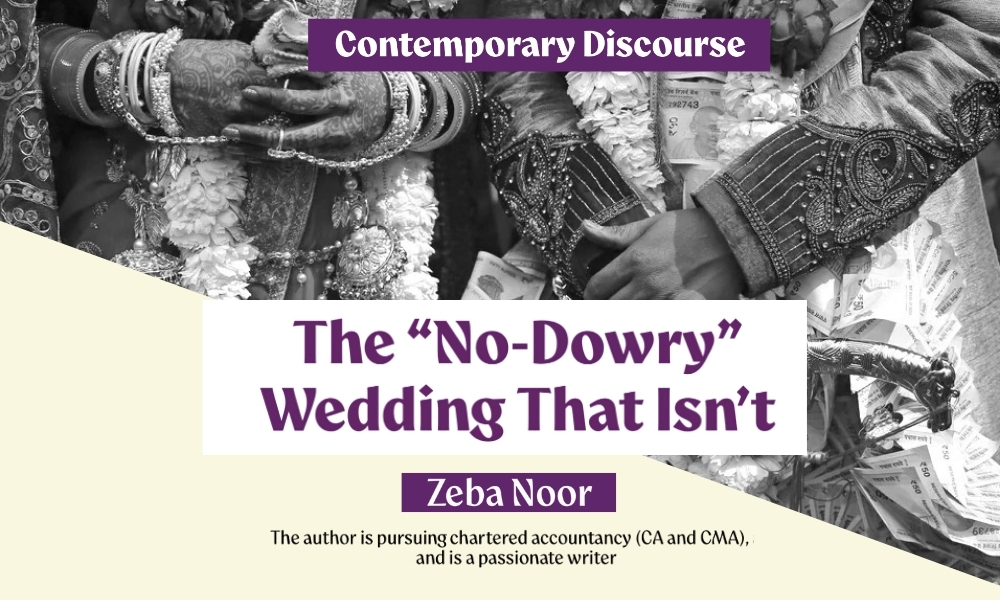
The “No-Dowry” Wedding That Isn’t
How jewellery, cars, and “voluntary” gifts continue to disguise dowry in modern India
I used to think dowry was a problem belonging to another generation. Growing up as an Indian student, I had heard the usual stories: a bride’s family being asked for cash, furniture, appliances, or a car before a wedding. Whenever the subject came up, it was easy to imagine dowry as something obvious — an outright demand made by a groom’s family. But the older I became, the more I realised that dowry had not disappeared. It had simply become better at hiding.
Today, we hear about “no-dowry weddings” with pride. Families announce that they have not demanded a single rupee from the bride’s side. The wedding is presented as progressive, educated and modern. Yet sometimes, when I look closely at what is happening around me, I find a strange contradiction. There may be no one saying, “Give us ₹10 lakh.” Instead, there is a list of expectations disguised as tradition, love, generosity and status. A car becomes a “gift”. Gold jewellery becomes “security for the daughter”. Expensive furniture becomes “helping the newly married couple settle down”. A lavish wedding becomes “what every parent wants for their daughter”. And suddenly, dowry is no longer called dowry.
I have grown up watching how much importance Indian families attach to weddings. As a student, I have attended weddings where people discuss the bride’s jewellery almost as much as they discuss the couple themselves. How many sovereigns of gold? What car did her parents give? Where was the wedding held? How many functions were there? What did the bride’s family arrange? Sometimes these questions are asked casually, almost innocently. But I cannot help wondering: when did a daughter’s marriage become a financial project for her parents? The most uncomfortable part is that modern dowry does not always involve an aggressive demand. Sometimes, the demand is communicated through silence. A family may never explicitly ask for a car. They may simply mention that the groom has always wanted a particular model. They may talk about how difficult it will be for the couple to travel without one. The bride’s parents understand the message. Nobody says, “You must buy it.” Yet somehow, the car arrives.
This is what makes disguised dowry so difficult to confront. There is often no dramatic confrontation that allows us to identify the wrongdoer. Instead, there are hints, comparisons and expectations: “Her parents gave her so much.” “We didn’t ask for anything, but they insisted.” “It is their daughter; they wanted to give her something.” These sentences can make an enormous transfer of wealth sound completely voluntary. And sometimes it genuinely is voluntary. Parents may want to give their daughter jewellery or financial support out of love. There is nothing inherently wrong with a parent gifting something to their child. The problem begins when “choice” exists only on paper. If a bride’s family feels that refusing to give an expensive gift could affect how their daughter is treated, can we honestly call it voluntary? If parents take loans because they fear that their daughter will be judged for having a “simple” wedding, is that generosity — or pressure? If a bride is expected to arrive at her husband’s home with gold, household goods and other expensive possessions simply because “that is what families do,” how different is that from traditional dowry?
As a student, I find this particularly disturbing because my generation is constantly told that education has changed society. We have women becoming doctors, chartered accountants, engineers, entrepreneurs, researchers and administrators. We celebrate women earning their own money and becoming financially independent. Yet at the same time, marriage negotiations can still reduce a woman’s family to what it can afford to provide. There is an irony here. We tell girls to study so that they can stand on their own feet. But when they marry, their family may still be judged by how much it can place at their feet. The language has changed faster than the mentality. What concerns me most is how normalised this has become. A family may genuinely believe it is progressive because it did not make an explicit dowry demand. But if everyone involved knows that certain “gifts” are expected, then changing the label does not change the reality. A ₹15-lakh car does not become less expensive because it is called a gift. Several lakhs’ worth of jewellery do not become less significant because someone says, “We gave it out of our own happiness.” And a family going into debt does not experience less financial pressure simply because nobody formally demanded the money.
I also think we need to stop placing the entire burden of this conversation on brides and their parents. A marriage is not a transaction between two families where one side provides the bride and the other side provides the groom. The groom and his family have a responsibility too. A man who genuinely believes in a “no-dowry marriage” should not merely refrain from making a demand. He should also be willing to reject benefits that he knows have been produced by social pressure. That distinction matters. There is a huge difference between saying, “We didn’t ask for anything,” and saying, “Please don’t spend beyond what you comfortably want to spend.” The second statement actually removes pressure. Perhaps the most meaningful no-dowry wedding is not the one with the most impressive declaration. It is the one where a bride’s parents can walk away without wondering whether they gave enough.
I don’t think we can eliminate dowry merely by changing terminology. We need to change the conversations that happen before the wedding — the comparisons, expectations and subtle negotiations that make families feel obligated to give. As a young Indian woman, I want to believe that marriage can be about companionship rather than compensation. I want a generation where parents are proud because their daughter is happy, not because they managed to fill a house with gold. And perhaps the real test of a “no-dowry” wedding is very simple: If the bride’s family gave nothing beyond what they genuinely wanted to give, would everyone still be equally happy to welcome her? If the answer is yes, perhaps we are finally moving forward. If the answer is no, then perhaps dowry never really left. We only taught it to call itself a gift.
The parents who are financially sound can give gift. This will be okay as far as its kept confidential. When it is displayed on the wedding day all this becomes a pressure on other families to take loan to do it.