
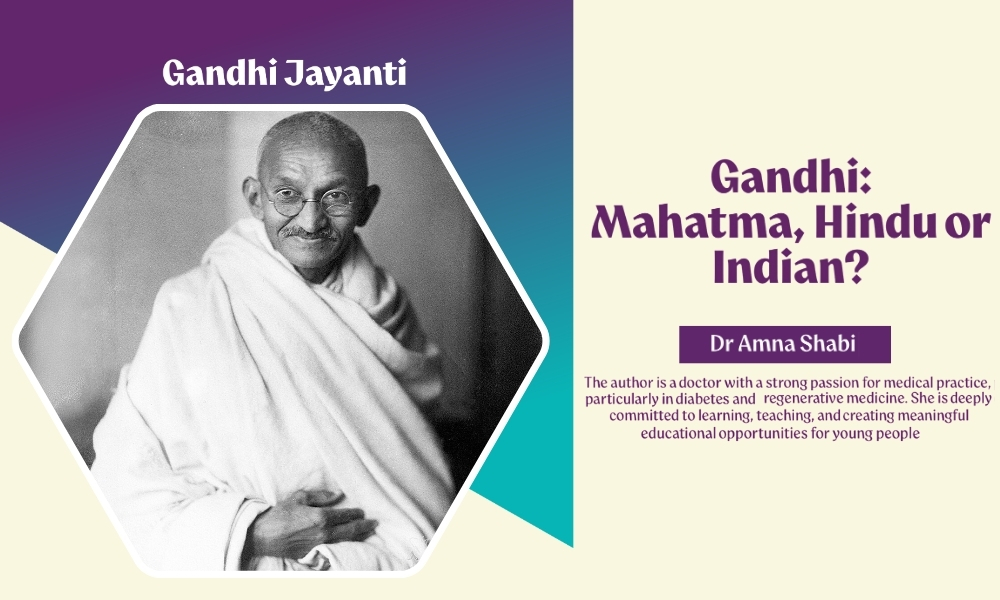
The author is a doctor with a strong passion for medical practice, particularly in diabetes and regenerative medicine. She is deeply committed to learning, teaching, and creating meaningful educational opportunities for young people
Few personalities in India’s political history are as complex as Mahatma Gandhi. He has been loved, hated, admired, criticised, worshipped and appropriated by different political traditions — sometimes even by the same people at different points in history. For some, Gandhi is the Father of the Nation. For others, he was a shrewd political strategist who understood the power of mass mobilisation like few others. Some Muslims remember him as a sincere friend of Hindu-Muslim unity, while others see him as a deeply religious Hindu whose politics could never completely escape the influence of his religious worldview. And today, one question is increasingly being asked: Was Gandhi a supporter of Hindutva? The question sounds simple. It is not. To answer it, we have to distinguish between being a Hindu and being a Hindutva ideologue. Gandhi was unquestionably a deeply religious Hindu. He spoke of Rama, Krishna, the Bhagavad Gita and Hindu traditions. He openly acknowledged his Hindu identity and drew much of his moral vocabulary from it. But the more important question is: What kind of India did Gandhi want? Did he want an India in which the Hindu majority would enjoy political supremacy? Or did he imagine an India in which Hindus, Muslims, Sikhs, Christians, Parsis and others could live together as equal citizens? This distinction is crucial. A person can be deeply rooted in his own religious tradition without believing that the state belongs exclusively to followers of that religion. Gandhi’s religious vocabulary was Hindu, but his political vision of India was not based on the idea of Hindu political supremacy. At the same time, there is no reason to turn Gandhi into a flawless secular saint. He had contradictions. He made political mistakes. His views on caste were strongly challenged by Dr B. R. Ambedkar. His approach to Muslim politics had serious limitations. His disagreements with Jinnah were profound. That is precisely why Gandhi needs to be studied — not worshipped.
There is a tendency today to tell a very simple story about Gandhi: he was either a great friend of Muslims or an anti-Muslim politician. The historical reality is much more complicated. Gandhi’s relationship with Indian Muslims was one of the most significant and controversial aspects of his political career. One of the most important episodes was his association with the Khilafat Movement. For many Indian Muslims, the fate of the Ottoman Caliphate was not merely a distant international issue. It had religious and emotional significance. Gandhi understood the depth of these feelings and decided to support the Khilafat cause. More importantly, he connected the Khilafat Movement with his Non-Cooperation Movement. This was not a small political calculation. Gandhi believed that Hindu-Muslim unity was essential to India’s struggle against British rule. He saw the Khilafat question as an opportunity to bring Hindus and Muslims together in a common anti-colonial struggle. His writings show that he repeatedly defended the legitimacy of Muslim concerns and argued that the actions of some Muslims should not be used to condemn the entire Muslim community. This part of Gandhi’s history is often forgotten. For Muslims, therefore, Gandhi cannot simply be remembered as a Hindu leader who occasionally spoke about Muslim rights. At important moments, he deliberately made Hindu-Muslim unity a central pillar of his political strategy. But this does not mean that Gandhi accepted Muslim political thought in its entirety. And this is where the story becomes more complicated.
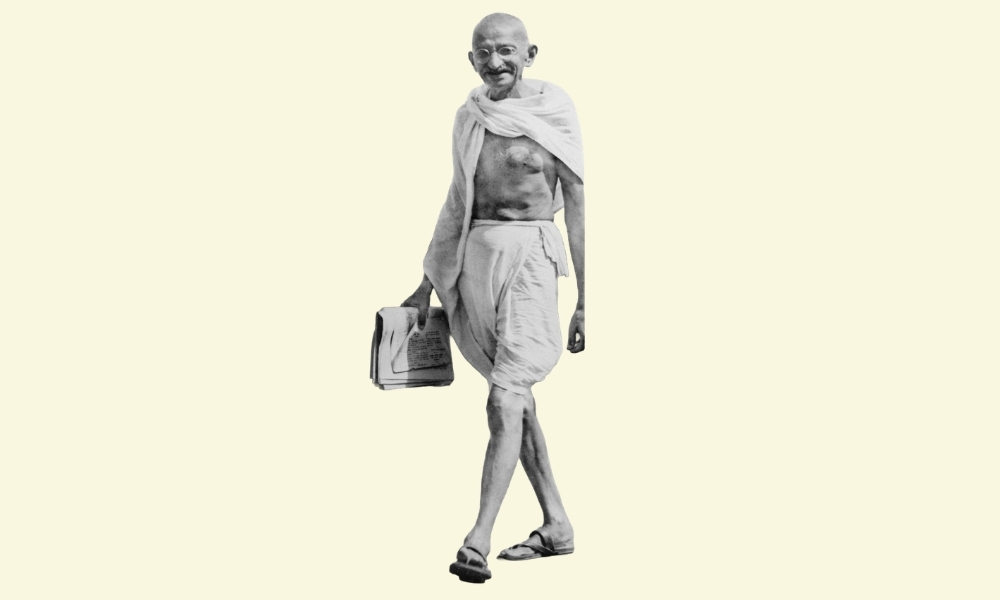
Gandhi and Jinnah: Two Visions of India
Gandhi wanted a united India. Muhammad Ali Jinnah increasingly came to believe that India’s Muslims were not merely a religious minority but a distinct political nation whose interests could not safely be left to the goodwill of a Hindu majority. This was not simply a personal disagreement between Gandhi and Jinnah. It was a disagreement over the very meaning of India. Gandhi believed that religious differences did not make a common Indian political identity impossible. Jinnah believed that Muslim political identity required constitutional and political safeguards strong enough to prevent permanent majoritarian domination. Their famous talks in 1944 reflected this fundamental disagreement. Gandhi went to Jinnah because he still hoped that the Hindu-Muslim question could be resolved without partition. Jinnah wanted the Muslim League’s political claim to be recognised. Neither side was prepared to surrender its central position. The result was failure. But the failure itself tells us something important: Gandhi did not simply dismiss the Muslim political question as irrelevant. He engaged with Jinnah repeatedly because he understood that India’s future could not be settled without addressing Muslim political anxieties. Muslims could therefore regard Gandhi as a friend without necessarily accepting Gandhi’s political solution. They could respect his sincerity while disagreeing with his politics. That is a much more mature way of reading history than either blind admiration or complete rejection.
Arundhati Roy’s The ‘Doctor’ and the Saint offers another important lesson. The book is primarily about Gandhi’s conflict with Dr B. R. Ambedkar over caste and the politics surrounding Gandhi’s saintly image. Roy challenges the tendency to place Gandhi on a moral pedestal where criticism itself becomes almost unacceptable. That criticism deserves attention. But the same principle should be applied consistently. If Gandhi is not beyond criticism on caste, he should not be beyond criticism on his relationship with Muslims either. And if Gandhi had political limitations, those limitations should not become an excuse for rewriting his entire political legacy. The danger lies at both extremes. One side turns Gandhi into a Mahatma without contradictions. The other turns him into a Hindutva politician before Hindutva, simply because he was a religious Hindu. Both approaches flatten history.
Perhaps the most revealing Gandhi appears during the final months of his life. India became independent in August 1947. But independence came with Partition, mass displacement and horrific communal violence. Millions were uprooted. Hindus and Sikhs fled Pakistan. Muslims fled India. Countless families lost homes, relatives and everything they possessed. For Gandhi, freedom could not be celebrated meaningfully while ordinary people were living in fear of their neighbours. He travelled through areas devastated by communal violence instead of remaining comfortably in Delhi to celebrate independence. His interventions in Bengal and Delhi were directed at protecting human life and restoring communal trust. By January 1948, his focus had turned particularly towards the safety of Muslims in Delhi. He went on a fast demanding an end to communal violence and insisting that Muslims had the right to live safely in India. The issue of the ₹55 crore payment to Pakistan also became part of this controversy. Gandhi supported honouring India’s financial commitment to Pakistan, arguing that a moral commitment could not be abandoned simply because relations between the two countries had deteriorated. This position angered many Hindu nationalist elements. And this is important when we discuss whether Gandhi was a Hindutva supporter. If Gandhi’s political objective was a Hindu Rashtra, why was he risking his life to defend the rights of Indian Muslims after Partition? Why was he demanding that India honour its commitments to Pakistan? Why was he opposing the logic that the suffering of Hindus and Sikhs in Pakistan justified revenge against Muslims in India? These questions cannot simply be wished away.
Nathuram Godse assassinated Gandhi on 30 January 1948. The assassination cannot be understood merely as the act of one angry individual. It was also the violent expression of a particular political disagreement over what India should become. Godse regarded Gandhi as an obstacle to his vision of Hindu nationalism. Gandhi, particularly in the final months of his life, was insisting on something very different: India could not become a country in which Muslims were treated as second-class citizens simply because Hindus were the majority. This is why the Gandhi-Godse contrast continues to matter. The question is not whether Gandhi was perfect. He certainly was not. The question is: What kind of India did each of them imagine? One vision placed religious majoritarian identity at the centre of the nation. The other insisted that India belonged to all its communities. That is why the question — “Is this country Gandhi’s or Godse’s?” — is not merely a historical slogan. It is a question about the basic character of the Indian republic.
The RSS and the Changing Image of Gandhi
The history of the RSS and Gandhi is itself revealing. Following Gandhi’s assassination, the government banned the RSS in 1948. The organisation has always denied responsibility for the assassination, and its own historical accounts describe the ban imposed after Gandhi’s killing. Yet decades later, Gandhi’s image has increasingly been embraced by political forces that were once deeply hostile to him. There is a political logic behind this. Gandhi has become too large a figure to simply reject. His image is now part of India’s national symbolism. Therefore, different political traditions increasingly compete to claim him. This is where a strange situation emerges. The RSS once had little use for Gandhi. Today, Gandhi’s image can appear in its public commemorations and political messaging. At the same time, some Muslims continue to describe Gandhi as essentially a Hindutva figure. Ironically, this can strengthen the very narrative that Hindutva politics wants to establish. The argument then becomes: Hindutva was not created by Savarkar; it was simply the natural political expression of India’s Hindu civilisation. Even Gandhi, one of India’s greatest national figures, was supposedly a soft or moderate version of the same idea. Nehru and other Westernised leaders later imposed secularism on India against the natural wishes of its
Hindu majority. Once this narrative becomes established, the Indian Constitution itself can be portrayed as an artificial interruption of India’s supposedly natural Hindu political destiny. This is why historical precision matters.
Kashmir provides another important test of Gandhi’s political thinking. The Kashmir conflict emerged in the immediate aftermath of Partition and soon became one of the most bitter disputes between India and Pakistan. Today, Kashmir is often discussed almost entirely in terms of national ownership: India’s Kashmir or Pakistan’s Kashmir? But Gandhi’s statements reveal a somewhat different concern. He recognised the demographic reality of Kashmir, where Muslims formed the overwhelming majority. At the same time, he opposed the tribal invasion and the violence that followed. His position was not simply that Kashmir was a piece of territory to be possessed by one country or the other. The people of Kashmir mattered. This becomes especially important when we remember that Gandhi had already witnessed the catastrophic consequences of turning religious identity into a territorial struggle. He rejected the idea that Kashmir should simply be divided along communal lines. He also condemned violence against Kashmiri Muslims and criticised the Maharaja’s role in creating the conditions that had led to the crisis. This does not make Gandhi pro-Pakistan. Nor does it make him anti-India. It shows that his nationalism had not completely erased his concern for human beings living inside the territory being contested. That is perhaps the most uncomfortable aspect of Gandhi’s Kashmir position for both modern nationalisms. He forces us to ask not only, “Who owns Kashmir?” but also, “What happens to the people of Kashmir?”
Was Gandhi a Hindutva Supporter?
More than seven decades later, that question remains unresolved. So, where does all this leave us? If Hindutva means the political ideology that regards India primarily as a Hindu nation and seeks to organise political power around Hindu majoritarian identity, then calling Gandhi a Hindutva ideologue is historically misleading. Gandhi was a deeply religious Hindu. But his political vision was not based on Hindu supremacy. He supported Hindu-Muslim unity. He supported the Khilafat cause at a crucial moment. He negotiated with Jinnah. He opposed Partition. After Partition, he defended the rights of Indian Muslims. He supported honouring India’s commitments to Pakistan. He opposed communal revenge. And in Kashmir, he repeatedly brought the question of the people into a dispute increasingly defined by territorial nationalism. None of this means that Gandhi was always right. He was not. His views on caste deserve serious criticism. Ambedkar’s challenge to Gandhi remains essential to understanding modern India. His political methods and religious vocabulary can also be questioned. His understanding of Muslim political aspirations had clear limitations. But none of these facts automatically turn him into a Hindutva ideologue.
Gandhi Jayanti: What Should We Remember?
Perhaps Gandhi Jayanti should not be another day of ritual praise. We do not need another photograph, another garland and another speech describing Gandhi as a flawless Mahatma. Nor do we need to turn him into a political villain simply because his religious vocabulary makes us uncomfortable. We should do something more difficult: read him, question him, criticise him and understand him. Muslims, in particular, should remember the complicated Gandhi — the Gandhi who supported the Khilafat Movement, the Gandhi who believed Hindu-Muslim unity was essential to India’s freedom, the Gandhi who disagreed with Jinnah but continued to engage with him, the Gandhi who opposed Partition but did not abandon Muslims after Partition, the Gandhi who stood with Muslims in the darkest days of communal violence, the Gandhi who was prepared to risk his life for principles that many of his own supporters considered politically inconvenient, and the Gandhi who, in the case of Kashmir, refused to completely erase the people behind the territory. At the same time, Muslims do not need to make Gandhi their political hero. They can disagree with him. They can question him. They can learn from Ambedkar’s criticism of him. They can recognise the limitations of his political thought. That is not disrespect. That is history.
The real danger is not that Gandhi may turn out to be more complicated than we thought. The real danger is that we may become so attached to our political narratives that we stop caring what history actually says. Gandhi does not belong to the RSS. He does not belong to the Congress. He does not belong exclusively to Hindus. And he does not belong exclusively to Muslims. He belongs to history — and history has no obligation to make us comfortable. So perhaps the most appropriate question to ask on Gandhi Jayanti is not: “Was Gandhi a Hindu?” He was. Nor is it: “Was Gandhi a perfect secularist?” He was not, at least not in the modern sense of the term. The more important question is: What kind of India did Gandhi fight and die for? An India where religious identity could inspire personal faith but could not determine the worth of a citizen. An India where Muslims could remain Muslims without becoming foreigners. An India where Hindus did not have to become less Hindu in order for Muslims to become equal citizens. An India where the nation was larger than the religion of its majority. Whether that vision succeeded is another question. Whether today’s India is moving towards it — or away from it — is an even more important one. And perhaps that is the real purpose of remembering Gandhi on Gandhi Jayanti: not to worship the Mahatma, but to confront the India he left behind.
Excellent and constructive analysis
Great work doctor sahiba
A very eye opening read for me. Thoughtful ✨️