
The author is a literature student, pursuing MA in English from Dr. B. R. Ambedkar University. She is a writer, reader, book reviewer, her work explores themes of literature, society and resistance. She is also the author of Secrets of My Heart (2020)
The Muslim Women: What Islam promised, what society permits.
When we talk about Muslim women, we often hear a very different story, that Muslim women are oppressed because of Islam. To understand the position of Muslim women today, we need to look at both what Islam says about women and what women actually experience in their everyday lives. Islam gave women rights that were not always available to them in the societies in which Islam emerged. Women were given rights to inheritance and property, the right to receive a marriage gift, and the right to have a say in marriage. The Qur’an also speaks about men and women as believers who are equally responsible for their own actions and faith. Therefore, it is important to understand that Islam and the practices followed by some Muslim families are not always the same.
The problem begins when cultural traditions and patriarchal ideas are presented as religious rules. In some families, women may be told what they can study, where they can work, whom they can marry, how they should dress or how they should behave, with the explanation that “this is what Islam says.” Sometimes, however, these expectations come more from culture, family traditions or male authority than from the actual teachings of Islam. Another problem is that women are not always taught about their rights. They grow up hearing about their responsibilities towards their parents, husbands and families, while hearing much less about their own rights. They are taught to compromise, remain silent and respect male authority, but not that they can question something they believe is wrong. When the same ideas are repeated from childhood, they can eventually begin to feel normal.
There is another question that needs to be asked: “Why are women still made to struggle for rights that already belong to them?” The right to education, the right to consent in marriage, the right to receive mahr, the right to own and earn money, and the right to inheritance are not extraordinary demands. They are basic questions of dignity, choice and economic security. So why does a Muslim woman sometimes have to fight for them? Why does she have to convince her family that she deserves an education, or that she should have a say in the decision of her own marriage? Why can asking for her share of inheritance be treated as greed or disrespect? Why can a woman’s financial independence become a matter of family concern when her right to own and manage her own wealth is recognised? The contradiction becomes difficult to ignore. Rights that should belong to a woman as a matter of principle become privileges that she is expected to earn through obedience, silence or rebellion. Something that should be hers by right is presented as a favour.
If a right has to be fought for before it can be exercised, then we must ask where the obstacle lies. Is it in the religious teaching itself, or is it in the social and patriarchal structures that stand between the woman and the right she has been told is hers? This distinction matters because the answer changes the entire conversation. If the problem is patriarchal interpretation and social practice, then the solution cannot be to take Islam away from Muslim women in the name of liberation. It should instead be to make women aware of their rights, give them the confidence to claim them, and challenge the structures that prevent them from doing so.
The Muslim woman then occupies a complicated position within this narrative. She is presented as the victim of the supposedly barbaric Muslim man and, at the same time, as evidence of the supposedly oppressive nature of Islam. Her suffering becomes useful to a larger political argument. Instead of being understood as an individual woman with her own experiences, choices and relationship with her faith, she becomes someone who needs to be “saved.” Gayatri Chakravorty Spivak talks about a similar kind of thing where she says that during colonisation, the white men would feel the need to save the brown women from brown men. Similarly, the Muslim woman is imagined as trapped inside a community that is incapable of giving her freedom, while the Hindu-majoritarian is positioned as the one who can liberate her.
The question of Agency
If Muslim women have rights within the Islamic teachings, another question that emerges is who has the authority to interpret those rights? The meanings of religious texts is shaped through scholarship from religious institutions, family practices and cultural traditions. Who decides what Islam allows a woman to do? Most importantly, how much space is given to her to understand and interpret her own faith. Formal religious interpretations have been majorly dominated with orthodox maulanas; very few men understand the rights given to women and share it with the women in their lives. This does not mean that every male interpretation is patriarchal nor does it mean that women have been absent from Islamic intellectual traditions. It points to an unequal distribution of interpretive authority. A woman may possess a right with Islamic rulings but if she is not given the knowledge or authority to understand and claim that right, the existence of the right alone may not be enough to change her lived reality. One of the major examples of this can be the Nikahnama, where without even asking the bride, the Qazi or the maulana would cross all the important columns where the girl could write her conditions- an important right given to her by Islam.
Practices that emerge from cultural or social contexts are sometimes treated as though they represent Islam itself. When women question these practices, they are then accused of questioning religion. But a Muslim woman questioning a patriarchal interpretation of Islam is not questioning Islam itself. She is questioning the way Islam has been interpreted for her. There is an important difference between rejecting a religion and asking whether the interpretation presented in its name is actually consistent with its teachings. A woman who says that she wants to read the Qur’an, learn about Islamic history, understand religious scholarship and examine the rights Islam gives her is not moving away from her faith. She is trying to understand it more deeply. When Muslim women challenge interpretations that deny them education, autonomy, consent, property, inheritance or other rights, their challenge should not automatically be understood as a challenge to Islam. They are challenging the patriarchal traditions that have been placed between them and their own religion
Muslim women are often placed at two extremes. In one narrative, they are portrayed as oppressed women who have no control over their lives. In another, they are expected to prove their agency by rejecting the practices or traditions associated with their religion. Both approaches are limiting because they assume that agency has only one form. In Saba Mahmood’s work, Politics of Piety, she questions the idea that agency must always appear as resistance to existing social or religious norms. Liberal understandings of freedom often assume that a woman becomes more agentic when she challenges tradition, rejects authority or moves away from practices considered restrictive. Mahmood asks us to think beyond this simple understanding. A person can exercise agency within religious traditions rather than only against them.
A woman who has been taught from childhood that obedience, silence and sacrifice are the natural responsibilities of a woman may eventually accept these expectations as part of her identity. Her acceptance does not necessarily mean that she has freely chosen every condition of her life. It would also be too simplistic to describe her only as a passive victim. She may negotiate with these expectations, accept some, reject others, or find ways of creating space for herself within them. The question, therefore, is not simply whether a Muslim woman obeys or resists. It is whether she has the knowledge, freedom and social space to understand her choices and make them meaningfully. The most important question is not, “Is the Muslim woman free?” but “Who gets to decide what freedom means for her?” If religious authorities define her freedom entirely for her, her agency is restricted. If patriarchal families define her role for her, her agency is restricted. But if outsiders assume that liberation can only mean distancing herself from Islam, here also her agency is denied.
Muslim women should be able to question patriarchal interpretations of religion without being told that they are questioning Islam itself. They should be able to read, study and interpret their faith without having their intellectual curiosity treated as rebellion. They should be able to challenge traditions that restrict them while remaining deeply connected to Islam. Only then can the discussion of Muslim women’s rights move beyond asking what others think is best for them and begin with the more important question of how Muslim women themselves practice their rights, their faith and their freedom.
Islamophobia, the barbaric Muslim and the politics of saving
Another force shapes how Muslim women are represented: Islamophobia. In the Indian context, this discussion needs to be situated within the politics of Hindutva, where representations of Muslims have been connected to wider ideas about the nation, culture, religion and belonging. Within such a framework, the Muslim woman becomes more than a woman facing particular social or patriarchal problems. She becomes a symbol through which the Muslim community is represented. Hindutva discourse has constructed the Muslim as the cultural and religious “other” of the Hindu nation. Muslims are portrayed as backward, intolerant, patriarchal, violent or incapable of becoming part of an imagined modern national culture. The figure of the Muslim man is represented as the barbaric or oppressive man who controls Muslim women and therefore as evidence of the supposed backwardness of Islam itself.
The Muslim woman then occupies a complicated position within this narrative. She is presented as the victim of the supposedly barbaric Muslim man and, at the same time, as evidence of the supposedly oppressive nature of Islam. Her suffering becomes useful to a larger political argument. Instead of being understood as an individual woman with her own experiences, choices and relationship with her faith, she becomes someone who needs to be “saved.” Gayatri Chakravorty Spivak talks about a similar kind of thing where she says that during colonisation, the white men would feel the need to save the brown women from brown men. Similarly, the Muslim woman is imagined as trapped inside a community that is incapable of giving her freedom, while the Hindu-majoritarian is positioned as the one who can liberate her.
A recent troubling example is the “Sulli deals” and “Bulli deals” incidents, where prominent Muslim women, including academicians, journalists, and doctors, were publicly auctioned online as if they were property. This reflects how Muslim women with public visibility are targeted and dehumanised, reinforcing the sexist and Islamophobic stereotypes present in society. The desire among some Indian Hindus to “possess” Muslim women and “humiliate” Muslim men was clearly visible after the abrogation of Article 370 in 2019, which ended Jammu and Kashmir’s constitutional autonomy. Following this, certain Hindutva supporters celebrated on social media the idea that they could now marry “fair-skinned Kashmiri women.” Alongside these celebrations, there were claims that this political move would free Kashmiri Muslim women from oppressive and discriminatory local laws. However, this rhetoric contrasted sharply with the reality on the ground, where Kashmir was subjected to strict lockdowns and communication blackouts after August 2019, severely restricting freedoms and rights in the region.
The Hindutva ideology deeply shapes perceptions of Muslim sexuality in India by portraying Muslim men and women through harmful, gendered stereotypes. Muslim men are depicted as hypersexual, violent, and a threat to Hindu purity and society. This portrayal is rooted in historic narratives that present Muslim masculinity as an invasive force that needs to be controlled or eliminated. Conversely, Muslim women are portrayed in two contrasting yet equally oppressive ways: either as sexually repressed victims forced into high fertility, or as exoticised sexual objects. It justifies the policing and control of Muslim men, criminalising them through discourses such as “Love Jihad,” which accuses Muslim men of seducing and converting Hindu women through forced marriage. It also promotes the idea of Hindu men as protectors and rescuers of Muslim women, whose bodies become symbolic territories in a demographic and religious battle. These gendered narratives reinforce the Hindutva movement’s obsession with defining a singular Indian identity that erases and demonises Islam, demanding Muslim conformity to prescribed roles of idealised femininity and masculinity aligned with Hindu nationalism.
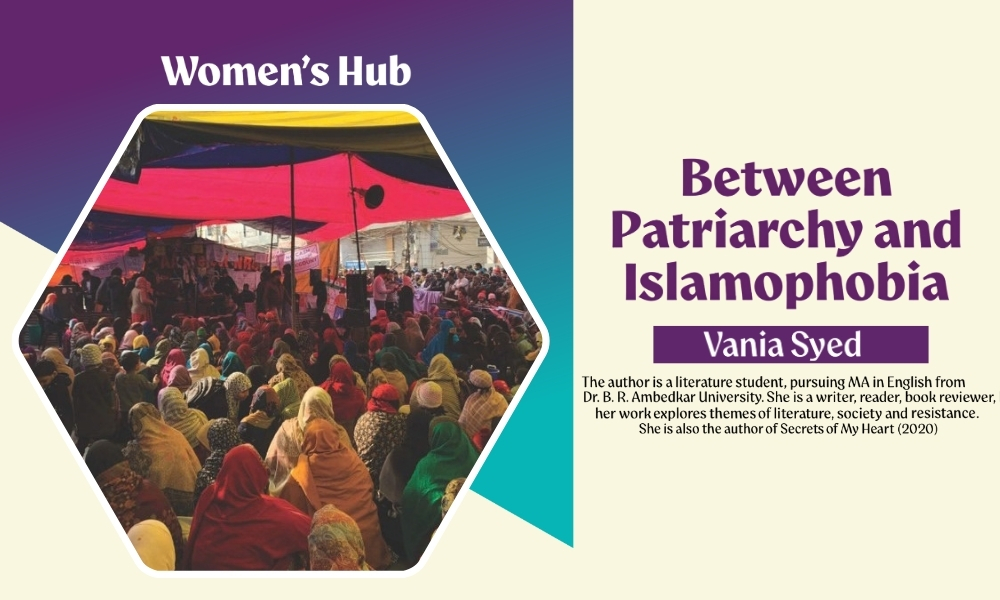
These factors strengthen policies like the criminalisation of triple talaq, bans on wearing hijabs in schools, and the revocation of Jammu and Kashmir’s special constitutional status. These Islamophobic narratives are not just abstract ideas but have real consequences for millions of Indian Muslims, including increased discrimination and inequality. Muslim women face significant hurdles, such as being 47% less likely to receive positive responses in job applications compared to Hindu women. However, Muslim women are not merely passive victims; they have actively resisted these stereotypes and oppression. A powerful example is the Shaheen Bagh protest of 2019–2020, where Muslim women across ages and social backgrounds led a sustained movement against the discriminatory Citizenship Amendment Act and the National Register of Citizens. Despite facing state repression, vilification by media and social platforms, and accusations ranging from being puppets to terrorists, these women asserted their agency and challenged narrow definitions of Indian Muslim women’s identity. At Shaheen Bagh, women with diverse appearances and heritages expressed their political voice, organized education centers, and articulated belonging to India based on lived experience rather than imposed stereotypes.
The Hindutva politics of “saving” therefore needs to be examined alongside the patriarchal politics that Muslim women may experience within their own communities. They are not the same form of oppression. Patriarchal control restricts a woman’s choices within a family or community, while Islamophobic and Hindutva discourse uses the image of that restricted woman to produce a negative image of Muslims as a whole. The woman consequently becomes trapped between two competing forms of representation.
On one side, patriarchal authority tells her, “This is what religion requires of you.” On the other, Islamophobic discourse tells her, “Your religion is the reason you are oppressed.” In both cases, there is a danger that someone else speaks for her.
Muslim Women as subjects of Resistance
Muslim women have never been merely passive victims. They have participated in social and political movements, challenged injustice, organised communities, pursued education, written, protested and raised their voices against both internal and external forms of oppression. Their activism also challenges the assumption that Muslim women need to be “saved”. Muslim women have repeatedly spoken for themselves. They have questioned patriarchal traditions within their communities, challenged discriminatory practices, demanded education and political participation, and resisted forms of violence and inequality. Their resistance has taken different forms and cannot be reduced to a single model of liberation.
Particularly, in India, from the anti-colonial period to contemporary movements, Muslim women have not simply stood on the margins of political life. They have organised, protested and created spaces from which to articulate their own concerns. Their activism also complicates the assumption that resistance to patriarchy requires a rejection of Islam. Many Muslim women have challenged patriarchal practices while remaining connected to their religious identity. The courage and activism of Muslim women, as seen in social movements offer hope for imagining and working towards inclusive, pluralistic, and anti-misogynist futures in India’s postcolonial modernity. This collective imagining and resistance are essential to challenge the entrenched gendered Islamophobia embedded in India’s politics and society. Muslim women are not waiting to be “saved”. They have been speaking, resisting and organising. What is required is not another voice speaking on their behalf, but the willingness to listen to the voices that have been speaking all along.

0 Comments