
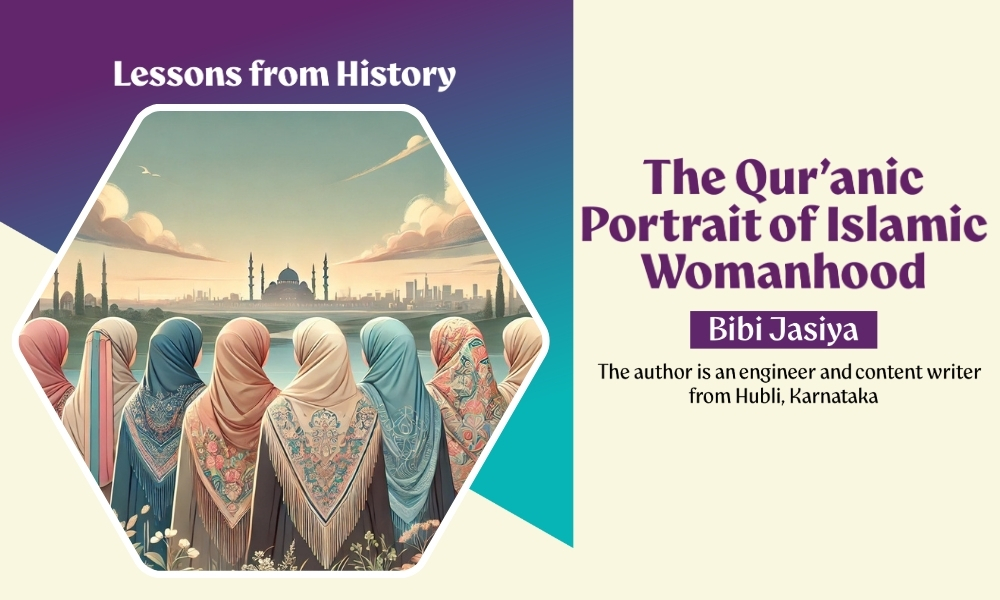
The author is an engineer and content writer from Hubli, Karnataka
Introduction
In the information era that we live in, women are no doubt given equal status to men, along with which comes the burden of fulfilling the responsibilities of both men and women. Women today are expected to ace a presentation and at the same time host a 5-course meal self-prepared without any fault by the end of the day. Femininity is wrongly described by the Western world as gaining equal power, making it only worse for women, as equal power does not mean equal strength; men and women are designed differently.
Women Then
Women of earlier times were warriors, doctors, scholars, entrepreneurs, businesswomen, teachers, and much more without compromising the feminine nature of a woman that is being compassionate, tender, gracefully nurturing, and vulnerable. Being upfront doesn’t mean a woman needs to compromise her innate nature. Women of the Qur’an are examples that a woman can be anything with her elite nature.
Quranic portrait of Women
The Qur’an portrays many amazing women who are the epitome of bravery, intellect, truthfulness, patience, and devotion. These feminists lived lives embracing the feminine nature of women, defining femininity as cultivating these timeless qualities and not about meeting society’s changing standards.
Allah has honoured women to such a degree that a whole surah is named Al Nisa. Many wonderful women are mentioned in the Qur’an. For example:
Hawa (AS)
Surah Al Baqarah verse 35 is where the first mention of a woman happens, and it is not mere coincidence that she is the first woman ever created. Hawa (AS) not only stood as a pillar of companionship to Adam (AS) but also readily took the shared accountability of the sin, followed by joint repentance. Hawa (AS) is revered as the archetypal mother who began human civilisation alongside Adam (AS) without any human example representing the natural fitrah of nurturing in women.
Asiya (RA)
Surah Tahrim ayat 11 mentions Asiya RA bint e Muzahim. She is described as an epitome of uncompromised spiritual priority, defiant emotional independence, and immense fortitude. Being the wife of the self-claimed God, Firaun, she had every adornment of the world yet never was inclined to material luxury. She proved that spiritual destiny is completely independent irrespective of spouse, family, upbringing, or environment.
When Tauhid -oneness’ of Allah- came to her knowledge, she willingly accepted the call and stood firm on her faith. Even when she was chained, Asiya (RA) made Dua for a house in paradise that is nearer to Allah SWT, prioritising companionship of Allah. Sabr and Shukr are the qualities one could inherit from her fitrah.
Maryam (AS)
Surah Al Imran verse 42-43 mentions Maryam (AS) as “chosen above the women of the worlds”. On this, people tend to say it is so as she was the mother of Prophet Isa (AS). No! Maryam (AS)’s life was pure, dignified, and devoted. Her life was filled with so much strength and difficulty. Maryam (AS) was an epitome of purity without pride, patience without passivity, independence through devotion to Allah, and motherhood with a purpose, which makes her the only woman who is mentioned by name several times in the Qur’an.
Sarah (AS)
Surah Hud verse 71-73 mentions Sarah (AS) as patient and graceful. She led a large part of her life as a barren woman, and for her perseverance, she was blessed with a child in old age. Her loyalty to Ibrahim (AS) is worth mentioning; she believed in him when none did, not even his father. This woman stood strong through thick and thin.
She was an epitome of altruism; recognising the longing of Ibrahim (AS) for a child, she gifted him a handmaiden selflessly. She took refuge in Allah, preserving her honour and chastity through divine protection.
Mother of Musa (AS)
Surah Taha verses 38-40 mention the Mother of Musa (AS). She is the personification of submission to Allah. Musa (AS)’s mother placed her infant in the chest with full faith and strong emotional resilience. These were the women who had the courage and were receptive. She even faced Firawn with dignified composure; for all of this, she was rewarded by being allowed to be the wet nurse for her own son.
The Queen of Sheba (Bilqis)
Surah An Naml verses 22-44 mention Bilqis, the Queen of Sheba. She was the epitome of leadership, intellect, and humility. Bilqis’ fitrah was brilliant rulership; she always made consultative and collaborative decisions. No evidence of a husband is found, which shows that a woman is not dependent on a king to be the Queen. Her keen political wisdom and foresight, intellectual humility over ego, and sincere monotheism made her a place in the book of wisdom, the Qur’an.
Aisha Bint Abubakr (RA)
Surah an Nur verses 11-26 were revealed to clear Aisha (RA) from the agonising historical incident of slander. Aisha (RA) was an epitome of chastity, dignified self-worth, and intellectual humility. The mother of the believers had the privilege of being the wife of our beloved Prophet PBUH.
Aisha (RA) excelled in fiqh, medicine, poetry, hadeeth, and Qur’an. She (RA) had deep perception, ultimate vulnerability, and Sakinah. She was a scholar who led even the Khalifa of her time to consult her on the most vulnerable matters. She was most beloved to the Prophet ﷺ, so much so that she earned the title “Habibat al-Habib”, “The beloved of the beloved.”
Khawalah Bint Thalabah
Surah Al Mujadilah ayat 1-4 mentions Khawalah bint Thalabah. She is an epitome of uncompromising moral boundaries. Khawalah (RA) was a self-aware woman who stood for her worth courageously. When her husband pronounced zihr, a pre-Islamic cultural practice, she abandoned it and went to complain to the Prophet ﷺ for a solution without hesitation about being judged or being shamed. When the Prophet ﷺ mentioned that there was no new revelation on this matter, she didn’t just walk away; she stood articulately on her voice for the injustice to women. Her call to action was so strong that Allah immediately revealed the verses and called out this practice in Islam.
Women of the Qur’an
Zainab bint Jahsh, the daughter of Shauyab (AS), the daughters of Lut (AS), Sisters of Musa (AS), Mother of Maryam (AS), Mother of believers and daughters of the Prophet ﷺ are mentioned along with the rest of believing women; the wife of Abu Lahab and the wife of Al-Aziz are the other women mentioned in the Qur’an that portray how womanhood is supposed to be and what it should not be like.
Takeaway
The Qur’an is the ultimate guide to mankind. It mentions women as the most worthy if she understands her fitrah. Women of the Qur’an illustrate that women’s value is not found in becoming like men but in fulfilling their purpose with faith, dignity, and excellence. Women are not required to carry out roles and responsibilities masculinely; staying in their innate nature will also bring honour for her qualities of wisdom, faith, and contribution to society like the women of the Qur’an.
Women of the Qur’an are timeless archetypes of womanhood; their circumstances were different from ours, but their qualities, if inherited, can make the challenges of modern life easier to navigate. They are truly a legacy worthy of holding onto.
JAZAKALLAHUKHAIRNKASIRA to the author and publisher for this wonderful reflection on women hood. This is a brilliant read for modern Muslim women navigating the complexities of today’s world. The contrast drawn between westernized definitions of ‘power’ and the authentic empowerment found in Islamic tradition is spot on.