
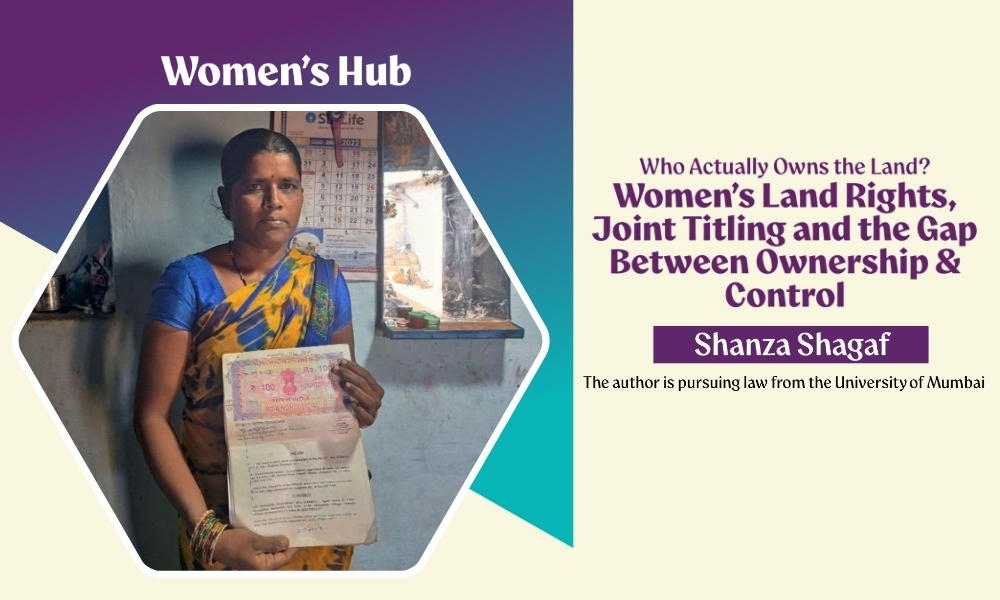
The author is pursuing law from the University of Mumbai
On paper, a woman may be a landowner. Her name may appear alongside her husband’s on a title deed, giving her a legally recognised interest in the property. Yet the reality of ownership can be much more complicated. Can she decide what happens to the land? Can she determine whether it is cultivated, leased or sold? Does she receive income generated from it? Can she use it to access credit? And, most importantly, can she defend her claim if someone challenges it?
These questions reveal a crucial gap in the discussion surrounding rural women and land rights: having a name on a document does not always mean having meaningful control over the land.
Land is much more than an economic asset in rural India. It can provide livelihood, housing, social status, security and intergenerational wealth. For women, particularly, land ownership can offer protection against economic vulnerability in situations such as widowhood, marital breakdown or poverty. Yet women who contribute extensively to agriculture and rural livelihoods continue to face unequal access to land and productive resources.
This issue becomes particularly important on the International Day of Rural Women, observed every year on 15 October. The day recognises the contribution of rural women to agriculture, food security, rural development and poverty reduction. But recognition of their contribution must also involve asking a more difficult question: Do rural women actually possess the resources and authority necessary to benefit from the work they perform?
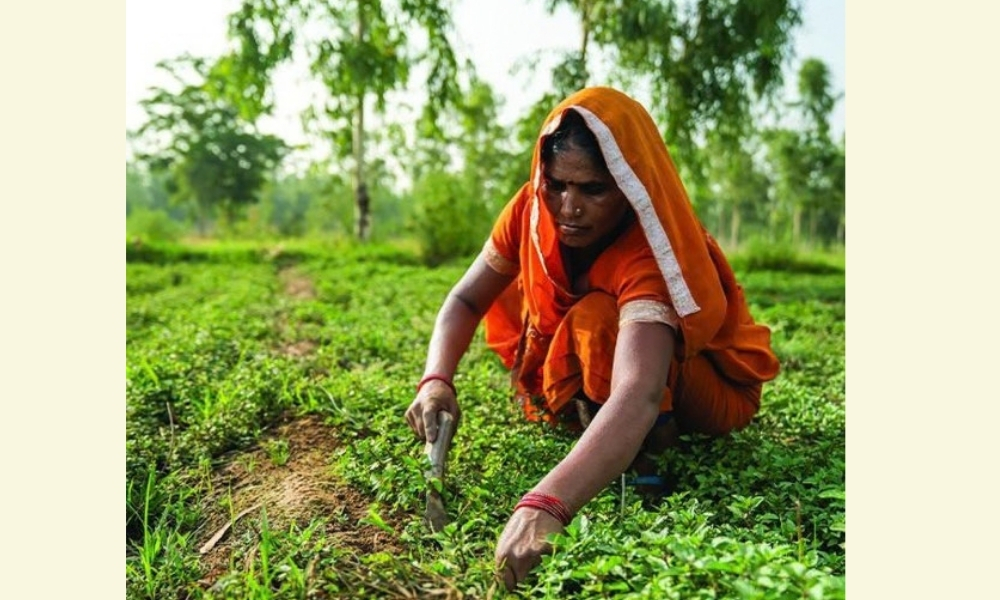
The Woman Who Works the Land
Rural women are deeply involved in agricultural production. Their work can include sowing, transplanting, weeding, harvesting, livestock management, food processing and the collection of water and fuel. Much of this labour remains unpaid or underrecognised.
Yet agricultural labour does not necessarily translate into land ownership.
A woman may spend years cultivating a field while the title remains exclusively in the name of her husband, father or another male relative. She may contribute to the household’s agricultural income without having independent control over that income. She may understand the land, its soil and its crops better than anyone else in the family and still have little authority over decisions concerning it.
This creates what can be described as an ownership paradox: a woman may contribute substantially to the creation of agricultural wealth without possessing an equivalent right to the asset that generates it.
The problem is therefore not simply that women need access to land. It is that they need secure and meaningful rights over land.
When a Name on the Title Is Not Enough
Joint land titling has emerged as one possible mechanism for addressing this inequality.
The basic idea is straightforward. Instead of registering land solely in the husband’s name, both spouses are recorded as owners. This can provide women with formal recognition and potentially protect them from losing their interest in the property.
Joint ownership can have important benefits. Research has found that formal joint property rights can strengthen women’s participation in household decision-making, improve their sense of security and increase their access to information about property.
However, the presence of a woman’s name on a title does not automatically transform household power structures.
A woman may be a joint owner while her husband continues to decide what crops are planted. He may negotiate the sale of agricultural produce, decide whether the land should be leased or mortgaged, or control the income generated from it.
In such circumstances, the woman has legal ownership but limited practical control.
This distinction is critical. Ownership is not meaningful only because a name appears on a document. It becomes meaningful when the person can exercise the rights associated with that ownership.
Ownership, Access and Control Are Not the Same
The language of “land rights” can sometimes hide several different realities.
A woman may have access to land because she is allowed to cultivate it. She may have the right to use it for agricultural or residential purposes. She may possess legal ownership because her name is recorded on a title. But she may still lack control over decisions concerning the property.
Control includes the ability to participate in decisions about cultivation, leasing, sale, mortgage and the use of income generated from the land.
This difference matters because policies can appear successful when measured only by documentation.
If the question is simply, “How many women’s names have been added to land records?”, joint titling may appear highly effective.
But if the question becomes, “How many women can independently make decisions concerning the land they legally own?”, the picture may become considerably more complicated.
Women’s land empowerment must therefore be measured not merely through documentation, but through decision-making power and economic benefit.
The Paperwork Problem
Legal rights can become difficult to exercise when the process of establishing and defending those rights is complicated.
Land ownership may involve registration, mutation, inheritance records, revenue offices, certificates and other administrative procedures. For rural women with limited mobility, financial resources or familiarity with government institutions, these procedures can become significant barriers.
A woman may inherit property but fail to have her name properly entered into the relevant land records. She may possess a legal entitlement but lack the documents required to demonstrate it. She may depend upon male relatives to navigate administrative procedures or explain legal paperwork.
The result is a gap between having a right and being able to use that right.
This is why legal literacy is essential. A woman cannot effectively exercise a property right if she does not know that the right exists, what it means or how she can enforce it.
The Law Can Recognise Her, But Can Her Family?
India’s legal framework has made important progress in recognising women’s property rights.
The Hindu Succession (Amendment) Act, 2005 significantly strengthened the position of daughters by providing that a daughter of a coparcener becomes a coparcener by birth, with the same rights and liabilities as a son in Mitakshara coparcenary property.
The Supreme Court’s landmark judgment in Vineeta Sharma v. Rakesh Sharma further clarified that daughters possess coparcenary rights by birth and that these rights do not depend upon whether the daughter was born before or after the 2005 amendment, subject to the statutory conditions concerning earlier dispositions and partitions.
These developments represent an important movement towards formal equality.
But formal equality does not automatically produce social equality.
A daughter may legally have an equal share in ancestral property while being discouraged from claiming it because doing so may be perceived as taking something away from her brothers. A widow may have succession rights but face pressure from relatives to surrender control over property. A woman may technically own land but hesitate to challenge her husband or family when her rights are ignored.
The law may recognise her ownership.
The social environment may still make exercising it difficult.
The Cost of Claiming What Is Legally Yours
Property disputes within families are rarely purely legal disputes. Relationships, dependence and social expectations also shape them.
For many women, claiming an inheritance can mean challenging an established family arrangement. A daughter who asks for her lawful share may be accused of creating conflict between siblings. A wife who insists upon her rights may be seen as challenging her husband’s authority.
Economic dependence makes the situation even more difficult.
If a woman has no independent income, limited access to legal assistance and little knowledge of administrative procedures, pursuing a property claim can be financially and socially costly.
Consequently, the existence of a legal remedy does not necessarily mean that the remedy is practically accessible.
This is one of the most important gaps between law in theory and law in practice.
Joint Titling Is a Beginning, Not the End
None of this means that joint titling is ineffective.
On the contrary, putting a woman’s name on a land title can provide meaningful legal protection. It can make her ownership visible, strengthen her position in disputes and potentially prevent property from being dealt with without her knowledge or consent.
But joint titling should be viewed as a starting point rather than a complete solution.
A title deed cannot teach a woman about her legal rights.
A registration certificate cannot guarantee that she will participate in household decisions.
A name on a document cannot automatically give her access to agricultural income.
And legal ownership cannot, by itself, dismantle social norms that have historically treated property as belonging primarily to men.
For joint titling to produce genuine empowerment, women must also have access to legal information, functioning land administration, affordable legal assistance and mechanisms through which they can actually exercise their rights.
Inheritance Matters Too
Another limitation of focusing heavily on joint marital titles is that not every woman is a wife.
Daughters, widows, unmarried women and women living independently also require secure property rights.
This makes inheritance particularly important.
The legal recognition of daughters also as equal coparceners is a major step forward, but the practical effectiveness of inheritance rights depends upon whether women actually claim and receive their shares.
Research has repeatedly shown that awareness, family pressure and social norms can influence whether women assert their legal inheritance rights.
A woman who voluntarily gives up her share because she believes that her brother should receive the land may appear, in official records, to have no property claim. Yet that absence does not necessarily reflect the absence of a legal right. It may reflect the social circumstances surrounding the exercise of that right.
Therefore, improving women’s land ownership requires attention to inheritance practices as well as marital property arrangements.
Why Land Ownership Matters
The importance of land ownership extends far beyond agriculture.
Land can provide economic security, access to credit, housing and a source of income. It can strengthen a woman’s bargaining position within the household and provide a degree of protection during economic or personal crises.
For rural women, land can also influence the opportunities available to their children.
This is why land ownership should be understood as a question of power and security, not simply property.
When women lack ownership, they may remain economically dependent even when they contribute substantially to household production.
When women possess ownership but cannot exercise control, the formal right may protect without delivering its full economic and social potential.
And when women have both ownership and control, land can become a genuine instrument of empowerment.
Conclusion: From Names on Paper to Rights in Practice
The question “Who actually owns the land?” appears simple, but the answer is not always found in a title deed.
A woman’s name on a land document is undoubtedly important. Legal recognition provides a foundation upon which security and empowerment can be built. India’s inheritance reforms and the Supreme Court’s interpretation of women’s coparcenary rights demonstrate the importance of ensuring equality in law.
Yet formal ownership is only one part of the picture.
If a woman has a legal share but cannot claim it, owns land but cannot decide how it is used, cultivates it but receives none of its economic benefits, or appears on a document without understanding the rights attached to it, then ownership remains incomplete in practice.
The challenge, therefore, is not simply to place women’s names on land records.
It is to make those names meaningful.
As the world observes the International Day of Rural Women on 15 October, celebrating women’s contribution to agriculture must go hand in hand with examining their access to the resources that sustain that contribution. Rural women should not merely be recognised as workers on the land. They should be recognised as rightsholders with the ability to own, use, benefit from and make decisions about it.
Because ultimately, the real question is not:
“Whose name is on the paper?”
It is:
“Who has the power to decide what happens to the land?”
Only when rural women can answer, “I do,” can ownership truly become empowerment.
References
Datta, N. (2006). Joint titling: A win-win policy? Gender and property rights in urban informal settlements in Chandigarh, India. Feminist Economics, 12(1–2), 271–298.
Oosterbaan. (2025). Unpacking gendered access to land: Intrahousehold sharing of land rights in rural Tamil Nadu. Rural Sociology.
The Hindu Succession Act, 1956. (1956). Government of India.
The Hindu Succession (Amendment) Act, 2005. (2005). Government of India.
Vineeta Sharma v. Rakesh Sharma, (2020) 9 SCC 1 (Supreme Court of India).
UN Women. (n.d.). International Day of Rural Women. United Nations Entity for Gender Equality and the Empowerment of Women.
UN Women. (2014, October 14). Rural women need to be at the heart of all development efforts—United Nations Entity for Gender Equality and the Empowerment of Women.
UN Women. (2021). International Day of Rural Women: Rural women cultivating good food for all. United Nations Entity for Gender Equality and the Empowerment of Women.
World Bank. (n.d.). Gender Data Portal: Women’s land ownership and property rights. World Bank.
World Bank. (n.d.). Women’s land rights, joint titling, and gender equality in property ownership. World Bank.
India Code. The Hindu Succession Act, 1956. Government of India.
Indian Kanoon. Vineeta Sharma v. Rakesh Sharma. Supreme Court of India.
“Women’s land ownership in India: Evidence from digital land records.” (2023). Land Use Policy.
“Women’s land rights, gendered epistemic tensions, and the need for a feminist approach to land administration.” (2023). Land Use Policy.
0 Comments