
The author is a Ph.D scholar, columnist, writer, translator, and teacher
In the last few decades, the number of women participating in politics has increased dramatically. More women are voting, running for office and taking seats in legislatures around the world than at any time in history. This is an important step on the way to an inclusive democracy, but it raises a fundamental question: does more political representation necessarily mean real political power is gained? The answer is far more complicated than just an increase in numbers.
Women are still underrepresented in political positions of power all over the globe. According to UN Women, women make up less than 28 per cent of members of national parliaments. There are only 28 countries with a woman as Head of State or Government. They make up less than a quarter of cabinet minister positions, and trends show it will be another 130 years before equal representation is seen at the top political echelons. These figures show that while some progress has been made, women are still a long way from equal participation in important political decision-making.
At the same time, it has been argued that women in leadership positions have a direct impact on improving democratic outcomes. Research conducted in India found that women-led Panchayats undertook 62 per cent more drinking water projects than their male counterparts, and studies conducted in Norway link higher female representation to structural improvements in childcare policies. The results show that increasing women’s participation is not only a matter of social justice, but also a vital component of the quality, responsiveness and accountability of governance.
The Indian Situation: The Question of Parity of Voters vs Lack of Legislation
India displays an amazing democratic paradox. Women’s participation as voters has reached record levels, with women’s turnout higher than men’s in several state elections. The Lok Sabha elections of 2019 and 2024 witnessed a near-equal voter turnout of men and women at about 66 per cent, indicating a quiet yet significant revolution in people’s participation in elections.
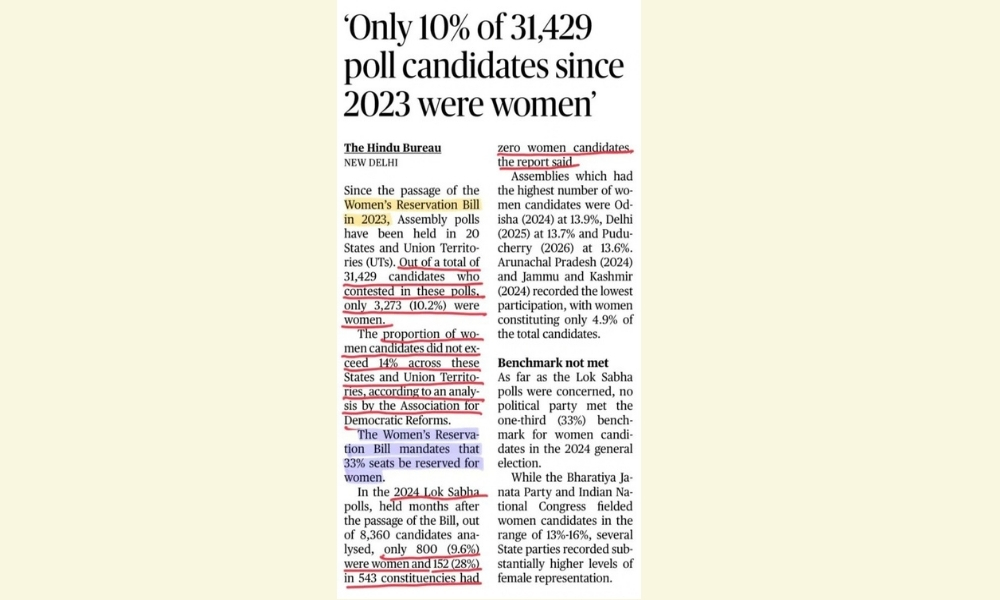
Yet this enthusiasm for democracy has not been matched by proportionate representation in legislative bodies. In the 18th Lok Sabha, only 74 of the 543 Members of Parliament (13.6 per cent) are women. Women are represented in State Legislative Assemblies in very low numbers, of the order of 9 to 10 per cent. By contrast, women occupy more than 44 per cent of the seats in local government, thanks to the constitutional quotas introduced by the 73rd and 74th Amendments (1992). This huge discrepancy points to a remaining structural hurdle: women are seen as an important voting bloc, but they are still systematically excluded from the rooms where laws and macroeconomic policies are drafted.
To fill this lacuna, Parliament passed the Constitution (106th Amendment) Act, 2023, popularly known as the “Nari Shakti Vandan Adhiniyam”. It demands 33 per cent reservation for women in the Lok Sabha and State Assemblies, with separate reservation also for Scheduled Castes (SCs) and Scheduled Tribes (STs). The law is indeed a historic step forward on paper. But the very fact that its implementation has been postponed indicates a far more calculated political aim.
Reservation, Delimitation and Hegemonic Power Politics in Disguise
The Nari Shakti Vandan Adhiniyam has been linked to two future events, the completion of the ongoing decennial Census and a subsequent nationwide delimitation exercise, unlike the earlier constitutional amendments. The BJP-led National Democratic Alliance (NDA) simply says the redrawing of constituencies on the basis of the new census data is necessary to allocate reserved seats in a fair manner without disturbing the present distribution of seats.
A more in-depth critical analysis shows that this connection is less concerned with empowering women and more about securing long-term power for itself. The way in which boundaries are defined on the basis of population growth will cause a fundamental change in India’s political landscape. Since there are such great differences in population growth rates, the northern and central Indian states—those where the rate of population growth has stayed high—will receive a large number of parliamentary seats. On the other hand, the southern states, having successfully carried out the national family planning policies, will lose some of their relative political influence.
Since the BJP has its strongest electoral support in these densely populated northern regions, a post-Census delimitation will result in an increase in the number of parliamentary seats it holds. The ruling party achieves a masterstroke of political engineering by carrying out the delimitation as part of the highly lauded and morally indefensible women’s reservation bill:
A moral defence against criticism: The ruling party presents any opposition to the delay in implementation or to the delimitation clause as being against women.
Structural electoral advantage: By delaying the reservation until after the delimitation has taken place, the fact that 33 per cent female reservation is introduced will occur in an enlarged Parliament in which the BJP’s geographic strongholds will have an overwhelming majority.
Decadal governance longevity: The document sets out a plan to ensure the ruling party maintains its legislative majority for decades to come, presenting a thoughtful strategy for achieving electoral dominance through progressive gender reform.
The legislation, by linking the women’s quotas to demographic realignment, is in fact a form of power politics since it sets out to alter the electoral map in favour of the governing party while claiming only to promote empowerment.
Beyond Representation: The Challenge of Real Authority
Even if reservation is finally achieved, the fact of a numerical presence by women does not mean that they automatically gain real influence. Women who hold public office still have to overcome strong structural obstacles within the party ranks. Political parties usually give fewer positions to women running in unreserved seats, seeing them instead as token candidates rather than as potential leaders.
When they are elected, women ministers are more likely to be given ‘soft’ social portfolios such as Women and Child Development or Culture, while the ministries which have a great deal of power—namely Home, Defence and External Affairs—continue to be largely dominated by men. The case of the “Sarpanch Pati” at the local level—where male relatives carry out the actual decision-making on behalf of women who have been elected—shows that the fact of holding a formal office does not automatically break down patriarchal control. Moreover, women politicians experience a higher level of online harassment, character attacks and systemic financial difficulties during their campaigns.
The democratic progress made in India is a striking example of increased women’s involvement as voters, but their rise to a position of primary decision-making is still obstructed by the way institutions are structured. Although the Nari Shakti Vandan Adhiniyam has great potential for change, the fact that it is tied to delimitation based on census data reveals the cynical nature of current electoral strategies.
It cannot be regarded as a political tool for the purpose of altering the electoral map or securing party majorities to reserve legislative seats for women. The real measure of women’s reservation is not the ingenuity with which it is timed to serve party interests, but whether it grants female leaders the independent authority, institutional support and power needed to influence the nation’s future.
0 Comments