
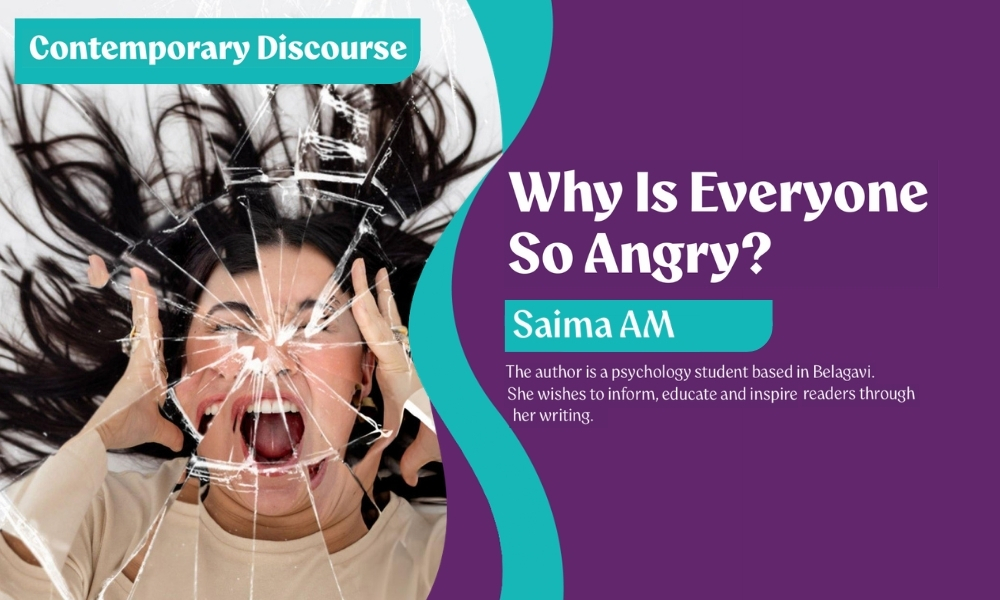
The author is a psychology student based in Belagavi. She wishes to inform, educate and inspire readers through her writing.
I am a psychology student. I do not have years of experience, but in recent years I have seen and understood enough to recognise patterns, identify areas that need attention and reflect on what needs to change. I have observed people struggle with anxiety, burnout and difficulties in relationships. Yet, very often, a deeper issue emerges beneath these challenges: anger.
People rarely present with “anger” as their chief complaint. In counselling and therapeutic settings, we often come across stories such as, “I snapped at my child when she simply asked for a snack,” or “I yelled at a waiter when he accidentally spilled a little juice near me.” While severe anger outbursts can be symptoms of underlying psychiatric conditions, this article focuses on the everyday displays of anger—at a child, a colleague, a friend or even a passer-by. People seem increasingly unable to control their anger, and many times the reaction is disproportionate to the situation. In this article, I attempt to make sense of what I observe using psychological principles, research and the perspective offered by the Qur’an.
I remember speaking to a mother of a three-year-old child (let’s call her Mrs A), who said she yelled at her child after a vase was accidentally knocked over. Later, Mrs A felt guilty for snapping and locked herself in the bathroom to cry. She said, “This is not me. I am usually in control of myself.” Here is something important to note: these people are not inherently violent or aggressive. They are often exhausted, overwhelmed and operating with overstimulated nervous systems. People are quick to lose their temper and slower to forgive. So the question is not whether anger is on the rise. The question is: why is it?
Understanding Through an Islamic Lens
This is where one can see the intersection of religion and psychology. From its earliest teachings, Islam has not treated anger as a personal failure that must simply be condemned.
Abdullah ibn Mas’ud (RA) reported that the Messenger of Allah ﷺ said:
“Whom do you consider a wrestler among you?”
The people replied: “The one whom men cannot defeat in wrestling.”
He said: “No. It is the one who controls himself when he is angry.”
(Sunan Abu Dawood, 4779)
This shows that Islam treats anger as something that must be regulated rather than ignored. It has also taught practical strategies to manage anger before it escalates.
Abu Dharr (RA) narrated that the Messenger of Allah ﷺ said:
“When one of you becomes angry while standing, he should sit down. If the anger leaves him, well and good; otherwise he should lie down.”
(Sunan Abu Dawood, 4782)
These principles were taught centuries ago, long before modern behavioural science emerged.
To understand why people snap so easily, it is important to examine what is happening inside the body. The body activates the sympathetic nervous system when responding to perceived threats. When a person remains under stress for prolonged periods, this system does not return to its normal resting state as effectively as it should. Stress hormones remain elevated, while the brain’s ability to reason and exercise impulse control becomes impaired. Simply put, when a person is already overwhelmed, a small trigger can become the tipping point. The mind and body are already stretched thin, making it much harder to regulate emotional reactions.
As a consequence of this inability to control emotions and reactions, many people carry deep shame and guilt about their anger. They often believe that something is fundamentally wrong with them. But here is another important point: shame is rarely the solution. In many cases, it worsens anger. People do not need more shame. They need a better understanding of their inner systems and practical strategies to calm themselves.
The World That Keeps Us Switched On
Having understood this, a natural question follows: where is this persistent stress coming from?
Modern life itself is one of the main sources. The carefully curated versions of others’ lives displayed on social media often fuel comparison, inadequacy and self-doubt, all of which become stressors. Sleep deprivation has become a silent epidemic, with even adolescents and young children experiencing reduced sleep quality. Financial and economic pressures, especially during periods of rising inflation, are often perceived by the brain in much the same way as physical threats.
Yet these factors are only part of the picture. Perhaps the greatest contributor is the relentless speed of modern life. Constant notifications, work emails, instant messaging, immediate responses and endless accessibility leave little room for patience—a virtue repeatedly emphasised in the Qur’an.
Silence, too, is gradually disappearing. When was the last time you simply sat quietly? No phone. No television. No scrolling. Just a moment alone with your thoughts, reflecting on your life, goals and direction. We often fail to recognise that silence helps the nervous system recalibrate. The Prophet ﷺ understood this when he would retreat to the Cave of Hira, seeking solitude and reflection.
However, silence does not mean isolation. Human beings are social by nature and were never meant to navigate life entirely alone, separated from family, friends and community. The importance of collective life is emphasised repeatedly in Islam. Performing Salah in congregation, visiting the sick, attending funerals, accepting invitations and helping neighbours all strengthen social bonds and create a sense of belonging.
Understanding Anger in Public
The exhaustion and burnout discussed so far are not limited to individuals. They are increasingly visible at a societal level.
Road rage, once considered a largely Western phenomenon, has become one of the most visible symptoms of collective exhaustion. Rude gestures, aggressive driving, physical altercations and public hostility are now common sights. An important point to remember is that these incidents are often not personal. The individuals involved are not necessarily predisposed to violence. More often, they are people carrying significant internal pressure that has found an external target.
Psychology refers to this as displacement—redirecting frustration from its original source towards a more readily available target. As mentioned earlier, Islam recognises this reality and offers practical strategies to address it. The Prophetic advice to sit down or lie down when angry interrupts the escalation process and creates space for self-regulation.
What We Can Actually Do
It is crucial to understand the causes of anger so that we can learn to regulate it effectively.
Because anger first manifests physically through bodily arousal, targeting physiology becomes the first line of intervention. This is precisely what the Prophetic instruction encourages. Sitting down, or lying down if necessary, functions as a form of progressive relaxation that interrupts anger before it escalates.
Other practices, such as slow and deep breathing, activate the parasympathetic nervous system, helping the body calm down and relax. Breathing exercises can lower cortisol levels and help regulate heart rate.
The second level of intervention is cognitive. Anger is often sustained by thoughts of helplessness, injustice and perceived threat. It is therefore important to identify these patterns and ask whether the threat is real or merely perceived. Replacing negative assumptions with more balanced and realistic interpretations can significantly improve emotional regulation.
Interpersonal relationships also matter. Anger often intensifies when people feel disconnected from others. Restoring genuine human connection and a sense of belonging can play a powerful role in reducing emotional distress.
Another crucial aspect concerns our online lives. Emotional regulation requires us to be mindful of what we consume digitally, to pause before reacting to strangers online and to prioritise real-world interactions whenever possible.
Final Thought
It is important to understand that anger itself is not the real problem. Unregulated anger—anger that dehumanises others and feeds upon itself—is the problem. We therefore need to understand anger, develop empathy and learn practical strategies for managing it. We need to choose a more peaceful way of living, as Allah says in the Qur’an:
“Those who restrain anger and pardon people; and Allah loves the doers of good.”
(Qur’an- 3:134)
Yes, that choice may be harder than before. But it is also more necessary than it has ever been. And that, perhaps, is the truest form of strength.
Well written great job 👏🤝Such a meaningful article mashaa allah You explained todays reality in powerful way Well done…Sometimes people are carrying pain we can’t Seee🌪️we really need more kindness and understanding in today’s world🌬️🫂❤️
Well written great job 🤝Such a meaningful article mashaa allah You explained todays reality in powerful way Well done…Sometimes people are carrying pain we can’t Seee🌪️we really need more kindness and understanding in today’s world🌬️💗
5voaz3
ul05y4