
The author is a skilled speaker, passionate writer, and researcher focused on healthy eating and relationship behaviour.
“Abbu, I want to get married in Makkah or Madinah. They’re sacred cities, and I believe that starting my marriage with the blessings of Allah in such a holy place will bring lasting happiness. But since you want our relatives to be part of the celebration, we can have the reception back home. I want it to be unforgettable for everyone. The venue must be large enough to accommodate all our guests—including my male and female friends. I want the best music system, a place for dance, and as a return gift, let’s give a silver coin to every guest so they can remember and cherish this day forever. I want to set an example for everyone, Abbu.”
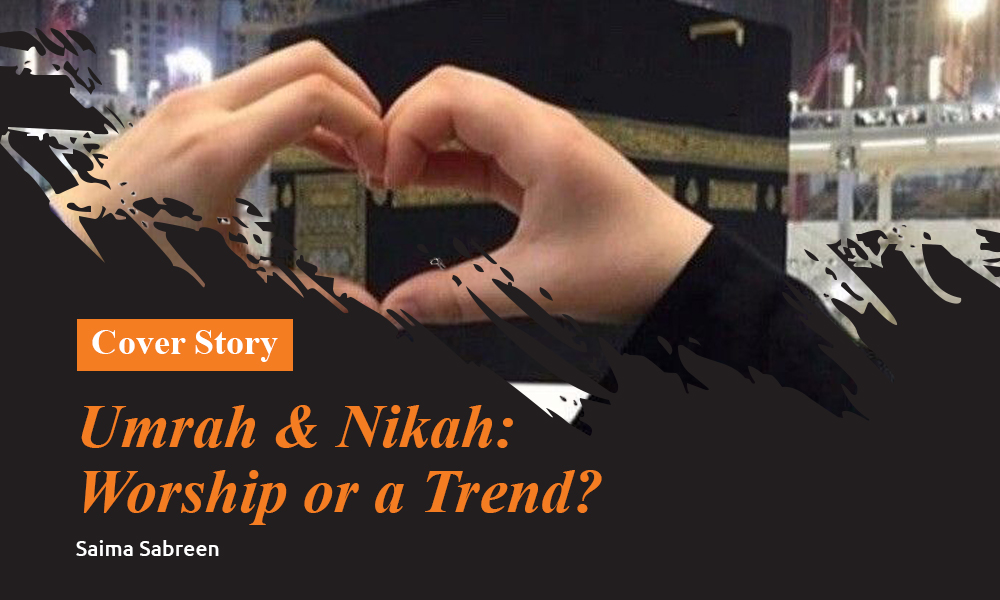
This type of conversation is becoming increasingly common among the younger generation who wish to combine their marriage with an Umrah trip to Makkah or Madinah, believing it will bless their union. But we must ask ourselves, did the Prophet ﷺ dedicate his life to establish Umrah as a trend or a social display of wealth? Was Umrah prescribed as an act of worship for people to show off their ability to travel to Makkah? Does this growing trend not risk affecting the sanctity and spiritual value of these holy places—especially Makkah, which houses the Kaaba, and Madinah, the city that embraced the Prophet ﷺ during his migration?
What is Umrah?
Umrah is a pilgrimage to the holy city of Makkah, performed by Muslims. Unlike Hajj, which is obligatory once in a lifetime for every able Muslim, Umrah is voluntary, simpler, and can be performed at any time of the year. It involves specific rituals such as entering the state of Ihram, Tawaf (circling the Kaaba), Sa’i (walking between Safa and Marwah), and shaving or cutting the hair.
This is basic knowledge for most Muslims. However, in today’s social media-driven world, Umrah is increasingly being influenced by trends set by influencers and public figures. As the Qur’an warns in Surah At-Takathur (102:1–2): “The competition for more (worldly gain) diverts you—until you end up in your graves.”
Has Umrah Become a Trend?
Unfortunately, yes for many people Umrah has become a trend. Nowadays, we see people rushing to perform Umrah, not necessarily out of love for Allah or a desire for closeness to Him, but to keep up with others, to post photos, or to prove that they can afford it. Just because others in our family or social circle have gone does not mean we are obligated to do the same. Umrah is a choice and privilege, one that should be made with sincerity, not competition. We must revisit the wisdom of a well-known hadith of the Prophet ﷺ, narrated by Umar ibn Al-Khattab (RA): “Actions are judged by intentions, and each person will get the reward according to what they intended. So, whoever migrates for worldly gain or to marry a woman, his migration is for what he migrated for.”— [Sahih Bukhari]
Before applying for the visa, Muslims need to pause and ask themselves: Why am I going for Umrah?, Is it to post photos on Instagram?, To make others envious?, To show that I’m successful and can afford a short religious trip despite my busy schedule?, To match the standard set by my relatives or friends?
If the intention is just to be seen, to show off, or to compete, then we must ask ourselves honestly:
Has our Umrah brought us closer to Allah? Has it truly benefited us? Or was it just a trip for the world to see? In Islam, intention (niyyah) is everything. If we don’t purify our intention, the outward act, no matter how holy, may have no weight in the sight of Allah.
The influence of social media doesn’t stop at simply setting trends, it has slowly eroded the sanctity and reverence that Makkah and Madinah are meant to hold in our hearts. While it’s understandable that not everyone gets the chance to witness the Kaaba in person, and loved ones want to share that moment through technology, the constant video calls during Tawaf, taking pictures instead of making heartfelt du’as, and the disruption caused to fellow pilgrims reflect a troubling shift in our priorities.
Standing near the Kaaba should be a time of immense spiritual reflection and a moment to connect deeply with Allah. Yet, we see people spending more time capturing photos and videos than capturing the blessings through prayer. Women remaining unveiled on video calls in public sacred spaces, long calls that distract others, and using the House of Allah as a background for selfie are not acts that Prophet ﷺ would have approved of. We must remind ourselves that Umrah is not a tour or a photo opportunity. It is an act of worship, one that requires full presence of heart and mind. It is a chance to pause, reflect on our inner selves, and seek forgiveness and transformation. True benefit from Umrah comes not from how beautifully our Instagram feed looks, but from how beautifully our hearts return from the journey.
Umrah is a divine opportunity to draw closer to Allah, to reassess our flaws, reconsider our unhealthy attachments, and reflect on the behaviors or desires that distance us from Him. It should be a trip that leaves a mark on our character. When we return home, our families and friends should sense a visible change in us, humility in our speech, sincerity in our actions, and mindfulness in our choices. It is not about how much we spent on tickets, hotel bookings, or shopping bags. It’s not about showing our presence in Makkah via endless posts and stories. Going for Umrah and then spending hours sleeping, watching shorts on YouTube, or sitting inside Masjid al-Haram scrolling through social media completely misses the purpose of this sacred journey. What truly matters is: the closeness to Allah we felt, the flaws and sins we sincerely repented for, the bad habits we left behind, the desires we controlled, the transformation from interest-based dealings to halal alternatives and the newfound commitment to live by Islamic principles. If none of this has taken root, then we must ask ourselves, what did we truly gain from Umrah? If there is no internal change, then sadly, the trip has become just another experience, not an act of worship. And in that case, the greatest loss is not in money spent, but in the spiritual rewards missed.
Performing Multiple Umrahs and Neglecting Hajj
While Umrah is a voluntary act of worship that can be performed multiple times by those who are able, Hajj is a compulsory pillar of Islam. The fact that many can afford repeated Umrah trips but delay or neglect Hajj is concerning. The cost of Umrah is often lower, and some invest in multiple short trips instead of saving for the mandatory journey of Hajj. This is not a matter of personal preference; it is a matter of religious obligation. As the Prophet Muhammad ﷺ warned: “Whoever has the provisions and the means to convey him to Allah’s House and he does not perform Hajj, then it does not matter if he dies as a Jew or a Christian. That is because Allah said in His Book: ‘And Hajj to the House is a duty that mankind owes to Allah, for whomever is able to bear the journey” [Jami’ At-Tirmidhi]. This stern warning highlights that Hajj and Umrah are not social options, nor are they milestones for public display. They are acts of deep spiritual significance. To perform them for social status, or to ignore them out of negligence, is to devalue the sanctity of worship.
Nikah in the holy cities of Makkah / Madina
This same principle of sincerity and purpose applies not only to Umrah but also to the institution of Nikah, which is increasingly being influenced by social trends and misunderstandings of Islamic teachings. Nikah is not merely a formality or social arrangement. It is a divine and legal covenant between a man and a woman, built on love, mercy, and mutual respect. It is a commitment made in the sight of Allah, meant to be rooted in simplicity, intention, and righteousness. Islam clearly advocates for a simple Nikah, free from extravagant spending, showmanship, or burdensome dowry. The spiritual depth of Nikah lies in its sincerity, not in the location, glamour, or display.
Performing Nikah in Makkah or Madinah with the belief that it will ensure a stronger relationship is a misplaced idea. The strength of a marriage is determined by faith, effort, and character, not by the venue. Moreover, broadcasting haram relationships on social media before Nikah, and then attempting to “purify” them by marrying in a sacred city, undermines Islamic values. It sends mixed messages and opens the door for criticism of Islam from those who observe this contradiction. Furthermore, celebrating the Nikah back home with extravagant functions, un-Islamic dress, mixed gatherings, and excessive spending while still calling it a “simple” marriage distorts the teachings of Islam. When such examples are showcased by influencers or admired figures, they end up setting harmful trends that mislead others, especially the youth, into confusing culture with religion.
Conclusion
In light of everything discussed, it’s time we realign our intentions. Umrah is a sacred act of worship, not a trend, not an experience for display, and certainly not a spiritual backdrop for worldly indulgence. The cities of Makkah and Madinah deserve our utmost reverence, not just in words, but in how we conduct ourselves while there. If Allah grants us the blessing to visit His house, let us make the most of it, not through photos and fanfare, but through repentance, prayer, and transformation. Let us return with cleaner hearts, stronger faith, and a renewed sense of purpose. Let it be a journey that brings out the best in us and removes what distances us from Allah. Let this be a message we actively spread to our friends, our families, and to those preparing for Umrah or Hajj. Because in the end, only a journey undertaken with sincere intention and humility will bear the fruits of closeness to Allah.
Indeed people are mixing religion with trend of display of wealth