
The author is a Psychologist (MSc Clinical Psychology) and has an eye for details in nature.
During an interview for a content-writer position, the candidate was asked a simple question: “What was the last article you wrote?” They seemed confused. They gave an answer they believed was correct, but it wasn’t. The candidate had used AI to write the article. Yet, when asked about their own work, they struggled to correctly identify its topic.
I kept thinking about that incident. How do you write something and then struggle to answer a basic question about it? More importantly, what happens when we become so dependent on AI that we can produce work without fully understanding or remembering it? This is not an argument against using AI. It is a question about what we are willing to give up for convenience.
When the answer isn’t the learning
We live in a time when almost anything can be generated within seconds. Need an article? A few prompts. Need an explanation? Ask a chatbot. Need an opinion, an argument or a creative idea? There is always something ready to offer one. The problem begins when getting the answer becomes more important than developing the ability to find one ourselves.
There is a difference between reading an explanation and understanding it, between submitting an article and knowing what it says, between producing an answer and being able to defend it. These things may look identical on a screen. They are not the same experience.
When we struggle with a question, search for information, make mistakes and try again, we are doing more than completing a task. We are processing information, making connections and testing our understanding. If we skip that process every time because a tool can do it faster, what exactly are we learning?
Research on memory offers a reason to take this seriously. Psychologist Kathleen McDermott’s 2021 review of retrieval practice found that actively trying to recall information helps strengthen learning and can slow forgetting. In other words, remembering is not merely something that happens after learning; practising recall is itself part of learning.
A 2025 randomized study of 120 undergraduates also reported lower scores on a delayed knowledge-retention test among participants who used ChatGPT as a study aid than among those who studied without it. The study examined a specific learning context, so it cannot establish that every use of AI weakens memory. But it raises a question worth asking: are we making learning easier, or are we sometimes removing the effort that helps it stay with us?
We often mistake immediate access to information for having that information at our disposal. We can look something up whenever we need it. But can we explain it without opening the same tool again? Can we connect it to something we already know? Can we recognise when an answer is incomplete or wrong? The ability to retrieve, interpret and question information matters just as much as the ability to access it.
What makes an idea ours?
For me, creativity is not simply the ability to produce something impressive. It is the perspective we bring to what we create.
It is the ability to question an idea instead of accepting it because it sounds convincing. It is listening to another person’s interpretation, considering their reasoning and still arriving at our own understanding. It is drawing from what we have learnt, observed and experienced, and finding a way to communicate that makes another person stop and think.
Two people can encounter the same event and understand it differently. Their experiences, knowledge and questions shape what they notice. That individual perspective is part of what makes their expression meaningful.
AI can generate ideas, write stories and produce responses that score highly on certain measures of creativity. A 2024 study in Scientific Reports, for instance, found that GPT outperformed the human participants in three divergent-thinking tasks. This is important evidence of what AI can do, although performance on those particular tasks cannot settle every question about human creativity.
We do not need to deny AI’s capabilities to recognise the value of our own. The question is what happens when we stop exercising ours. If AI supplies the argument, organises the reasoning, chooses the examples and writes the conclusion, what part of the thinking have we actually done? If we accept its first answer because it sounds polished, have we evaluated it or have we simply mistaken fluency for understanding?
And when every idea is available on demand, do we still give ourselves enough time to sit with a difficult question, disagree with an answer or arrive at an idea that is genuinely our own? Creativity requires more than the final product. It requires the willingness to think before the product exists.
Assistance or dependence?
AI is useful. It can help us organise complicated information, identify gaps in an argument, improve grammar, explore alternative explanations and approach a problem from a different angle. Refusing to use a useful tool simply because it is new would be an equally unhelpful response. But there is a difference between using a tool to strengthen our thinking and using it to avoid thinking altogether.
Write your first draft, even if it is messy. Try to organise your argument before asking AI to organise it for you. If you are stuck, use it to explore possibilities, but question those possibilities. If you need help with grammar, let it help. If you ask it to critique your work, examine the criticism rather than accepting every suggestion.
And once the work is finished, close the tool and explain the argument in your own words. What are you trying to say? Why do you believe it? Which parts are supported by evidence? What would you change if someone challenged your conclusion?
If you cannot answer these questions, the solution is not necessarily another prompt. It may be to return to the work and understand it properly.
This applies beyond writing. Whether we are studying, preparing for an interview, making a decision or expressing an opinion, we need to remain involved in the process. The purpose is not to prove that we can do everything without assistance. It is to ensure that assistance does not become a substitute for our own judgement.
We should also be careful about assuming that every difficulty with recall or every weak piece of work is caused by AI. People forget things for many reasons. One interview cannot establish a universal rule about technology. The concern is the pattern we risk creating when we repeatedly hand over tasks that would otherwise require us to practise. Convenience becomes a problem when we no longer notice what it costs us.
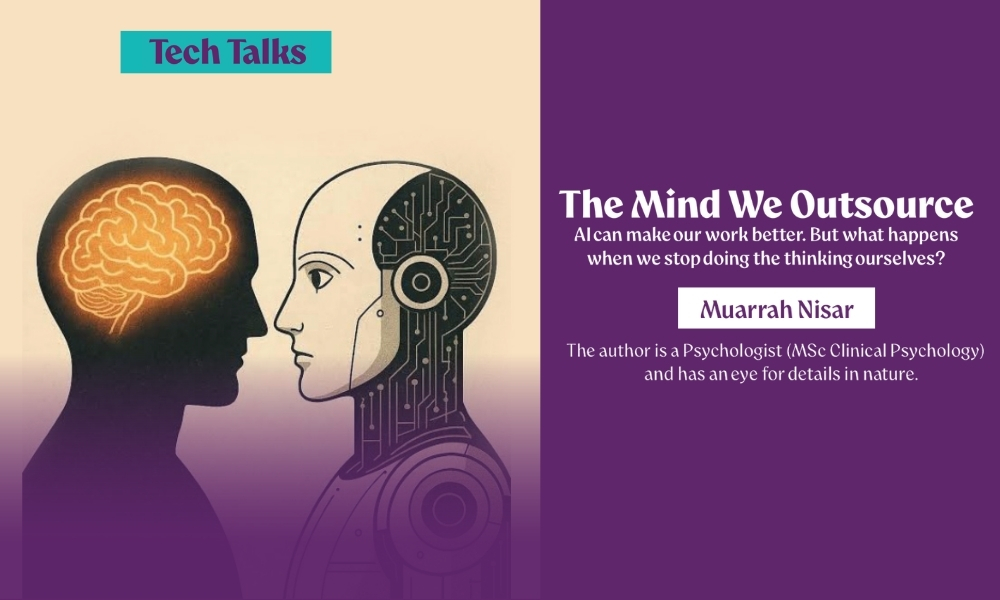
The mind we outsource
Perhaps the most uncomfortable part of this conversation is that dependence does not always feel like dependence. It can feel productive. We finish faster. Our writing looks better. We have an answer ready when someone asks. The result may even receive praise.
But what happens when the tool is unavailable? When someone questions our argument? When we need to explain a decision, defend an opinion or create something without a ready-made starting point?
We cannot expect to develop skills we consistently avoid practising. We cannot expect independent judgement to grow if we accept every convincing answer without examining it. And we cannot claim ownership of our work simply because we submitted it under our name.
AI can help us create more. It can help us learn, question and improve. But those benefits depend, in part, on whether we remain active participants in our own thinking. The danger is not simply that machines are becoming capable of producing what humans once produced. It is that we might become comfortable surrendering the effort that made us capable in the first place.
That interview question has stayed with me because it was so ordinary. Someone was asked about an article they had written, and they struggled to identify its topic. It made me wonder how often we confuse having something produced with having learnt something, and how easily we accept a finished product as evidence of our own ability.
We talk about what AI can do, what it might replace and how much time it can save us. Perhaps we should also ask what we are choosing not to develop while it does the work for us. If we keep outsourcing the thinking, the questioning, the remembering and the creating, what will be left of the very abilities we were trying to make our lives easier with?
DID YOU KNOW?
A Microsoft Research and Carnegie Mellon University survey of 319 knowledge workers found that the more they trusted AI to do a task, the less critical thinking they reported applying to its output. Those confident in their own skills reported thinking more critically. The findings are self-reported
0 Comments