
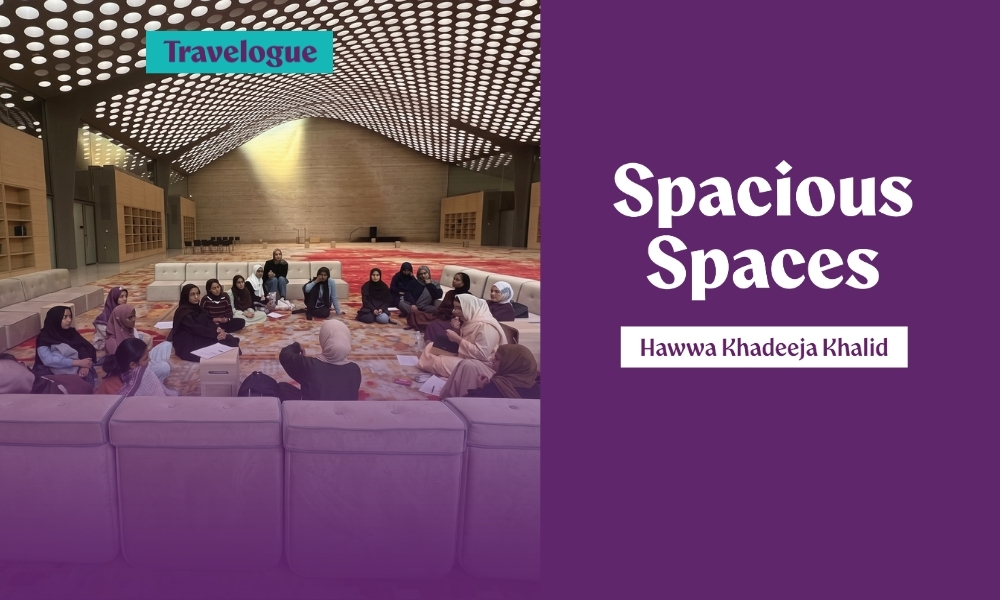
“And how many people are able to achieve all these?” Dr. Sohaira Siddiqui, Chief Executive Officer of Al Mujadilah Mosque and Centre for Women, asked us, looking at the crowded whiteboard. It was filled with answers students said when she asked: “What qualities should a leader possess?” ‘tolerant, courageous, decision-making, team building’, the answers went on and on. “It is too much for a single person to have, right? That’s why leaders are few in number in a society”, she explained. And when people are too focused on the idea of leadership, the rest, the followers, the majority, become stagnant. They fail to recognize their role in society. This is the point from which Al Mujadilah works on nurturing stewards, not leaders, in society. Every single person is a steward- a khalifa. They are in action all their lives and are responsible for whatever they do and the impact they make wherever they engage.
Prophet (pbuh) said, “All of you are shepherds(guardians) and are responsible for your flock(subjects)”. They are responsible for what is under them, however small or insignificant it may seem. Every action is counted; no man is left unseen.
Ria’ya is a stewardship program for young adults, conducted by Al Mujadila, Qatar. Its participants range in age from 17 to 22. And they prepare these girls for their future lives by providing sessions and workshops on academic as well as real-life lessons. The courses was on topics like ‘Ways of Knowing: Seeing Ourselves and the World’ led by Dr. Maryam AlSada, ‘Thriving in a Digital Age: Navigating Technology with Purpose’ led by Dr. Maryam Bahameish, ‘Islamic Ethics and Navigating Everyday Life’ led by Dr. Mutaz AlKhatib, ‘Anchored Within: Identity, Faith, and Well-being’ led by Dr. Zulkayda Mamat’, and ‘Environmental Stewardship in Islam and Building Sustainable Futures’ which was led by a number of guest speakers due to some emergency the expected guest faced. We had workshops: ‘Islamic Social Vision Concept’ led by Dr. Sohaira Siddiqui, ‘Innovative Mindset for Entrepreneurial Ventures and Career Growth’ led by Noor ElQumbarjee, ‘Financial Literacy, Faith, and Personal Development’ led by Atieh Hajian and a workshop on Natural Dyeing at VCU Arts led by Dr. Dian Widiawati and a workshop on Islamic Art at the Museum of Islamic Art.
The Ria’ya Program was not a pro forma. They had studied us well. Wadha ma’am, one of our mentors, when she met us for the first time, said, “Don’t worry, I’ve read your applications tens of times. I know you guys better than your parents”. Another instance is when Noor El Qumbarjee, who led the workshop on Entrepreneurship, made us into groups based on our capabilities. She was reading a description about each of us, which she compiled from our personal essays or resumes or personal information or bios, which the team requested from us before our arrival there. Further, she assigned us roles based on the description (and mine was a saleswoman). There were other instances, too, when our instructors addressed us as if they knew us. Another thing some professors did that impressed me was that when they wanted us to introduce ourselves, they asked us to, apart from saying our name, place and educational status, answer a question regarding the topic. For example, in the session on Financial Literacy, the professor asked us to answer any of the three questions; one, What was the first instance when you handled money? two, A money dream you have and the third one, I don’t remember.
Al Mujadilah is situated inside Education City. Her Highness Sheikha Moza bint Nasser founded the Qatar Foundation in 2003. She set her sights on educating young men and women from infancy to adulthood. The blockade of Qatar by neighboring countries affected the country in many ways, particularly in education. Two years after the blockade, Her Excellency Sheikha Hind bint Hamad Al Thani captured her thoughts about how Qatar championed education despite the challenges. Spanning 12 square kilometres, it’s a place with branch campuses of some of the world’s leading educational institutes, a homegrown research university, start-up incubators, technology parks, heritage sites, cultural institutions, and so much more. The buildings in EC have been designed by internationally renowned architects.
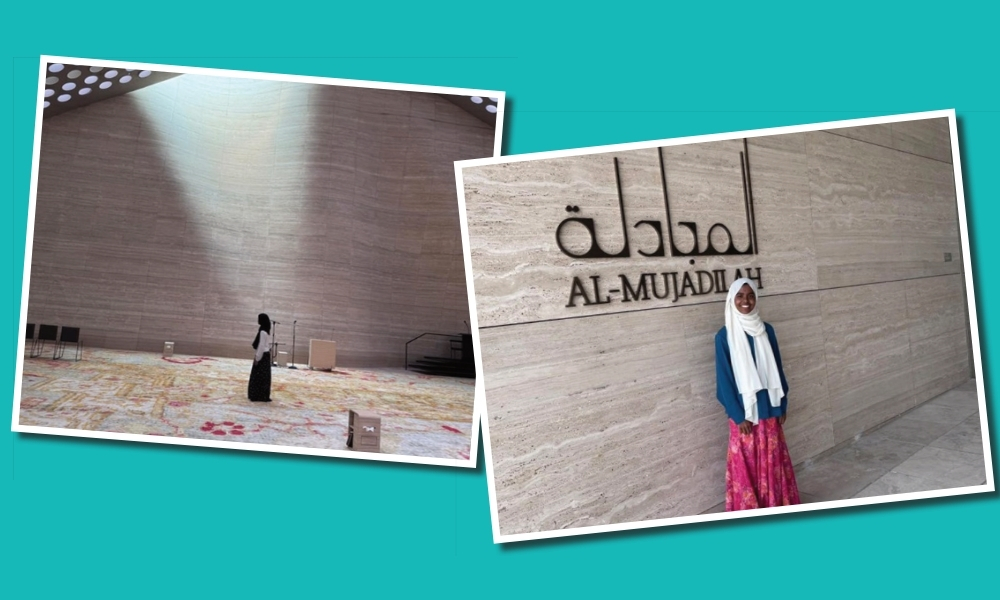
Al Mujadilah, founded by Sheikha Moazza, conducts numerous programmes, religious, developmental, social and global, for women, both in Arabic and English, hosting prominent scholars from both outside and inside the country. It is a single-floor space accommodating a bright and beautiful musallah, ablution area, restrooms, lobby, lounge, cafe, library, offices and rooms named Asiya, Bilqis, Hajer (that’s where we get water), and Khawla, used for classes and conferences. Can’t be unnoticed, it also has two tall olive trees in the centre. One of my colleague’s favourite part about the masjid was the space. She once said in all her rage, “You know, the feeling we get when we are in Al Mujadilah, the biggest factor of it is the space. A masjid in Koykodangadi (Kozhikode city), what does it have for women!!” Once, I heard a girl saying, when the instructor said she would consider what we suggested, “It’s Al Mujadilah, of course they’ll hear us”. Think that through, that sentence holds more.
Just a few days before going to Qatar, I had this experience. We were riding, and couldn’t find a masjid for me and my mother to pray. We searched for a long time for at least a signboard that said: “yathrakkaraya sthreekalk namaskara soukaryam und” (prayer arrangements for travelling women). A signboard found occasionally around Kerala on small prayer sections for women detached from the main masjid, without any ventilation, built close to toilets, unclean wudu sections and dirty slippers, which would make us run after the prayer. Along our search, the fellow with us said that once he saw another line below this “thadhheshiyaraya sthreekal namaskarikaruth” (native women should not pray). At last, we found a masjid. We stopped there and started to search for the women’s entrance. We took the stairs and found the door to be closed. Next, we found a door a bit far. Only one of the toilets was working. The wudu section was not clean enough. None of these felt new to us. We offered prayer and left. And I told my father, “this is why Al Mujadilah is built”.
And when I reached Al Mujadilah, the front doors were wide open for us. We would find women who are engaged in worship or studying or in dialogue inside.
All the participants of the program were exceptional. The cohort was 25 in size, from 16 different countries. There were founders of initiatives for community, youth, and refugees, there were girls who work on such platforms, political activists and leaders of student organizations, and winners of national and regional contests, a designer cum owner of a clothing brand, a financial investor, and a student ambassador of the UN. The students came from different backgrounds, like Tech, Law, Linguistics, Architecture, Science, etc.
We also had refugees from Palestine, Sudan and Syria. It was an honor meeting those blessed, resilient souls who say, “Alhamdulillah, at least I am alive”, “it’s fine, I can talk about it”, “I should move on, right”, “I am blessed”. Everyone engaged actively in the sessions with questions and opinions. And whenever I think of Ria’ya, I’ll definitely remember that, in those days, I unlearned that not only people who engage with Ulum al-Shara’iyya are contributing to the ummah, but also people from varied backgrounds are. Once, Dr. Maryam AlSada said that “just because we are not doing that professionally, doesn’t mean we don’t care about it”.
I never believed those glorious narratives on travelling. I believed it was the narrative of the privileged since travelling demands too much money and facilities. Even though there are direct commands in the Qur’an and Hadith on it, I never bothered. But now I realise, travelling indeed is reformative.
I travelled to a new place, also a very distant one, met numerous people from varied backgrounds, got to know things different from my place, understood many of my beliefs were wrong, and gave up many prejudices. How blessed would a person be to experience all these. So what was wrong with travelling that I didn’t perceive it this way earlier? Maybe the nation-states put all these obstacles in front of a traveller. Earlier, it only took a willing mind. Even the sustenance was found along the way.
Of all the places I visited in Qatar, my favorite is Al Mujadilah. It is a place where we feel welcomed, belonged.
Of all the experiences I had, the most stunning was shaking hands and hugging the professors. Those prominent scholars, azharis, postdoc fellows, doctors, researchers, we shared majlis with them, table with them. They greeted us with a hug, not even going for a handshake. When I said to Dr. Najah Nadi, the research head of Al Mujadilah, how grateful I am for this place, and I feel dignified here, she hugged me again. And I was just shocked- it felt strange to me. The experience was strange to me because most of the prominent figures we depend upon for academic or social purposes in our place are men, and we won’t be able to engage with them freely. It was an honour to meet these wonderful women who work for the betterment of society despite all the obstacles the very society put in front of them.
I can’t put into words how grateful I am for this.
To travel this far, in this age, and experience all these, at zero cost, is a great favor Allah has bestowed upon me, and I am just not able to express how grateful I am. “Oh Allah, I am not capable of enumerating the praise of You. You are as You have lauded Yourself”. I, for myself, do not deserve it and “Allah giveth without account to whom He will.”
My girl 🌈
Such a beautiful piece of writing 🥹💎
Masha Allah
go ahead
Masha allah
Very fantastic
Beautiful🌻
Masha Allah, it’s a meticulous piece of work!✨🌹
🙌
Masha Allah ❤️
🤍✨
Besutiful write-up! ♥️
🤍🫂
Excellent writing. Travel more, expand your horizon, write more.
All the very best.
I have seen this mosque in reels. But to read this experience is great ❣️