
The author is a writer and a content creator with an interest in literature, culture, and ideas.
‘Would you be comfortable sending your kids to Mars?’ asks Jonathan Haidt in his book The Anxious Generation: The Great Rewiring of Childhood. He calls out parents by noting that ever since the widespread arrival of mobile phones, specifically post-2007, parents have been overprotecting their kids in real life while under-protecting them in online life. He establishes the internet as equivalent to sending your kids to Mars, mainly due to its vastness and subtle predatory nature.
As technology has evolved and the internet has become easily accessible, the perils of the real world have quietly and subtly shifted to the online world. Most parents still focus on protecting their children from predators outside their homes, yet these children face greater risks in the comfort of their own bedrooms, unbeknownst to their protectors. Allowing children personal smartphones before they reach mental maturity is exactly like sending them onto an unknown planet without a sense of right and wrong, leaving them vulnerable to decisions made on a whim.
The Risks Children Encounter Online
In his book, Haidt discusses research documenting incidents where, despite being excessively monitored, teenagers continued to make accounts on social media. For example, parents who checked phones daily were still deceived by app-disguising features, such as changing an Instagram icon to look like a calculator app.
Children naturally lack an understanding of life in their early developmental years; how, then, can parents trust them in the online world? The same applies to teenagers, developmental analysis offers an insight into how their brains function. They are easily swayed by peer-pressure and hormonal fluctuations; teens are more susceptible to being influenced by factors designed to capture their attention and numb their minds. Since 2007, research across the USA and Europe shows a steep rise in eating disorders, self-harm, anxiety, and suicide rates among teenage girls. Among teenage boys, researchers note a sharp increase in depression, suicide rates, and obsessive use of video games and pornography.
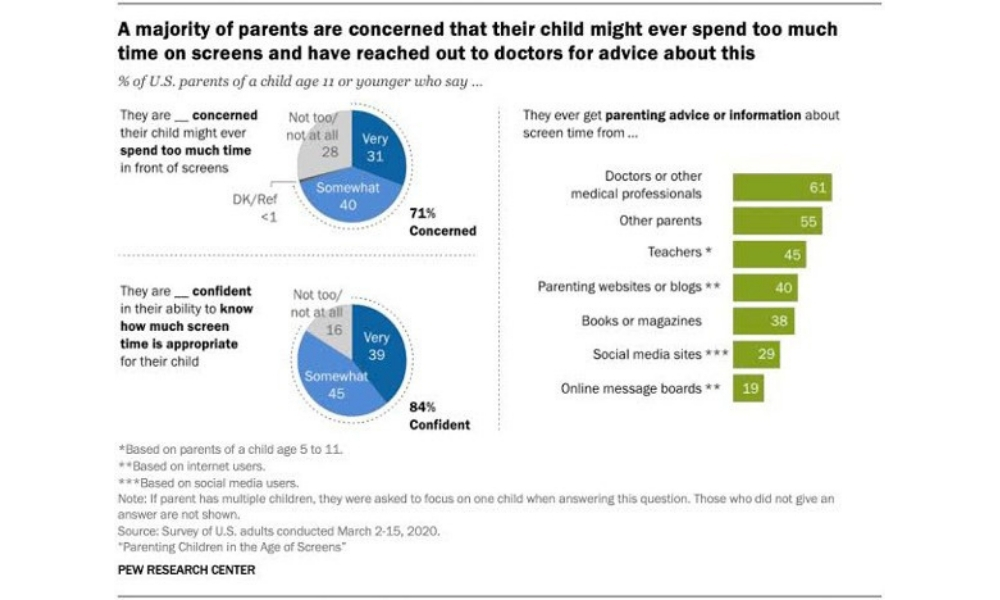
This data brings us to an extremely important question: “Why are parents allowing their kids free access to a world that they themselves are fully unaware of?” Parents are meticulous when warning children about ‘stranger danger,’ advising them on opting good company at school, and micromanaging their daily lives. Yet, when it comes to the internet and social media, children are allowed free access. This is precisely where Digital Literacy comes into play. The reason parents don’t warn their kids about online hazards is that average adults are often unaware of the risks themselves. Concepts like child privacy, consent before posting, online child exploitation have only come into the spotlight quite recently. In situations like these, digital literacy for parents and caregivers is essential so that they can better assess risks, and teach children how to navigate the internet safely.
What is Digital Literacy
The term was first popularised in 1997 by technology writer Paul Gilster in a book of the same name. It refers broadly to the ability to understand, evaluate, and use information gathered through digital technologies. As technology has evolved, so have the skills associated with it. It is no longer enough to merely know how to operate devices and how to browse the web; digital literacy entails safe and responsible usage while understanding how platforms operate and how companies manipulate user traffic and data.
While digital literacy is important for everyone, special emphasis must be placed on children. Impressionable minds need to learn how to navigate the digital world and what red flags to look out for. Even when parents are diligent in keeping their children away from the internet and social media, they will inevitably encounter it in one form or another. Realistically, the goal should not be total prohibition, but to equip them with tools that will help them navigate this world wisely. It is about preparing their minds for a world that is extremely vast, deep, and constantly changing.
Why Parents Need Digital Literacy
If parents want their children to develop healthier digital habits, then they must reassess their own relationship with technology. Digital literacy cannot be treated as a lecture delivered to children while parents stay passive observers. It begins with parents and their understanding of it. It should be a shared process of learning, questioning, and adapting.
This understanding develops when parents familiarise themselves with how online sites collect data, how advertisements work, how recommendations work, and how companies target audience to prolong engagement.
How to Develop Digital Literacy at Different Ages
1. For Early Childhood
Children in their early childhood (from ages 1-5) learn through ‘serve and return’ communication. It is the back-and-forth communication that happens during play, conversations, and daily routines. It is only possible when the child is involved and interacting with another human being. When screens are involved, communication becomes one-way: the screen speaks to the child, but there is no return communication. Consistent exposure to this type of communication will leave a child challenged in many ways. As the screen offers passive content, the child’s neural pathways that are necessary for language learning, problem solving, and emotional regulation will be compromised.
The Solution: Instead of letting young children watch video after video without any external stimulus, turn screen into a family activity. Simple actions, like repeating sentences from a video to your child fosters engagement and encourages interaction with you rather than passive absorption. It makes the screen a tool for connection rather than a replacement. It also transforms the whole experience into an interactive learning rather than just passive viewing.
2. For School-Age Children
When children start school, their interaction with technology increases. Today, schools are integrating digital devices in the learning process from a very young age. It is very important to remember that all screen interaction is not harmful. It is valuable to let them explore devices and their functionality, but it should happen with a cautious approach. Because habits formed during this period can last a lifetime, keeping a careful accounting of their digital world is essential.
The Solution: In addition to parents keeping an eye on what their children are doing, schools should introduce digital literacy directly in their curricula. Teachers and other caregivers should keep thoughtful, and guiding eyes while children learn to navigate these tools.
3. For Teenagers
Top-down, surveillance-based monitoring does not work, especially among teenagers. Youth at this age know ways to work around things when they are being restricted. Some even go to the extra length of uninstalling apps while at home and installing them again when not at home. Attempting to fear-monger them into submission is counterproductive.
The Solution: Open discussions and mutual decisions are the way forward. The best way to prepare teenagers for online risks is to teach them how to spot trouble at its first sign. Introduce them to concepts like doomscrolling and help them understand how platforms use phone data to collect information about preferences, age, and gender to advertise those things to them. Shift from a mindset of surveillance to open dialogue, co-creating healthy boundaries, and prioritizing critical thinking over blind prohibition. Parents should openly discuss how to recognise online predators, identify cyberbullying, and verify information before believing or sharing it.
Practical Tips for Families
There should be open discussions on digital dangers, identifying fake news/deepfakes and how to find correct sources.
Remain vigilant about their presence online, especially during interactions with strangers.
3. Parents should use parental control features for children, while establishing mutually agreed-upon boundaries with teenagers.
Teach them to say no when someone online asks them for photos, full name, home address, school name, passwords, and other sensitive information, and to inform the adults immediately if asked.
Establish tech-free zones at home where no gadgets are allowed, e.g., dining table, kitchen, etc.
Teach them ‘think before you post’ rule. Explain to them that online words carry real-world emotional weight. If they would not say it face-to-face, they should not type it.
Teach them to recognise cyberbullying and immediately let elders know.
Use family-shared devices and enforce a “no devices in the bedroom” rule.
Have a conversation about body privacy and instruct to immediately alert adults if they see a pop-up image or video that makes them feel uncomfortable.
Teach children the etiquettes of webcam and microphones, explaining why they should keep them off and when they should be on.
Conclusion
With the way things are moving in today’s time, it is impossible to completely disconnect children from using the internet. Attempting to do so would ultimately be a disservice to their future. Equipping them with proper tools is the only realistic path forward. Passive scrolling is fundamentally different from intentional, educational learning on digital devices, and it should be treated like that.
References
Haidt, Jonathan. The Anxious Generation: The Great Rewiring of Childhood. Penguin Press, 2024
Gilster, Paul. Digital Literacy. John Wiley & Sons, Inc., 1997
https://ibos.school/a-parents-guide-to-online-safety-and-digital-wellbeing-for-children
You’ve thrown light on such an important topic. It’s extremely important for adults to be digitally literate in today’s world of social media as failing to do so would put the social as well as psychological well being of children at risk. As you’ve rightly suggested that we should equip our children with the tools necessary to navigate the ever evolving world of technology so that it paves newer paths of learning rather than becoming a hindrance.