
The author is a student of Delhi University
The Constitution of India begins with a promise: Justice, Liberty, Equality and Fraternity. It also guarantees citizens the right to speak, express and peacefully assemble. But we must ask ourselves, are these principles meant only for the pages of the Constitution, or are we prepared to defend them when the voices demanding them are inconvenient?
Dissent When It Is Inconvenient
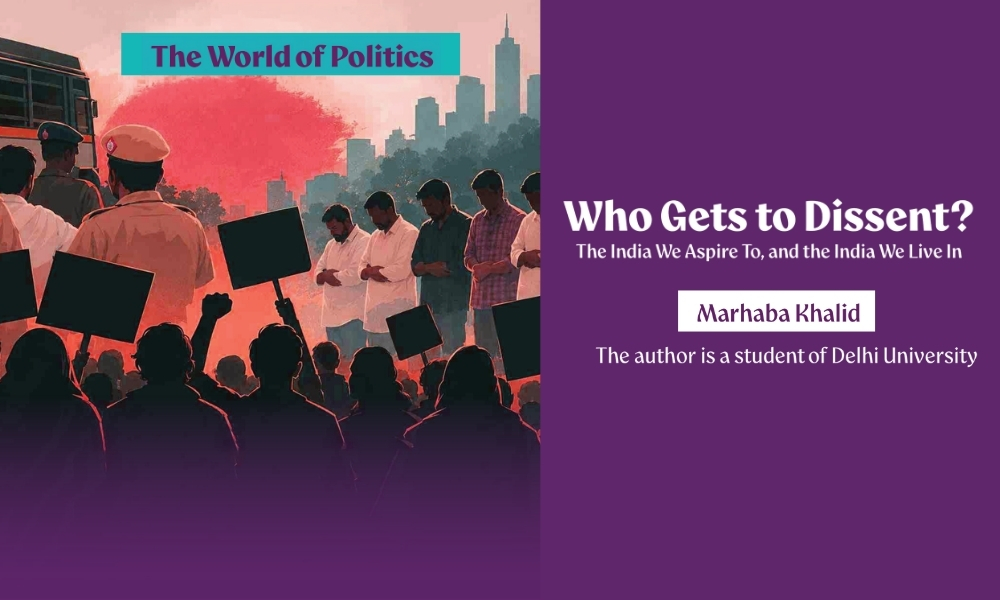
The protest at Jantar Mantar on 29 September, centred on concerns regarding Waqf, religious places and the rights of minorities, raises questions that go beyond one law or one community. Reports of detentions during the protest make the larger question even more important: what happens to dissent when it becomes politically uncomfortable? Jantar Mantar itself has reportedly been denotified as a designated protest site, which sharpens the question further.
A democracy cannot treat protest as legitimate only when we agree with what is being protested. The right to dissent cannot depend upon who is speaking, which community they belong to, or whether their demands fit comfortably within the dominant political narrative.
This does not mean that every demand made during a protest must automatically be accepted. Democracy allows disagreement. But disagreement should produce debate, evidence, law and accountability, not silence or violence.
Minority Rights and Mature Democracy
And this is where the question of minority rights becomes important.
A minority does not become less entitled to constitutional protection because it is numerically smaller. At the same time, defending minority rights does not mean blindly accepting every political claim made in their name. A mature democracy should be able to do both: listen to a grievance and critically examine it.
So why do certain concerns receive enormous political attention while others barely enter public conversation?
Why is there sometimes greater enthusiasm for one kind of protest than another? Why do political parties and institutions often become hesitant when the concerns involve politically sensitive questions about minorities?
These questions are not merely about Waqf. They touch upon secularism, equal citizenship, democratic dissent and government accountability.
Lifting the Veil
And perhaps the problem is not always that we do not know.
Perhaps we know enough, but we have become comfortable with not knowing more.
Are we living under a veil of ignorance, or are we simply afraid of lifting it because what lies beyond it may disturb our political and social comfort?
We see unemployment, poverty, violence, sexual violence and inequality around us. Yet public attention can become consumed by religious and communal conflicts. Religious identity is an important part of Indian society, but when it becomes the primary language through which politics is conducted, other questions can disappear from view.
We should therefore ask a difficult question: is every conflict really only about religion, or can religion also become a powerful instrument through which questions of power, money and political mobilisation are played out?
And who ultimately pays the price?
Often, it is ordinary citizens, irrespective of religion, caste, gender or political identity, while those in positions of authority remain at a distance from the consequences.
This is why political awareness cannot be treated as an option anymore. Democracy does not exist only on election day. It exists when citizens question power, when institutions answer them, when dissent is heard and when constitutional rights are defended even when doing so is uncomfortable.
The plea, therefore, is not simply for one community or one religious place. It is a plea to citizens to look closely at the fault lines within the system we proudly call the world’s largest democracy. To ask before accepting. To question before choosing sides. To look beyond the noise. And perhaps, most importantly, to ask ourselves:
Is this really the India we aspire to and the India we are actually living in?
The legacy we celebrate should not remain only in our history. It must live in our present and shape our future.
Because the Constitution is not merely a document we inherit.
It is a responsibility we have to keep alive.
A democracy cannot treat protest as legitimate only when we agree with what is being protested. The right to dissent cannot depend upon who is speaking, which community they belong to, or whether their demands fit comfortably within the dominant political narrative.
This does not mean that every demand made during a protest must automatically be accepted. Democracy allows disagreement. But disagreement should produce debate, evidence, law and accountability, not silence or violence.
0 Comments