
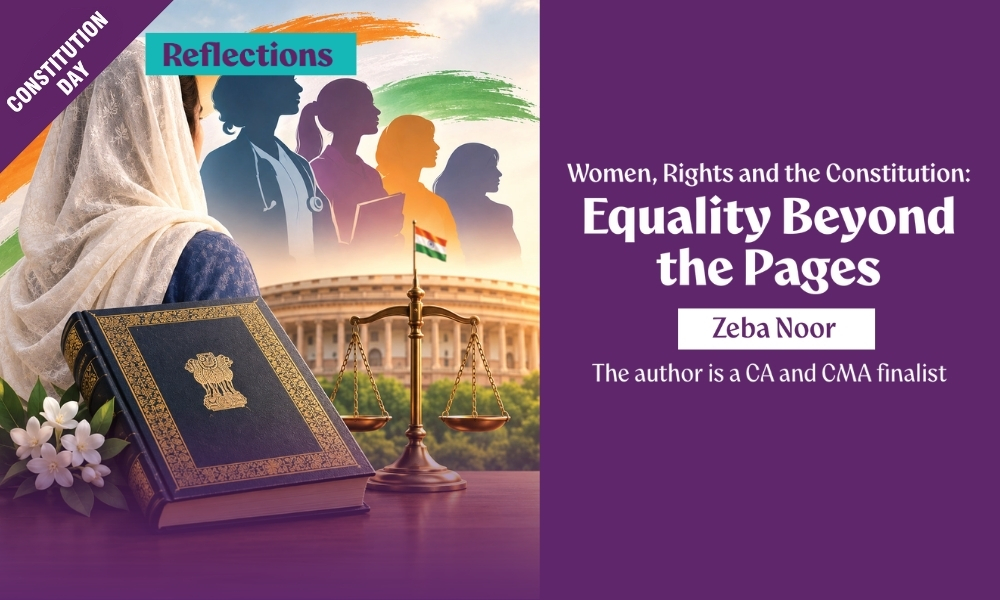
The author is a CA and CMA finalist
When I think about women’s rights in India, I often think about how complicated the conversation can become. As a 23-year-old Indian woman, I have grown up seeing two very different realities. On one side, I see women becoming chartered accountants, doctors, entrepreneurs, teachers, politicians and professionals in almost every field. On the other, I still hear girls being told what they should study, where they should work, what they should wear and how much of a voice they should have in their own lives.
As a niqabi (veiled) woman, I have also experienced how quickly people make assumptions about a woman based on her appearance. Sometimes people assume that a woman who chooses modesty must automatically be uninterested in education or ambition. I don’t believe these things have to contradict each other. A woman can choose modesty and still want financial independence, education, a career and a meaningful place in society. To me, women’s rights should begin with allowing women to have agency over their own lives.
The Indian Constitution provides an important foundation for this. Article 14 guarantees equality before the law, while Article 15 prohibits discrimination on grounds including sex. Article 15(3) also specifically permits the State to make special provisions for women and children. Article 16 provides equality of opportunity in matters of public employment.
But having rights on paper and experiencing equality in everyday life are two different things.
I have seen this in ordinary conversations. A boy deciding to pursue a demanding career is often seen as ambitious. A girl doing the same may be asked how she will manage marriage and family. A young man working late can be considered dedicated, while a woman doing the same may face questions about whether it is “appropriate.” These expectations may not always come from laws or institutions; sometimes they come from families, communities and social attitudes.
This is why I think constitutional rights cannot be understood only through courtrooms and legal textbooks. They also have to become part of everyday thinking.
For me, equality does not mean pretending that men and women have identical lives or experiences. It means that being a woman should not automatically become a reason to deny someone an opportunity. If a woman is qualified for a job, her gender should not determine whether she deserves the opportunity. If she wants to study, her ambition should not be treated as something temporary that will disappear after marriage. If she chooses to become a homemaker, that choice should also be respected.
At the same time, I don’t think empowerment has one particular appearance. A woman in ‘modern’ clothes and a woman in a niqab can both be educated, ambitious and independent. A woman who wants a corporate career and a woman who wants to build a family are both capable of making meaningful choices. The important question is whether the choice is genuinely hers.
Financial independence is another area that matters deeply to me. I believe women should understand money, savings, investments and careers regardless of whether they eventually become the primary earners in their families. Financial literacy gives a woman the ability to understand her circumstances and participate in decisions affecting her future.
The Constitution gives us a framework for equality, but society determines how much of that promise becomes visible in daily life. Laws can prohibit discrimination, but attitudes take longer to change.
As a young Indian woman, I don’t want equality to remain a word we repeat on Constitution Day. I want it to be something I can recognise in classrooms, workplaces, homes and ordinary conversations.
For me, women’s rights are not about asking society to give women special treatment simply because they are women. They are about recognising women as complete individuals—with minds, ambitions, responsibilities, beliefs and choices of their own.
And perhaps that is where constitutional equality becomes real: not when every woman is expected to live the same life, but when every woman has the freedom to shape her own.
0 Comments