
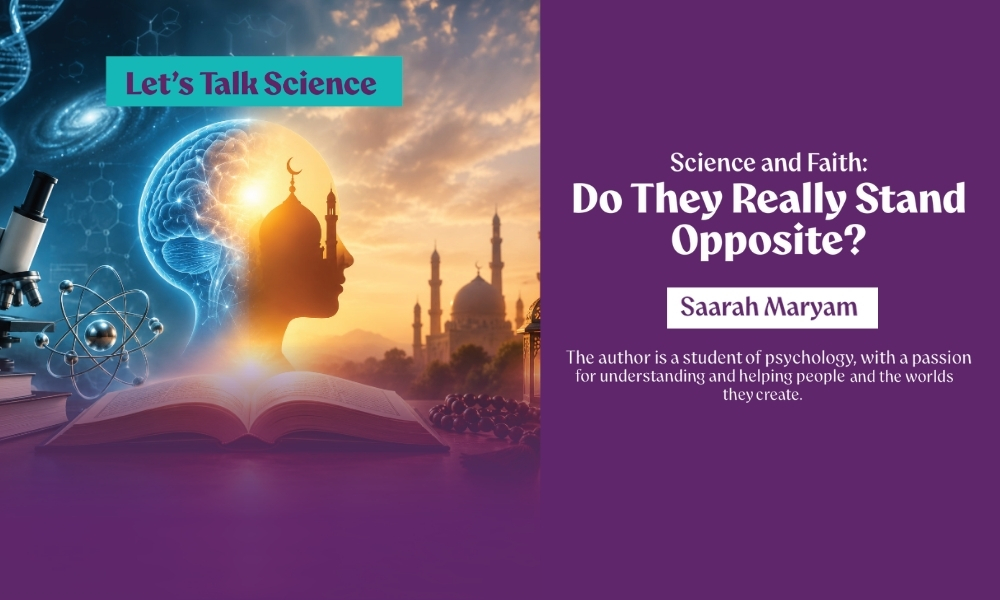
The author is a student of psychology, with a passion for understanding and helping people
and the worlds they create.
For a long time, science and faith have been placed on opposite sides of the same argument. Science is said to belong to evidence, reason and discovery, while faith is often reduced to belief without proof. But maybe the real problem is not that science and faith contradict each other. Perhaps it is that we have been asking them to answer the same questions.
How and Why
Science asks how. How are stars formed? How does the human brain work? How does life develop? How does the universe expand? And science has given us extraordinary answers. But there are questions that remain beyond a laboratory: Why is there something rather than nothing? Why does the universe exist? What is the purpose of consciousness? Why should anything be considered right or wrong? Knowing how something works does not automatically tell us why it exists.
Interestingly, the Qur’an does not ask human beings to close their eyes to the universe. It asks them to open them. The Qur’an says, “Indeed, in the creation of the heavens and the earth… are signs for those who possess understanding.” (3:190). The universe is presented not merely as something to live in, but something to think about.
Signs in the Universe and Within Us
And perhaps this is where science becomes fascinating from an Islamic perspective. The more science discovers, the more there is to wonder about. We now know that the universe is expanding, that our galaxy contains billions of stars, that living cells contain extraordinarily complex systems, and that the human brain contains billions of neurons. Yet every answer seems to uncover another question.
The Qur’an says, “And in yourselves – will you not then see?” (51:21). Think about that. The same body we casually call “myself” contains a brain capable of studying the universe that produced it. We are made from the very matter we spend our lives trying to understand, and somehow that matter is conscious enough to ask, “Why am I here?” That question is difficult for science alone to answer.
The Qur’an also says, “We made from water every living thing.” (21:30). Modern biology shows us just how fundamental water is to life as we know it. But the deeper point is not that the Qur’an was written as a biology textbook. Its purpose is to make us notice. Something as ordinary as water becomes extraordinary when we stop taking it for granted.
This is why we should also be careful with the phrase “scientific miracles of the Qur’an.” Not every modern discovery needs to be forced into a verse. The Qur’an does not need to be turned into a science textbook to be meaningful. It repeatedly does something much more powerful: it makes us look. Look at the sky. Look at the earth. Look at life. Look at ourselves. And then think.
Where Science and Faith Meet
Science can tell us that the universe has an extraordinary history. Faith can make us ask what that existence means. Science can describe the complexity of the brain. Faith can make us wonder about consciousness, morality and the soul. Science can reveal the immense scale of creation. Faith can ask us who created it and what our place within it is.
And perhaps the most humbling scientific discovery is not how much we know, but how little we know. The Qur’an reminds us: “You have not been given of knowledge except a little.” (17:85). We can send machines into space, edit genes, observe galaxies billions of light-years away and uncover secrets hidden inside a single cell. Yet we still cannot completely explain consciousness, the origin of existence or the deepest questions of human beings.
So, science does not make faith unnecessary. Perhaps it makes us ask better questions. The telescope shows us how vast creation is. The microscope shows us how intricate it is. The human mind allows us to understand both. And the Qur’an asks us to pause and reflect on what all of it means.
Maybe science and faith were never meant to be enemies. Science can tell us how the universe works. Faith asks us why it matters. And sometimes, the further we look into creation, the more astonishing the question becomes: if this is only what we have managed to discover, how much more is there that we still cannot see?
DID YOU KNOW?
Between 1011 and 1021, while under house arrest in Cairo, the scholar Ibn al-Haytham (Alhazen) wrote the seven-volume Book of Optics. It relied on experiments, including an early pinhole “dark room”, to explain light & vision. The book strongly shaped European optics between the 13th & 17th centuries.
0 Comments