
The author is a freelance writer with a background in content writing. After writing in niches like tech, finance and digital marketing, she has now pivoted towards social & political issues.
With the coming of the digital age, technology has forayed into every aspect of our lives. Now anything is possible at the click of a mouse. The integration of technology in different walks of life has also created several challenges and problems. While the growing use of AI tools has revolutionised the work culture, it also raises serious privacy and security concerns. Since the early days of the internet, women have been disproportionately targeted by cyber criminals. Deepfakes are one of the many forms of online harassment that women face. The word deepfake consists of two terms: deep learning – a subset of machine learning – and fake, which is pretty much self-explanatory.
A deepfake is a video, an image or an audio clip created with artificial intelligence, intended to convincingly depict a person saying or doing something they never did. It uses tactics like voice cloning, synthetic video calls and AI-generated content to mimic the ways an individual communicates. These AI-generated fakes are increasingly being used in scams, disinformation attacks, election manipulation, social engineering, identity theft and financial frauds. However, a major cause of concern is non-consensual pornography, which accounts for 98% of deepfakes on the internet. The technology is also used to create hoax instances of revenge porn. It is simply not a technology problem. The impact goes beyond damage to reputation, leading to extreme psychological stress, online harassment, low self-esteem, insecurity, social stigma and breaches of privacy and dignity.
Origins of the Deepfake Technology
In the year 1997, researchers Christopher Bregler, Michele Covell and Malcolm Slaney created a program called Video Rewrite that was capable of syncing new audio to existing facial footage. The program was initially created for movie dubbing, but it laid the groundwork for the present-day deepfake. In 2014, Ian Goodfellow – a PhD student at the University of Montreal – introduced the concept of the Generative Adversarial Network (GAN). A GAN pits two AI systems against each other: one creates the fake content (the “generator”) and the other evaluates whether it passes as real (the “discriminator”). The generator keeps improving until the final output is convincing enough to deceive the discriminator and eventually a real person. By processing large datasets of images, video and audio samples of a specific person, the system learns to replicate their facial expressions, voice tone and mannerisms with striking accuracy. Goodfellow’s invention is widely credited as the foundation stone of modern-day deepfake technology. The term “deepfake” entered the public discourse in the year 2017, when an anonymous Reddit user started sharing AI-manipulated videos and their open-source code on GitHub. Today, someone with zero technical skills can create a convincing deepfake with a mobile or web app. Once, creating a deepfake required considerable technical skills and powerful hardware. Today, the code for creating a deepfake is readily available online, and one clear face image is enough to create a 60-second deepfake video of anyone.
Factors Affecting Susceptibility to Deepfakes
The vast majority of deepfake apps and tools are used to generate non-consensual intimate imagery, specifically aimed at women to harass, humiliate or extort them. Sexualised or manipulated images or videos carry a heavy social stigma that disproportionately damages a woman’s reputation, personal relationships and professional life. Public worry about deepfakes grew in India after an AI-manipulated video of actress Rashmika Mandanna circulated on the internet in 2023. In January 2024, the internet was flooded with intimate images of pop icon Taylor Swift. The abusive content wasn’t real; it was synthetic imagery generated by artificial intelligence. As per a 2023 report by securityhero.io, deepfake pornography made up an astonishing 98% of all deepfake videos online, and 99% of the individuals targeted in deepfake pornography are women. These figures are worrisome as they reveal the distressing misuse of the technology. With their ability to copy and replicate the likeness of an individual without their permission, deepfakes pose a serious threat to personal integrity, privacy, security and digital well-being. The total number of deepfake videos online in 2023 was 95,820, representing a 550% increase over 2019. This exponential growth is an indication of the rapid proliferation and integration of deepfake technology in the digital world.
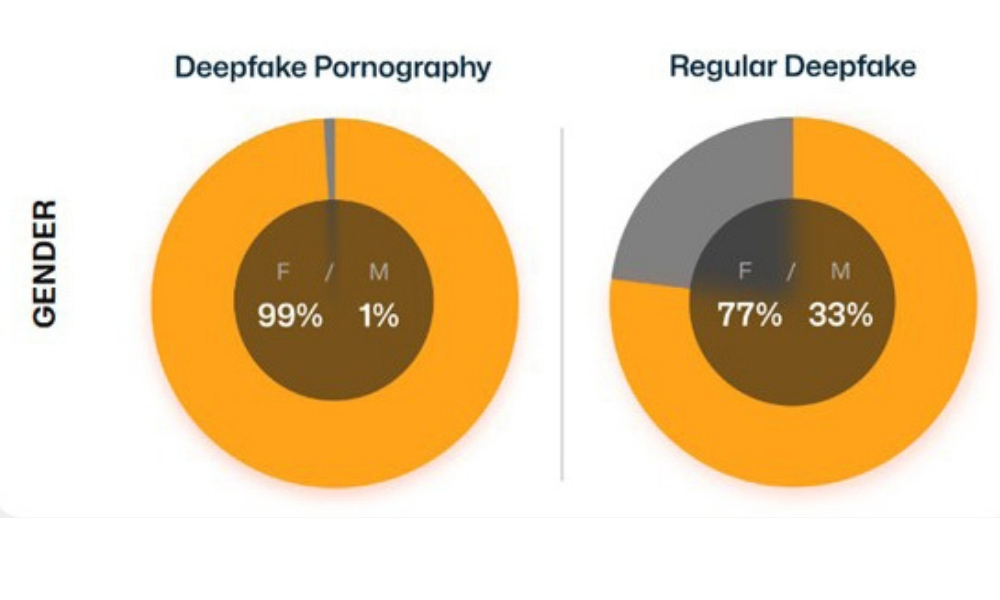
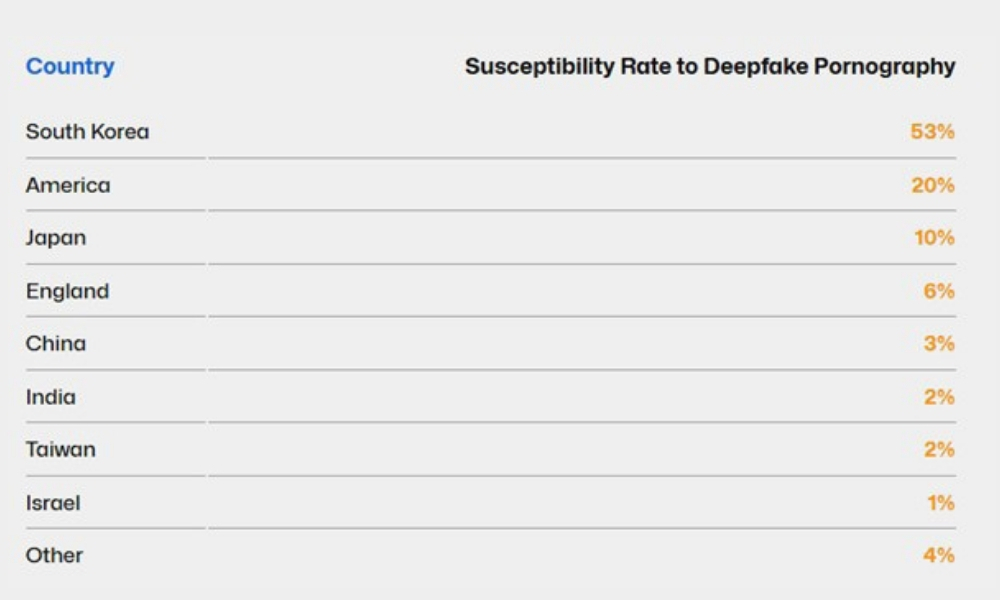
Deepfake content production is selective, with factors like gender, nationality and profession affecting the choice of targeting specific individuals. A glaring 99% of deepfake pornographic content comprises female subjects, while only 1% features men. Another factor affecting the targeting of individuals is nationality. Geopolitical tensions, cultural stereotypes or simply the desire to create content for a specific audience make certain people a more attractive target for deepfake pornography. South Korea tops the list with a 53% rate of susceptibility to deepfake porn. Other countries on the list include America at 20%, Japan at 10%, and the United Kingdom at 6%, followed by China at 3%, India and Taiwan at 2%, Israel at 1% and the rest of the world at a combined rate of 4%.
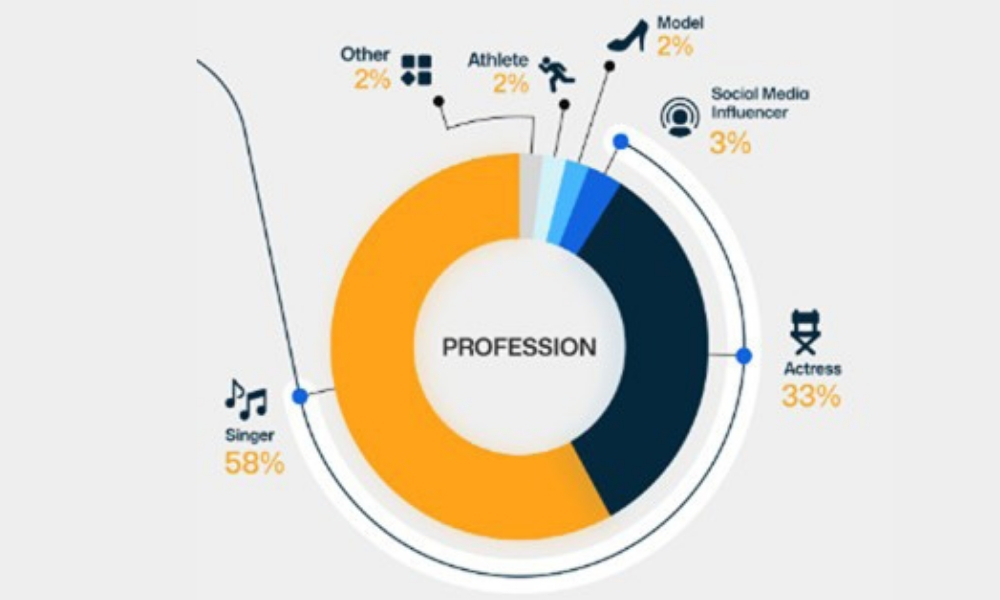
Profession also plays a key role in the selection of targets for deepfake content. Public figures become easy targets for the deepfake industry due to their visibility and the potential impact of malicious content on their careers and social standing. The list of highly featured professions in explicit deepfake content includes singers, actresses, social media influencers, models and athletes. The table below statistically summarises this information.
Privacy and Personal Safety Risks
While public figures are at a higher risk of being victims of deepfakes, virtually anyone (women being disproportionately targeted) can be a victim of non-consensual intimate deepfakes (NCID). Once AI-generated content is shared online and goes viral, it becomes nearly impossible to remove it completely, as it gets shared across multiple platforms and saved to private devices. This phenomenon has raised serious concerns over privacy, consent and misuse on digital platforms. It has complex social, legal and ethical implications, particularly related to privacy violations, identity theft and reputational damage.
In certain cultures, deepfake abuse can serve as a catalyst for honour-based crimes, where a perceived breach of honour on digital platforms can lead to extreme physical violence against women or even death. How sexually explicit deepfakes affect women differs from country to country and with the prevalent views of women at play. In India, journalist Rana Ayyub experienced a deepfake smear campaign after she advocated for justice for an eight-year-old girl who was repeatedly raped and then murdered. Women have reported that they find it difficult to find or maintain employment after being a target of image-based sexual violence.
Apart from facing professional repercussions, victims of deepfake abuse experience deep psychological stress in the form of anxiety, depression, trust issues, loss of autonomy, low self-esteem and withdrawal from social media as a coping strategy. Additionally, deepfakes can be extremely damaging to relationships. Women often feel intense shame or fear that their parents, children or friends may see the fake images. Partners may see fake explicit content and unfairly blame the woman for it, adding emotional abuse to the violation. Today, anyone can become a target of “revenge porn” without the publisher actually being in possession of any sexually explicit material of the target. They can be created out of images or photographs scraped from the internet. The threat of targeted digital abuse can deter women from pursuing public discourse, politics, journalism or online networking.
How to Spot a Deepfake
Detecting a deepfake isn’t always easy, but there are signs to look for:
Unnatural movements: Replicating natural eye movements is difficult, as people’s eyes usually follow and react to the person they are speaking to. So, a lack of eye movements is usually a good sign of a deepfake. Also, AI-generated faces may blink too much, too little or not at all.
Bad lip-syncing: Lip-syncing in deepfake videos will not align with the words being spoken by the people in them.
Odd lighting or discolouration: Deepfake images can also be recognised by discolouration, inconsistent lighting or misplaced shadows.
Unnatural facial expressions: Deepfake eyes do not show the change in pupil size or focus that occurs naturally. A smile with perfectly stationary eyebrows can be a giveaway.
Unnatural hair and skin colour: AI models often struggle with the finer details of human hair and skin texture.
While deepfake detectors are better at identifying fake images, humans are still better at identifying deepfaked videos, and they get better at it when primed for it. That’s where deepfake detection sites come in handy. Deepfake detection software helps in identifying geometric inconsistencies in images or noise in a video to check if it’s real. In case you see a suspicious video, check if credible news outlets are reporting the same and trace back their sources.
How Can Women Protect Their Online Privacy?
Women can protect themselves from deepfakes and non-consensual synthetic media by managing their digital hygiene and footprint. Before sharing anything online, think carefully about which images or videos you want to put up for public viewing. Review your privacy settings on social media regularly, and the content you wish to make publicly accessible. Avoid posting high-resolution face photos or sensitive information. Use strong passwords and enable two-factor authentication wherever you log in. Update your operating system and antivirus system from time to time. Be careful before posting long, clear recordings of your voice online, as they can be harvested for voice cloning or sextortion by bad actors. In case you find yourself targeted by a deepfake, do not send money or comply with the demands of blackmailers. Take full-screen screenshots, capture URLs, download copies of the post or message and note down the timestamps before the content gets deleted. Reach out to the platform or site owner; many have policies requiring them to take the content down. Report crimes to law enforcement and seek advice from local aid organisations to understand which laws in your location can protect you.
Legal and Platform Protections
As of now, India doesn’t have a standalone deepfake law, but there are existing laws that can be applied to tackle the offence in question. In February 2026, the government also notified the Information Technology (Intermediary Guidelines and Digital Media Ethics Code) Amendment Rules, 2026, in force from 20 February 2026. These rules bring deepfakes, termed “synthetically generated information”, within the due-diligence obligations of online platforms, with labelling requirements and faster takedown timelines.
Information Technology Act, 2000: Various provisions of this Act can be used to prosecute deepfake offences. It penalises the capture and transmission of non-consensual intimate images. It also criminalises the publication and transmission of any obscene material in electronic form. Cheating by way of impersonation through online platforms can also be prosecuted under this Act.
Bharatiya Nyaya Sanhita, 2023 (BNS): This Act can be invoked in cases of defamation, insulting the modesty of a woman, forgery of electronic records, or voyeurism involving manipulated images or videos.
Digital Personal Data Protection Act, 2023: This Act protects an individual’s personal data in the form of photos, videos, audio recordings and biometric information. It penalises the unauthorised processing of personal data.
The biggest drawback of the existing legal framework is that the current laws were passed before AI became widespread. In the absence of an AI-specific law, victims are forced to navigate multiple legal provisions at once. Secondly, the current laws are only reactive, not preventive. They do not provide enough protection against the creation and initial spread of this content. Thirdly, the abusive content can be spread through anonymous accounts, encrypted platforms and websites outside of India, making investigation and enforcement challenging.
Conclusion
To tackle the menace of deepfake abuse, several measures need to be taken. Parliament should adopt AI-specific laws that severely penalise the creation and distribution of non-consensual deepfake content. For tracking anonymous creators, law enforcement agencies should be provided with advanced technical equipment and special training. Cryptographic watermarking should be made mandatory for developers. Watermarks are embedded during content generation and detected post-creation to authenticate the origin of the content and detect misuse or unauthorised replication. Tech platforms must be compelled to create systems for reporting abuse and responding swiftly to abusive content. Tools employed in the creation of deepfake porn should be made inaccessible to consumers and children. Lastly, governments should invest in educating the public about digital security and training citizens to detect deepfakes. The need of the hour is a balanced approach to deepfake regulation that promotes innovation while protecting the privacy and safety of women.
0 Comments