
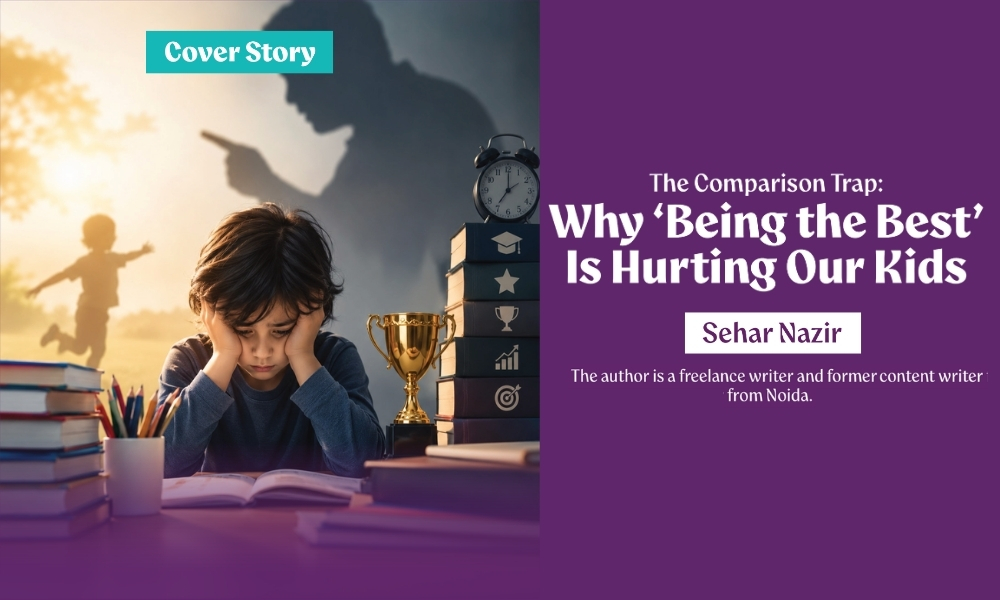
The author is a freelance writer and former content writer from Noida.
A child carries the burden to perform, compete and be the best.
“You used to be at the top of your class… What happened?”
“See, your cousin gets first position every year… Why can’t you?”
These words don’t just echo in a child’s ear. They settle in, becoming a quiet voice that whispers during exams, after school, and even when the child is lying awake at night. They are not meant to wound, but they plant a fear: ‘I’m not enough unless I’m the best.’ For many children, this constant comparison at home turns learning into a battlefield. Children suffer anxiety and sleepless nights, and slowly some of them become depressed.
Sometimes, in our race to push children forward, we are spoiling their childhood. Heard in many homes, such sentences turn siblings and friends into rivals!
How Academic Pressure and Motivation Turn into Damage
Once upon a time, a parent’s proudest words were, “My child is a topper.” Today, that sentence has become part of the problem, and there is no single villain. There is a tradition and culture that worships the topper; there are parents who carry their own unfulfilled dreams and expect their child to fulfil them; there are schools chasing rankings; and there is social media, busy sharing others’ success stories every second, never their struggles and pain.
It is the belief that a child’s worth, safety and future depend entirely on beating others, especially cousins, at grades. We call it ‘motivation’, but children feel it as a burden. Academic pressure is the weight a child carries: the real or imagined need to perform, outperform and never underperform. It is the knot in the stomach before an exam and on results day; the belief that a low grade means letting everyone down; the terror that love, respect and a future depend on being the best.
A disappointed look, a silence or a sigh can weigh on a child’s mind as heavily as a parent’s anger. Schools were once temples of learning, and teachers were inspiring role models. Now school is a competition ladder for every child. From preschool interviews to IIT coaching, children are sorted, ranked and labelled before they even know who they are.
Here’s what happens inside a child under pressure:
Learning becomes a race, and curiosity dies.
Mistakes bring shame and fewer chances to improve.
Self-worth gets tied to numbers on a report card.
Mental health suffers; anxiety rises, and depression settles in.
This is not helpful pressure; this chronic stress rewires a child’s brain for fear instead of growth.
Why Academic Pressure Is Worse Today
Academic pressure on kids hasn’t always been this brutal. A child comes home with 94%, and the mother’s first words are: “What happened to the other 6%?” That moment is small and ordinary, and it is repeated in millions of homes. It is where the damage begins. Marks and competition now take the joy away.
A child wakes up to a phone full of notifications, goes to school already anxious, comes home to more screens, more comparisons and more stress, and somewhere in between is expected to top the class, plan a future and stay calm in every situation. The body protests: headaches, insomnia, stomach aches before exams. These are not excuses but a nervous system waving a red flag.
The World They’re Growing Up In
We compared ourselves with one classmate. Maybe a neighbour’s kid got a scholarship. That was the scope of our world at that time.
Nowadays, our children don’t just study; they race… against classmates, cousins, siblings and millions of strangers online!
Every scroll is someone winning; every post, a highlight reel masquerading as real life. They are measuring their boring day against someone else’s best moment. The silent sadness of “I’m already behind.”
Why Is the Pressure Suffocating?
Social media is the Comparison Machine. It didn’t just add a new way to compare; it is creating a culture of ‘perfect’. The phone never stops. The winning never stops. ‘Average’ has become an unacceptable word! Only ‘the best’ gets shown, let alone celebrated. Childhood should be a time to learn, play and dream, but now children constantly worry about being the best. Even a small mistake can bring criticism and shame.
Children may not understand our worries, but they can sense them. The unspoken message lands early: “If I fail, everybody suffers.” So children grow up believing that their struggle doesn’t count and their effort isn’t enough.
Another factor is the post-pandemic mess, which is affecting children’s learning. During COVID-19, schools closed and learning paused. When the doors reopened, everything accelerated. Teachers moved faster because they had to cover the syllabus, and parents pushed harder, worrying about their child’s future. But many kids had forgotten the basics and missed foundational skills such as reading fluently, doing maths and staying focused. Some had to catch up ‘while already stressed’.
The pressure never left, and the weight of expectations remained. That is not just academic stress; it is fear about their whole life. Parental expectations and competition at school, too much homework and too many tests make a constant workload for young minds and leave no time to rest.
All this tells a child one thing, over and over:
“Your worth is your grade…”
Progressive Steps to Help Kids Cope with Stress and Reduce Pressure
Kids don’t need more pressure; they need more breathing space. It starts with small shifts at home and in school. Simple changes can reduce childhood stress and anxiety and help children feel happier and safer.
For Parents
Praise their effort, not their score. Stop comparing them with others, try to understand their emotions, and talk about their feelings, not ranks. Make playtime and rest real priorities. Let them express themselves, and value growth over perfection. Confident, stronger and happy children are the life of our homes.
“Love them for who they are, not what they score.”
For Schools
School should be a place where children feel happy, safe and excited to learn. Shorter school days, enough breaks and fewer high-stakes tests can help children enjoy learning more. Playtime is equally important because it helps children make friends, be creative and solve problems. Instead of comparing children by their marks or ranks, schools can celebrate everyone’s progress. Teachers can also notice when a child is worried or having a difficult day and offer support.
More importantly, we should ask, “What did you learn?” instead of only asking, “What marks did you get?” A great classroom is one where children can ask questions, make mistakes, learn from them and feel confident to try again. When children feel happy, they learn better, and when they feel free to dream, they can go further.
Helping Children Handle Social Media and Study Pressure
A little support, less pressure and more understanding can help kids grow happier and healthier.
Parents can set healthy screen limits and keep fixed times for phones and social media. Encourage outdoor activities, hobbies and sleep. Give children your time, talk openly and listen to their worries without scolding. Teach them the value of hard work and discipline, and support their dreams.
“A happy child is confident, and confident children can do wonders.”
What We Can Learn from Systems That Work
“Less pressure, more learning… the best school knows it.”
Children learn better when they are not scared. Where there is less competition, there is more growth. If the best systems are slowing down to protect young minds, maybe we should too.
Some countries have already figured this out: they don’t push harder; they let children be humans first.
Finland doesn’t start formal schooling until age seven, keeps homework minimal, and doesn’t make children sit a single standardised exam until the very end of high school! Teachers are trusted to assess students individually in a low-pressure environment. There is less time in the classroom and more time for play, and yet Finnish students have long ranked among the best in the world. So we learn that less pressure doesn’t mean less learning.
In Singapore, learning is rigorous, yes! But the system has been actively reforming. The “Teach Less, Learn More” policy encourages teachers to go deep rather than rush through content. The focus has shifted from memorisation to critical thinking and problem-solving. Even a high-performing system recognised that cramming and pressure weren’t the answer.
Japan takes a different but equally important angle. School isn’t just about grades; students learn responsibility, discipline and community through everyday practices. They even clean their own classrooms. The message is that character matters as much as results.
South Korea sits at the top of global rankings, but it is also a cautionary tale. The culture of pressure is so intense that the government introduced ‘exam-free semesters’ and restrictions on private tutoring hours, because the mental-health cost had become impossible to ignore.
What connects all of them? The best education systems invest in quality over quantity. They train and trust their teachers. They build in room for children to breathe, grow and develop as whole people, not just test-takers.
The pressure many children face today isn’t producing better learners. It’s producing anxious ones. The world’s top systems are proof that another way is possible.
These systems aren’t soft; they’re smart. They understand what we’ve forgotten: pressure doesn’t create excellence; fear kills it. When children stop competing to prove their worth, something shifts. They actually want to learn. They take risks. They think.
A Gentle Reminder from the Qur’an: Your Child Is Not Their Grades
In a culture obsessed with achievement and rankings, Islam offers a different vision of excellence. It sees the child, not the trophy. And it reminds us with divine clarity:
“Allah does not burden a soul beyond what it can bear.” (Qur’an 2:286)
This isn’t just a verse about hardship; it’s a parenting principle. The unrelenting drive for academic supremacy often pushes children beyond their God-given capacity.
The Prophetic model reinforces this. Our beloved Prophet Muhammad (SAW) once kissed his grandson Al-Hasan, and Al-Aqra‘ ibn Habis, who was sitting beside him, remarked that he had ten children and had never kissed any of them. The Prophet replied: “Whoever is not merciful to others will not be treated mercifully” (Sahih al-Bukhari 5997; Sahih Muslim 2318). Gentleness towards children was part of his message, and humanity was his goal. A child’s ultimate worth is inherent, not measured by a test result.
For parents gripped by fear about the future, Islam whispers a different truth. Success (rizq) is Allah’s promise, not the result of ruthless competition. Hard work matters, but so do rest, kindness and knowing when to take a break.
When pressure breeds anxiety, the pursuit of knowledge loses its spiritual purpose: raising children to become noble human beings.
The Childhood We Forget
We push kids to be the best. We compare them with others. We tie their worth to their grades. But a child is not a score; they need love, not pressure. And maybe that’s the real success: not perfection, but peace.
Let’s stop asking our children to be the best.
“Let them be children first… the rest will follow…”
The Comparison Trap
A study of more than 41,000 college students in the US, Canada and the UK found that the feeling that others expect them to be perfect rose by 33 per cent between 1989 and 2016. The researchers analysed 41,641 students, and found socially prescribed perfectionism up 33 per cent over the period. One author said this may be affecting students’ psychological health.
0 Comments