
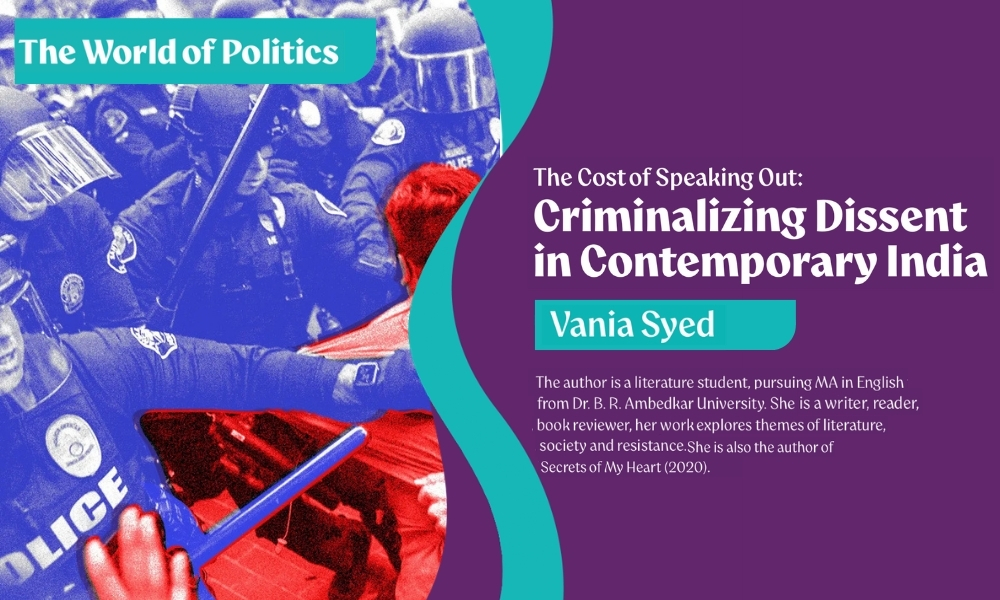
The author is a literature student, pursuing MA in English from Dr. B. R. Ambedkar University. She is a writer, reader, book reviewer, her work explores themes of literature, society and resistance. She is also the author of Secrets of My Heart (2020).
Democracy and Dissent
Dissent is generally a vital part of democracy because it allows citizens to hold those in power accountable and bring attention to injustice and unpopular policies. Dissent is the act of expressing disagreement with established authority, policies or dominant political narratives. In a democratic society, dissent serves as an essential mechanism through which citizens participate in public debate, challenge power structures and demand accountability. In a democracy, dissent is essential. Yet, in contemporary India, dissent is increasingly being treated as a threat to national security. Laws such as the Unlawful Activities (Prevention) Act (UAPA), sedition provisions and preventive detention laws are frequently invoked against activists, students, journalists and political critics, raising serious concerns about civil liberties and democratic freedoms.
Democracy is founded upon the principles of participation, accountability and the protection of fundamental rights. Among these rights, freedom of speech and expression occupies a central position, enabling citizens to voice opinions, criticise those in power and participate meaningfully in public life. Free speech is not merely the right to agree with prevailing views; it also includes the right to express unpopular, critical or dissenting opinions without fear of punishment. A democracy that punishes dissent risks transforming criticism into criminality and citizenship into obedience, undermining the very principles upon which democratic governance rests.
Colonial and Post-independence Background
The criminalisation of dissent is not entirely new to India. Many of these legal frameworks have colonial roots. The sedition law under Section 124A of the Indian Penal Code was introduced by the British colonial administration to suppress anti-colonial resistance and silence nationalist leaders. Figures such as Mahatma Gandhi and Bal Gangadhar Tilak were charged with sedition for criticising colonial rule. Despite independence, the law remained part of India’s legal system and continued to be used by successive governments. Preventive detention laws, which allowed detention without trial under the suspicion of future threats, were incorporated into the postcolonial state apparatus in the name of maintaining public order and national security.
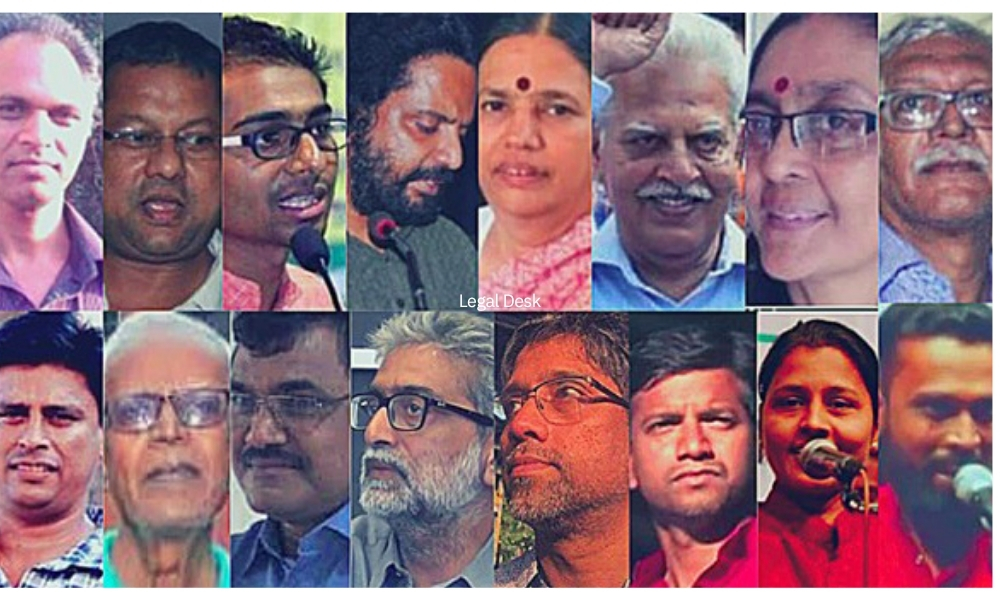
Among contemporary laws, the Unlawful Activities (Prevention) Act (UAPA) has emerged as one of the most controversial. Originally enacted in 1967, the law has been repeatedly expanded over the years, granting increasing powers to the state. The 2019 amendment further intensified concerns by allowing individuals to be designated as terrorists. The UAPA also makes obtaining bail extremely difficult, leading to situations where accused individuals remain incarcerated for years without trial. Prolonged incarceration and legal exhaustion become forms of repression. Several recent cases illustrate this pattern. Student leaders, activists and intellectuals involved in protests or political movements have been arrested under anti-terror laws despite limited or no evidence of violent activity. The arrests connected to the Bhima Koregaon case and the incarceration of student activists after the 2020 Delhi violence have intensified debates around the use of the UAPA against political dissent. The distinction between violent extremism and democratic protest appears increasingly blurred.
Contemporary India and the Case of Political Prisoners
Years after their arrest, Umar Khalid and Sharjeel Imam continue to occupy a significant place in India’s democratic landscape. Their prolonged incarceration has become symbolic of a broader debate surrounding dissent, national security and the use of unjust laws. Arrested in connection with the anti-CAA-NRC protests in Delhi in 2020 and charged under laws including the UAPA, both men have spent years navigating a legal process where even the prospect of a trial appears distant. They represent individuals whose dissent has been criminalised by the state, but for the government, their participation in the protests is a matter of maintaining law and order and addressing alleged conspiracies linked to public violence.
Along with Umar Khalid and Sharjeel Imam, Khalid Saifi, Meeran Haider and Gulfisha Fatima are among the activists who have faced incarceration for practising dissent. While some of them have been released on bail, the conditions under which they must live are, according to critics, no better than a life deprived of freedom. From surrendering their passports and personal information to state authorities to refraining from attending public gatherings, they remain bound by restrictions that limit their freedom, while at least allowing them to see their loved ones daily.
The question that should be asked here is how certain groups or individuals are allowed to practise dissent in contemporary India. While some demonstrations are permitted to proceed with police approval and security arrangements, many others have been met with criminal prosecution and prolonged incarceration.
The recent large-scale protest of The Cockroach Janta Party on 6 June at Jantar Mantar emerges as a significant example. The protest was organised to demand the resignation of Dharmendra Pradhan, India’s Education Minister, following criticism of the handling of major examinations. The youth of this country are understandably frustrated and angered by multiple NEET paper leaks and concerns surrounding examinations such as CUET and UGC-NET. The protest was aimed at improving the education system and can be seen as an effort to protect the future of young people.
The founder of CJP created the movement initially as a meme page, a parody of the current ruling party. However, it gained remarkable momentum, particularly among Gen Z, reportedly attracting millions of followers on social media. The founder was expected to be detained upon arrival at the airport, but it was puzzling to see him received with extensive security by the same police force often criticised for using force against students and protesters challenging state policies.
The permission to protest was granted relatively easily, and the demonstration was conducted peacefully and successfully without disruption. Why is the state perceived as being so welcoming and accommodating towards CJP while appearing oppressive towards other dissenters?
The CJP protest has been labelled as the first Gen Z protest, which is problematic because the anti-CAA-NRC protests were also largely driven by Gen Z participants, particularly students from Jamia Millia Islamia, Aligarh Muslim University and JNU. This “first Gen Z protest” claim overlooks the significant role that young people played during the anti-CAA-NRC movement, and some continue to bear the consequences of participating in it. This contrast raises serious questions: Are all citizens afforded an equal right to dissent? Or do political, religious, ideological and social factors influence how dissent is viewed, recognised and regulated by the state? In contemporary India, the question moves beyond whether citizens have the right to dissent and instead becomes: who is allowed to dissent, and at what cost?
University Spaces and Campus Crackdowns
Universities have long functioned as spaces where ideas are debated, dominant narratives are questioned and political consciousness is cultivated. Student movements have played a significant role in democratic struggles across the world, often bringing attention to issues of inequality, discrimination and state accountability.
In India, universities such as Jamia Millia Islamia, Jawaharlal Nehru University, Dr B. R. Ambedkar University Delhi and the University of Delhi have historically been associated with political engagement and critical inquiry. However, in recent years, university campuses have increasingly become sites of surveillance, policing and disciplinary action, raising concerns about the narrowing space for democratic participation by young people within educational institutions.
During the anti-CAA-NRC movement, the entire country witnessed the state’s response through force, lathi charges and tear gas directed at university students. The police entered the university and beat students; many felt they had nowhere to hide or run. From libraries to washrooms, the police were targeting individuals inside the campus, regardless of whether they had participated in the protests. This raises important questions regarding academic freedom and the freedom to dissent.
Last year, reports emerged from Dr B. R. Ambedkar University Delhi of a Muslim female student being suspended during the final semester of her Master’s programme after questioning the Vice-Chancellor’s remarks regarding minorities in India. It demonstrates how authorities often fear student voices. Another example can be seen at Jamia Millia Islamia, where student activists attempted to organise a march commemorating the Batla House encounter of 2008. The administration did not permit the march and instead responded with a crackdown. Police surrounded the university, while security personnel were instructed to remove students and hand them over to the authorities. Female students were taken to Jamia Nagar Police Station and released after sundown, while others were reportedly taken to locations outside Delhi.
Student dissent has always unsettled structures of power because students occupy a unique place in society. The concern is not merely about protest itself but about the transformative potential of young voices, which are capable of inspiring broader social and political change. A politically conscious student body can question dominant narratives, expose structures of power and mobilise society around issues of justice and rights. For this reason, student dissent is often treated not as a democratic practice but as a threat.
Draconian Laws and the Abnormality of Dissent
In contemporary India, the criminalisation of dissent often operates through the language of law. Laws such as the UAPA, sedition provisions and preventive detention laws have become central to the state’s management of political disagreement. While these laws were introduced to address threats to national security and public order, their application has increasingly extended beyond cases involving violence or terrorism to encompass individuals engaged in protest and dissent.
Students who organise protests, journalists who question official narratives, activists who advocate for marginalised communities and ordinary citizens who challenge state policies often find themselves subjected to legal scrutiny. These laws have become mechanisms through which dissent is monitored and punished. The effect is not limited to those directly targeted; it also contributes to building a broader climate of fear in which citizens hesitate to criticise authority, participate in protest or express unpopular opinions. When these laws are repeatedly invoked against those exercising democratic rights, dissent itself begins to acquire the appearance of criminality.
Eugène Ionesco’s play Rhinoceros offers a useful framework for understanding the contemporary politics of dissent. In the play, townspeople gradually transform into rhinoceroses; conformity becomes the social norm while resistance appears increasingly irrational. Those who resist are treated as abnormal, unreasonable or isolated. The play demonstrates how societies can normalise dominant ideologies to the extent that those who continue to question them are viewed with suspicion.
One of the most disturbing aspects of the play is the gradual normalisation of the absurd. What initially feels shocking eventually becomes ordinary. Similarly, legal measures, prolonged incarcerations, campus crackdowns and restrictions on protest have increasingly become normalised. Ionesco reminds us that the greatest danger to any society is not merely the rise of conformity but the normalisation of it. When extraordinary restrictions on speech, protest and political participation become accepted as ordinary, the boundaries of democracy begin to narrow. The dissenter is no longer seen as a citizen exercising a democratic right but as a figure to be punished.
Conclusion
The criminalisation of dissent in contemporary India raises concerns that extend beyond individual laws or isolated cases. The prolonged incarceration of activists, the deployment of preventive detention laws against citizens, and the increasing regulation of university spaces collectively point towards a shrinking democratic sphere in which certain forms of dissent are viewed with suspicion.
The contrasting responses to different protest movements further expose the uneven ways in which dissent is recognised and managed, suggesting that not all voices are granted the same legitimacy in the public sphere. The question, therefore, is not whether dissent should exist in a democracy, but whether a democracy can continue to call itself democratic when dissent is selectively tolerated, criminalised or silenced.
The answer to that question will determine not only the future of free speech in India but also the future of democracy itself. When the dissenter is transformed into a suspect, the activist into a criminal and the student into a threat, who will remain to ask the questions upon which democracy itself depends?
DID YOU KNOW?
India’s colonial-era sedition law (IPC Section 124A, dating to 1870) has been replaced by Section 150 of the Bharatiya Nyaya Sanhita — though critics argue the new provision uses similarly broad, undefined language.
Conviction rates under the UAPA (Unlawful Activities Prevention Act) are extremely low — one widely cited figure puts it at roughly 3% for 2018–2020 arrests, with the vast majority of those arrested still awaiting trial years later.
The UAPA allows police to detain a person for up to 180 days before filing charges, and shifts the burden onto the accused to prove their innocence even at the bail stage.
India’s UAPA has direct lineage to colonial laws — including the 1919 Rowlatt Act and the 1911 Prevention of Seditious Meetings Act — both designed to suppress anti-colonial dissent.
A 2022 multi-university study of 423 criminal cases against journalists (2012–2023) found that only 6% had reached a concluded trial; 40% hadn’t even seen a police investigation start.
lpei62
mdnphm
2fs6mj