
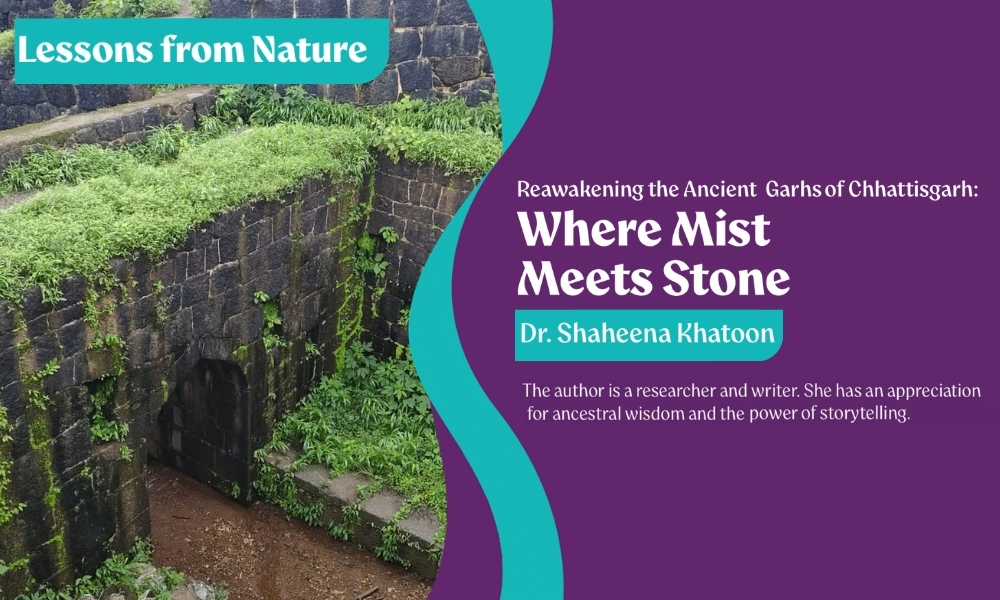
The author is a researcher and writer. She has an appreciation for ancestral wisdom and the
power of storytelling.
Chaiturgarh: The Invincible Fortress
Chaiturgarh Fort, also known as Lafagarh Fort, is an excellent example of how man and nature can work together. It is a majestic historical site situated in the Korba district of Chhattisgarh. Located at an altitude of 3,060 feet above sea level, Chaiturgarh Fort offers breathtaking views of the surrounding landscape. Today, it is a monument protected by the Archaeological Survey of India (ASI), attracting both historians and nature lovers.
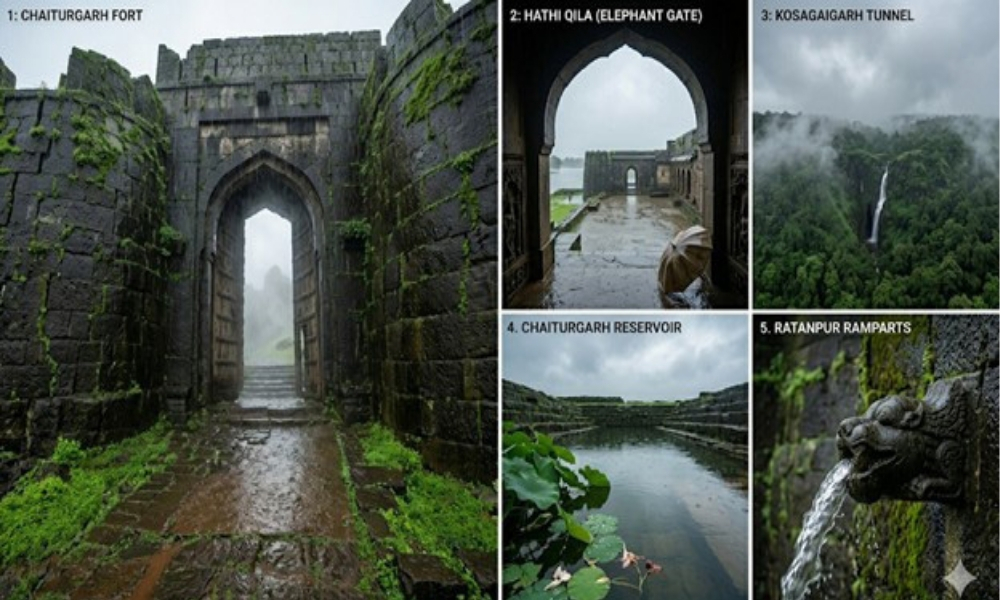
This ancient fort dates back to the 11th century and is believed to have been built by Raja Prithvideva I of the Kalachuri dynasty. Unlike conventional forts with massive constructed ramparts, Chaiturgarh uses its surrounding cliffs—with sheer drops of 200–300 feet on all sides—as a natural barrier. There are only a few narrow passes leading up to the plateau, making the site extremely defensible even without heavy fortification. During the rains, its vertical cliffs are engulfed in dense fog; upon ascending these cliffs, three monumental gates—namely Menaka, Humkara, and Simhadwar—emerge from the thick clouds.
The true genius of the fort lies in how it trapped water. Five ancient ponds sit on top of the plateau, beautifully integrated into the natural slopes. The Kalachuri engineers knew they couldn’t survive a prolonged siege without water. By carving these huge catchments straight into the mountain’s basalt core, they built a reliable rainwater harvesting system. Even today, the heavy rains fill these reservoirs to the brim, storing pristine water throughout the year. Watching the rains replenish these ancient eco-cisterns is a stark reminder of a time when survival relied on gracefully working with nature.
Ratanpur: The Water Fortress
While Chaiturgarh touched the clouds, Ratanpur was designed to harness the rivers. Located in the Bilaspur district of Chhattisgarh, it was once the capital of the Kalachuris. This fort functions as a Jaldurg—a water-fortress. In the dry season, the ruins of the Hathi Qila (Elephant Gate) and the royal Hamam (bath complex) sit among the local farmland. But when the monsoon hits, the entire landscape undergoes a massive transformation. The network of natural gorges and tank systems, like the historic Bikrampur Tank, fill to the brim, turning the entire capital into an island isolated by a defensive barrier of water.
Walking the damp, slippery stone ramparts in July, the atmosphere feels deeply narrative. The heavy gray skies and the rhythmic patter of rain on mossy basalt rocks bring old legends to life. Local folklore of the brave King Gopal Rai and the strategic manoeuvres of Queen Anandi Bai still echoes in the region. In the monsoon mist, it is clear that the Kalachuri architects turned seasonal floods into a military asset, letting nature itself stand guard over the empire.
Kosagaigarh: The Invisible Fortress
Hidden deep in the dense forest, about 25 km from the Korba-Katghora road on Futka Mountain, lies Kosagaigarh. Here, military architecture fully surrenders to nature. In contrast to the prominent peaks of Chaiturgarh, Kosagaigarh was designed to stay hidden. When the monsoon arrives, the surrounding Sal and Teak forests grow aggressively, creating an impenetrable green wall that completely hides the ancient fort from view.
The defining feature of this citadel is a strategic, natural stone tunnel that serves as its main entry point, wide enough for only one person at a time. During war the soldiers used to prevent the enemy by rolling down big stones from the fort. During the monsoon, this combat corridor undergoes a beautiful metamorphosis. The tunnel transforms into a natural conduit for cascading rainwater, acting as a rocky aqueduct for the mountain’s overflow. Walking through this rushing stone throat while water pours heavily from the overhead canopy is incredible –a powerful visual of nature reclaiming a space once built for war and turning it into a living path for the monsoon.
Conclusion: A Living Legacy
The “36 Garhs” of Chhattisgarh are not only dry archaeological sites or quiet winter ruins; they are dynamic monuments where history and nature merge seamlessly. The monsoon rains wash over these ancient stone structure revealing their true purpose. When the skies break, clouds drift through the magnificent gateways of Chaiturgarh, floods fortify the defenses of Ratanpur, and rains transform the secret tunnels of Kosagaigarh into rushing aqueducts. These structures remind us of the profound architectural genius of our ancestors. They remind us of an era when human ingenuity did not seek to conquer nature, but rather found its greatest strength by learning to gracefully flow alongside it.
DID YOU KNOW
Chhattisgarh still carries one of India’s highest forest covers — around 41% of the state, the third-highest share of any Indian state after Madhya Pradesh and Arunachal Pradesh.
Scheduled Tribes — Gond, Halba, Baiga, and others — make up roughly 30% of the state’s population today, among the highest shares in the country.
Despite all that forest, Chhattisgarh also holds India’s third-largest coal reserves — one of the few states that is simultaneously this green and this mineral-rich.
Just hit a decent win on the slots today! The interface is very user friendly and doesn’t lag. Love zs777slot
No more hassle with login issues. This link works perfectly every time I want to play my favorite games. Visit zs777login
Great variety of games and the customer support is actually helpful. Definitely my new go to spot. Try phzs777
ynmiyj
g78eir
h0ymko
w4wvdz
I’ve tried a few platforms lately, but this one really stands out. The interface is super smooth and the payouts are fast. Definitely my new go-to spot! Check out idmega303 for a great experience.
[5484]famousbet login ph | legit online slots sa Pilipinas,Gamitin ang famousbet login ph para sa legit online slots philippines. Mag-download APK na para sa pinakamabilis na gcash casino. Maglaro at manalo na! visit: famousbet