
I would like to share my experience and the lessons I learned in Mecca last year during my Arabic Summer School programme. I was excited about the trip, and I am sure everyone feels the same way when they are about to visit the Holy Land. As they say, visiting Mecca is by Allah’s invitation, and we are His guests.
Before the trip, I faced many personal challenges, from booking flights and arranging a visa to dealing with health issues. I was anxious about what else to expect once the journey began. Then, the words of Allah consoled my heart: “Once you make a decision, put your trust in Allah. Surely Allah loves those who trust in Him.” [3:159]
So, I put my trust in Allah and began my journey. I was excited about performing my Umrah; the thought of visiting Allah’s House filled me with immense joy, and I prayed for ease in my journey and for the opportunity to perform Umrah as soon as I arrived. I had many plans for my Umrah, but “Allah is the Best of Planners.”
Although I was excited, Allah tested me with something both common and challenging. I boarded my flight with the intention of performing Umrah and entered the state of ihram.
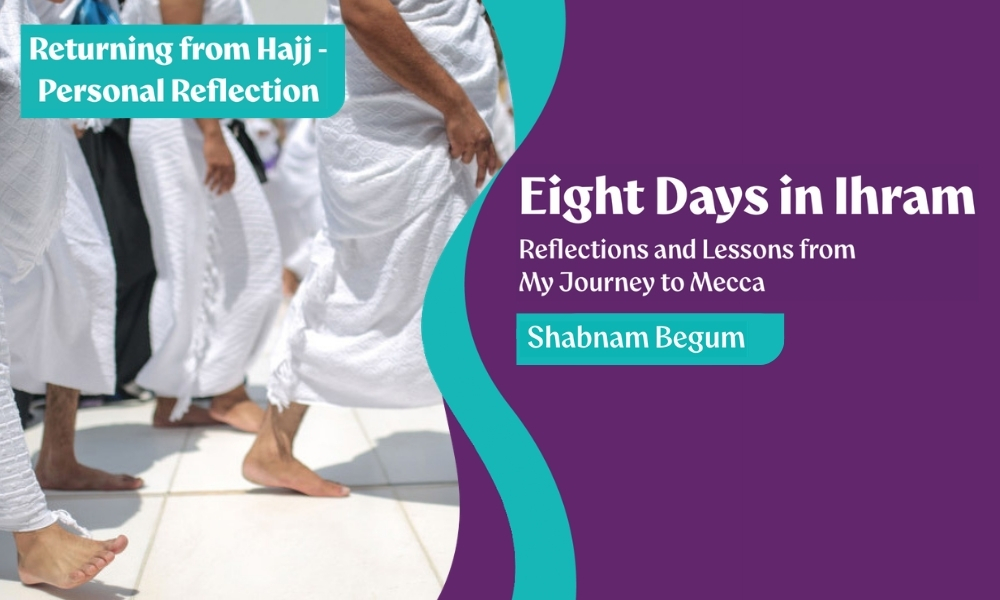
Before continuing, it is worth understanding the significance of ihram. Ihram is the sacred spiritual state that a Muslim enters before performing Hajj or Umrah. Derived from the Arabic root harama (to forbid or make sacred), it is a state in which certain lawful actions become prohibited, requiring the pilgrim to observe both outward restrictions and inward discipline. More than a set of rules, ihram is a reminder of humility, self-restraint, and complete submission to Allah.
However, my state of ihram was prolonged due to my menses, and I could not perform my Umrah immediately upon arriving in the Holy Land. I felt disappointed and saddened, especially after looking forward to this blessed journey for so long. But more than the sadness, it was the fear of maintaining the boundaries of ihram that made me anxious. We are all aware of our own souls and where we truly stand. I knew it would be easier to observe the external requirements of ihram, such as avoiding perfume and refraining from cutting my hair or nails. But what about the corruption hidden within my heart? How would I be able to control my inner self when it tempted me towards things that might displease Allah? How would I restrain my tongue from hurting others, control my anger, correct my behaviour, and avoid the lies, backbiting, and other sins that I had been accustomed to for much of my life? How could I discipline a soul that had held me captive for so many years, even for just seven or eight days?
From that day, I began to hold myself accountable for both my inner and outer actions. I spent those days reflecting on the true state of my soul, examining my speech and actions. I pondered whether the state of ihram is limited to the boundaries of the Haram alone. We enter the holy land, change our clothes and places, but do we truly change ourselves and what lies within us? As we come back, do we return with the same condition of our hearts as we had before entering the holy land, with nothing having changed and our hearts still rusted? Is the state of ihram merely about altering our external appearance and location, without transforming our hearts and souls?
Allah says in the Quran that He is closer to us than our jugular vein [50:16]. If the Haram is the house of Allah, then why do our hearts not become the true house of Allah when He is closer to us than our jugular vein? Why don’t we make our hearts a spiritual Mecca? Allah does not look at our faces and our wealth, but He looks at our hearts and deeds. So our hearts should be humbled and overwhelmed by the presence of Allah, and our internal state should reflect the ideal condition of ihram. Perhaps we are more mindful of our physical appearance and neglect the state of our hearts. As Prophet Muhammad ﷺ said:
Beware! There is a piece of flesh in the body. If it becomes good (reformed) the whole body becomes good but if it gets spoilt the whole body gets spoilt and that is the heart.
As my journey of self-control and self-discipline continued, the days passed, and finally, the day arrived when I was ready to perform my Umrah. The journey from my accommodation to the Haram became so challenging that my heart nearly cried out, “Why is this happening to me?”
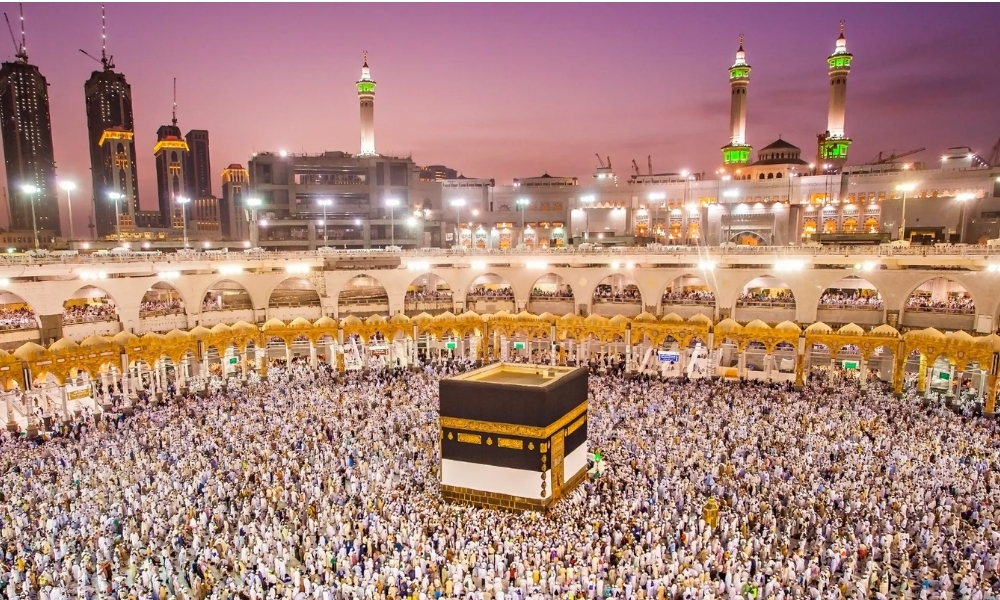
Finally, I arrived at Masjid al-Haram. It was raining, and as I approached the Mataf and my gaze fell upon the Ka‘bah, it was not my heart but my soul that cried. I had almost died for this moment, just to have one gaze at the Ka‘bah. I do not even remember the first du‘a I made upon seeing the Ka‘bah for the first time.
It was Thursday night, and the area was quite crowded. After performing Tahiyyatul Masjid and ‘Isha Salah, I began my Tawaf. I do not remember much beyond that moment. What I do recall is the rain, the pleasant weather, and that, despite the crowd, I felt as though I were alone with Allah.
Subhan Allah, I was reminded of Shaykh Akram’s words during our Arabic Summer School classes when a brother asked about achieving Khush’u in Salah. Shaykh Akram replied, “When you attend something, you are always absent from other things.” That’s what my Umrah experience felt like. While I was engaged in the gathering of pilgrims, I was absent from everything else on this planet. I was just grateful that Allah granted me the opportunity to enter His land once again.
The trip made me realise that despite our planning, intentions, efforts, and spending, everything is ultimately in Allah’s hands. Our plans can fail, our efforts can be fruitless, and the money we spend can seem wasted, all by His will. Nothing is in our control; we often become arrogant and self-sufficient when things go according to our plans, but true success is in Allah’s hands. At that time, I realised how weak and poor I am and that Allah alone is Al-Qawiyy (The All-Strong) and Al-Ghani (The Self-Sufficient).
Apart from the lesson that Allah taught me through the prolonged state of ihram, I also learnt profound lessons from Shaykh Akram and my other teachers. The humility of my teachers left me deeply inspired. From them, I learnt about perseverance, nobility, kindness, humility, and many other traits that define an ideal believer. They were constantly in the service of others, dedicating their days and nights to their duties with complete ikhlas (sincerity). Their example made me question, “Am I even a fraction of what my teachers are?”
I still cannot forget the most beneficial trip to the Museum of Revelation and the Maghsal (where dead bodies are washed and shrouded). The visit to the museum was a great reminder of the stories of the messengers and the story of Revelation. It highlighted the struggles of Prophet Muhammad ﷺ, his marriage to Khadijah RA, and everything else in the museum proved to be enlightening for us. The second visit to the Maghsal was a reminder of the reality of death. It reminded us that we all have to die one day and that we will completely rely on others in the future. We will be buried, but this burial will not only be of our bodies but also of our ego, arrogance, ill desires, disobedience, and more. After that visit, our hearts were filled with fear, and our eyes were full of tears.
The continuous reminders from Shaykh about Taqwa (God-consciousness), Sabr (patience) and Shukr (gratitude) were profoundly beneficial. While we read about the significance of these traits in the Quran, we often forget and need to be reminded. The entire trip felt like a training session for me, deeply impacting my heart and life in a significant way.
The first lesson that we learnt from Shaykh’s teachings was:
What is Taqwa
(God-consciousness)?
Although we often recite various verses in the Quran about Taqwa, it might be easy to pronounce on the tongue, but its meanings are deep and heavy on the heart and soul. Shaykh taught us that Taqwa comprises three key elements, and to become a Muttaqi (one who possesses Taqwa), these elements must be achieved:
1. i) Fear of Allah:
Fear of Allah is the health of the heart. It’s the belief and reality that Allah’s gaze is upon us even before our eyes fall on something inappropriate. Allah is aware of every ill desire and action we perform with our limbs or hearts. We should be aware that actions that are against Allah’s will cannot bring any blessing into our lives.
2. ii) Muraqabah:
Muraqabah means being aware that we are seeing Allah, for even though we cannot see Him, Allah sees us. We are always under the surveillance of Allah. Our actions are being recorded and presented to Him, so we should strive to behave accordingly. For example, how do we behave during Ramadan? Despite food being available, we control our hunger, thirst, and desires and wait for the prescribed time because we are mindful that Allah is watching us. The Quran was sent down to teach us Taqwa, and Ramadan came to train us in it. However, we must remember that Ramadan can come and go, but Allah is always present; He never leaves. Thus, we should strive to please Allah rather than merely please ourselves. The one who pleases Allah is ultimately fulfilling their own desires in the most meaningful way. We should learn to discipline ourselves through hardships and trust that if one door closes, Allah will open new ones for us.
3. iii). Obedience:
No disobedience to anyone can harm us as much as disobedience to Allah can. Since Allah sees us, and we have fear of Him, we must obey Him. If we fear Him but do not obey Him, it is a false fear. We should discipline ourselves and strive to fulfil what is truly pleasing to Allah. We receive two types of instructions:
A) Huda (guidance): This is external and divine, serving as guidance for us.
B) Hawa (desires): This is internal and comes from within ourselves.
If we follow hawa, we will falter. The One who created us knows best what kind of instructions will keep us on the right path, which is why He gave us Huda – the Quran. Since we have received this divine guidance, we should avoid falling back into old, misguided habits and instead live according to the commandments set forth by our Lord, starting a new life.
The second lesson we learnt from Shaykh’s classes was about Sabr (patience) and Shukr (gratefulness).
These are two key attributes of the Messenger of Allah ﷺ. He demonstrated Sabr during difficult times and Shukr during good times. We should strive to embody Sabr and Shukr in every situation. Life’s constant ups and downs can sometimes make us feel ungrateful, and during hardships, we might forget the blessings Allah has bestowed upon us. However, the ideal state for a believer is to maintain both Sabr and Shukr in every situation, believing that every situation is guided by Allah’s wisdom and holds some form of goodness. Even though we might not fully understand Allah’s wisdom, this is where our tawakkul (trust) in Allah truly lies.
Once we recognise Allah’s favours and His wisdom in both bestowing and withholding, we should always be grateful to Him. The constant repetition of “Alhamdulillah” can reveal hidden blessings and bring blessings into our lives. This is affirmed by Allah’s promise in the Quran:
If you are grateful, I will certainly give you more” [14:7].
The entire trip taught me sabr not only in the face of delay but also in our ibadah (worship). It taught me that everything has a destined time and cannot reach us before its appointed time. What we can do is make efforts and leave the outcome in Allah’s hands. I have also made shukr a habit in every moment of my life. Since adopting this habit, I have witnessed countless blessings come my way. Even when things return to their rightful Owner, I say “Alhamdulillah,” trusting that there is a hidden blessing and that Allah will compensate me with something better while rewarding my patience.
The most important lesson I learnt from Shaykh was about “Zuhd” — detachment from the dunya (worldly life).
One night, while returning from Masjid al-Haram to our accommodation, Shaykh reminded us that we don’t truly belong to this world; we are merely travellers here, and everything else is also travelling and will ultimately return to its Creator. As we got off the bus, Shaykh said to me, “This lesson was especially for you. I hope you understand it.”
It left me awe-inspired, as this has been my greatest challenge. I have often become easily attached to things, people, and even places. When I had these things, the period felt like the most beautiful and exciting time of my life. However, once Allah took them away, those same periods seemed to turn into the most difficult and dismal times, making everything around me seem bleak. I struggled to cope with the loss, and it often took me years to move on. I realised that I had been placing my hopes like a fragile vase on the edge, and when it fell, I was filled with sadness and complaints. In retrospect, I see that the real mistake was not in the loss itself but in leaving the vase of my hopes in such a precarious position and expecting it to remain intact. Similarly, I had entrusted my hope and heart to the dunya and then blamed the dunya for breaking it.
In a narration, Prophet Muhammad ﷺ said,
Be in this world as if you were a stranger or a traveller.
Therefore, we should place our hopes in the highest entity, who is the originator of everything, rather than in the things themselves. Our ultimate destination is Allah, though our paths and means to reach Him may be different. We should avoid becoming attached to everything that crosses our path. While we may use and own things in this world, we should ensure that nothing owns us. We should be like a ship travelling on the ocean – let’s make sure the ocean’s water doesn’t get into the ship and cause it to sink.
There is goodness in both Allah’s bestowing and withholding. Every blessing is a gift from Allah, and He is the true Owner of everything. While we may be temporary possessors of these gifts, it is important to remember that they can return to their rightful Owner at any time. The real test and our tawakkul (trust in Allah) are truly revealed when a blessing is taken away. Will we grieve over the loss, or will we respond with “Inna lillahi wa inna ilayhi raji’oon” (Indeed, we belong to Allah and to Him we shall return)? This response acknowledges that our loss will be compensated either in the same form or in a better one and that the reward for patience will be granted both in this world and the hereafter.
In conclusion, this journey was a significant spiritual transformation for me. I pray to Allah not only for a change in our outward appearance but also for the purification of our souls. May we embrace the ihram of taqwa, patience, gratitude, kindness, mercy, and nobility and detach ourselves from this dunya and worldly desires. May we fully submit to Him, who holds our souls. Ameen
1tlxa0