
The author is a Counselling Psychologist and writer.
Every year on May 8th, the global community unites to observe World Thalassemia Day, a pivotal moment dedicated to raising awareness about this inherited blood disorder. Thalassemia poses significant medical, emotional, and financial challenges for patients and their families.
Thalassemia is the most common inherited form of anaemia in the world. According to the World Health Organization, around 60,000 babies are born each year with severe thalassemia. Although it is more common in people from tropical regions, it is now a global health issue due to migration across countries.
Even though modern treatments like stem cell transplants and gene therapy show promise, the main methods of managing thalassemia are still regular blood transfusions and medicines that remove excess iron from the body.
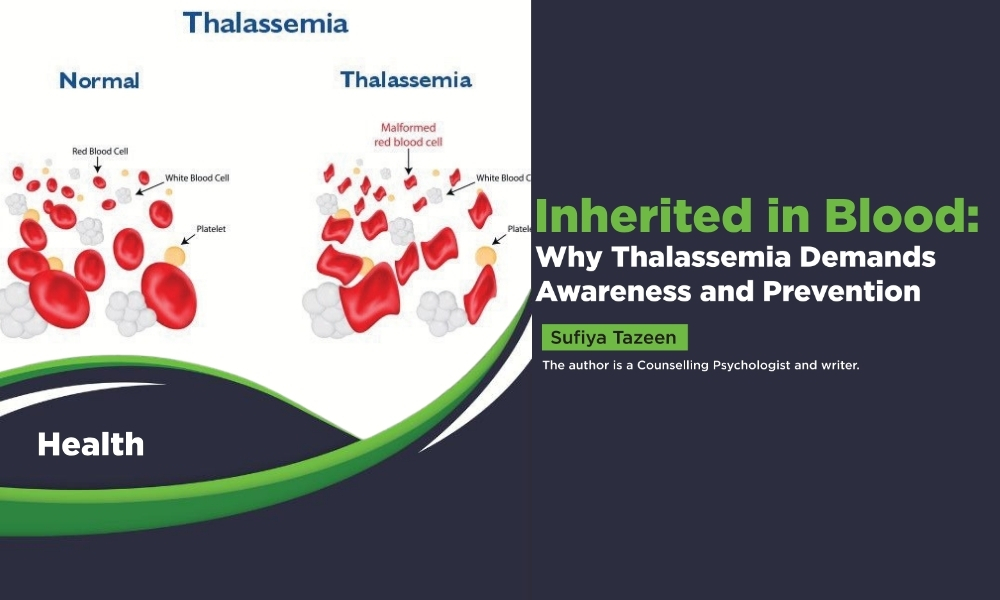
This condition happens because the body cannot properly produce parts of haemoglobin, the protein in red blood cells that carries oxygen. Depending on which part is affected, it is classified as alpha-thalassemia or beta-thalassemia.
Thalassemia was first identified in 1925 in both the United States and Italy. Doctors recognised both a severe form (now called thalassemia major) and a milder form (thalassemia intermedia). Later, a third form, thalassemia minor, was identified, which usually causes mild anaemia and occurs when a person carries only one defective gene.
Over time, scientists discovered that thalassemia is caused by inherited defects in haemoglobin production and is one of the most common single-gene disorders in humans. While it was once mainly associated with the Mediterranean region, it is now widespread across Africa, the Middle East, Southeast Asia, and the Western Pacific.
How is Thalassemia Inherited?
Thalassemia follows an autosomal recessive inheritance pattern, meaning a child must inherit defective genes from both parents to develop the severe form of the disease.
If both parents are carriers (thalassemia minor):
- 25% chance the child will have thalassemia major
- 50% chance the child will be a carrier
- 25% chance the child will be unaffected
Carriers themselves are usually healthy and may not even know they carry the gene. This silent transmission is what makes thalassemia particularly dangerous from a public health perspective—without testing, it can pass unnoticed across generations.
Why Awareness is Crucial
Despite its prevalence, public understanding of thalassemia remains limited. Studies show that while many people may have heard of the condition, only a small percentage truly understand that it is genetic or preventable.
This gap in knowledge has serious consequences:
- Both couples may unknowingly be carriers
- Screening opportunities are missed
- Preventive healthcare decisions are delayed
- Stigma and misconceptions persist
Globally, thalassemia continues to affect tens of thousands of newborns each year, even though effective prevention strategies already exist. Awareness is not just about information, it is about empowering individuals to make informed reproductive and healthcare choices.
Prevention: A Public Health Priority
Unlike many genetic disorders, thalassemia is largely preventable through well-established public health strategies. Countries that have implemented structured prevention programs have significantly reduced new cases.
Key prevention approaches include:
- Carrier Screening
Testing individuals especially before marriage or pregnancy helps identify carriers. This is one of the most effective ways to prevent the birth of affected children.
- Genetic Counseling
Couples identified as carriers can receive guidance on reproductive options, helping them understand risks and make informed decisions.
- Prenatal Diagnosis
Medical testing during pregnancy can detect whether a fetus has thalassemia, allowing families to prepare or consider options.
- Public Education Campaigns
Awareness programs play a central role in encouraging testing and reducing stigma.
Public health authorities, including the World Health Organization, emphasize that awareness, screening, and counseling must work together to reduce disease burden.
Testing: The Bridge Between Knowledge and Action
Testing is the practical link between awareness and prevention. Yet, in many regions, screening remains underutilized due to social, economic, and cultural barriers.
Challenges include:
- Lack of access to affordable testing
- Limited healthcare infrastructure
- Cultural hesitation around genetic testing
- Misconceptions about hereditary diseases
Making screening routine especially premarital or antenatal screening can dramatically lower the number of severe cases.
The Social Realities of Living with Thalassemia
Beyond biology, thalassemia deeply affects everyday life. Patients with severe forms often require:
- Regular blood transfusions (sometimes every few weeks)
- Lifelong medication to manage iron overload
- Continuous medical monitoring
The burden extends beyond the individual:
- Emotional and Psychological Impact
Living with a chronic condition can lead to anxiety, stress, and social isolation, especially among children and adolescents.
- Financial Strain
Long-term treatment is expensive, placing significant pressure on families, particularly in low- and middle-income countries.
- Social Stigma
In some communities, genetic disorders are misunderstood, leading to discrimination or reluctance to discuss carrier status.
- Family Burden
Caregivers often face physical and emotional burnout, along with economic challenges while supporting affected individuals.
Despite medical advancements, quality of life is still heavily influenced by access to care and social support systems.
Thalassemia and Public Health: The Bigger Picture
Thalassemia illustrates a crucial truth in public health: prevention is often more effective and more humane than treatment alone.
With millions of carriers worldwide and significant numbers in countries like India, the disease places a sustained burden on healthcare systems. Early intervention strategies not only reduce suffering but also conserve medical resources.
Effective public health responses must include:
- National screening programs
- School and community education
- Integration of genetic counseling into primary healthcare
- Policies that ensure equitable access to treatment
Conclusion
Thalassemia sits at the intersection of genetics, healthcare, and society. It is a condition written in our DNA but its impact is shaped by awareness, education, and public health action.
Understanding how thalassemia is inherited empowers individuals. Expanding access to testing enables prevention. And building awareness transforms communities.
Ultimately, reducing the burden of thalassemia is not just a medical goal, it is a collective responsibility.
How is Thalassemia Inherited?
Thalassemia follows an autosomal recessive inheritance pattern, meaning a child must inherit defective genes from both parents to develop the severe form of the disease.
If both parents are carriers (thalassemia minor):
25% chance the child will have thalassemia major
50% chance the child will be a carrier
25% chance the child will be unaffected
The most professional betting site I have come across. Everything is transparent and the payouts are prompt. Trust maxbetonline for your gaming needs.
The payouts are fair and the games are top notch. I have told all my friends to join pkpion777