
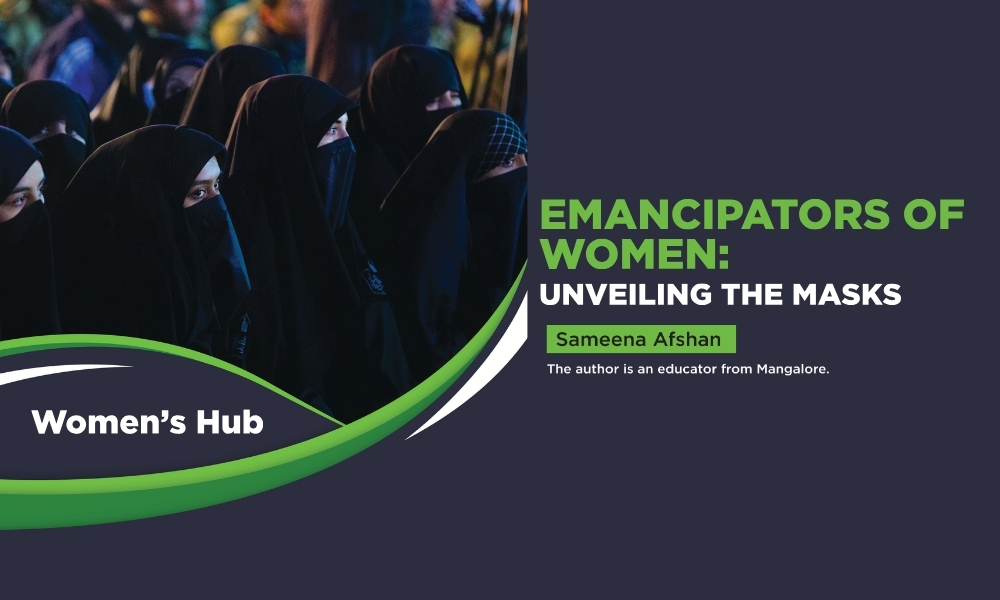
The author is an educator from Mangalore.
In an age that proudly declares itself progressive, words like empowerment and emancipation of women dominate public discourse. It is printed on campaigns, echoed in speeches, and embedded in the language of modern identity. Women today are told they are freer, stronger, and more independent. But beneath this confident narrative lies an uncomfortable question: Are women truly liberated, or are they navigating a new, more sophisticated form of control?
We know that Women today have more visibility, more opportunities and more choices than ever before. However, it is a fact that many women feel more pressured, more judged, and more exhausted than ever before. We are told women are liberated, yet they are constantly evaluated, more alone than ever before.
The loudest self-proclaimed emancipators of women often wear the most convincing masks. They replace one cage with another, urging women to conform not to tradition but to market-driven ideals that commodify their bodies, time and identity. They tell women that freedom lies in imitation, dignity lies in defiance, and success lies in detachment from responsibility, relationships, and values.
Many so-called masked emancipators present a version of freedom that reduces a woman to her external choices – what she wears, how she appears, how loudly she rejects tradition. They celebrate rebellion, but rarely speak of consequences. They glorify independence, but ignore isolation. They promise strength, but often leave women unsupported in their most vulnerable moments.
Let us unveil some of these masks:
The Illusion of Choice
At the heart of modern empowerment lies the idea of choice. We are told that women can choose their paths, define their identities, and shape their futures. Yet a closer look reveals a contradiction. Not all choices are equally respected. A woman who rises in a corporate hierarchy is celebrated as empowered. But a woman who chooses to prioritise family, caregiving, or a quieter life is often viewed as lacking ambition. A woman who conforms to visible expressions of confidence is applauded, while one who embraces modesty or tradition may be subtly dismissed. This kind of freedom validates only selective choices. It is not the absence of control. It is the redefinition of control.
The mask worn by capitalism – commodification of confidence
One of the most pervasive masks of modern emancipation is the transformation of the female body into a site of ‘empowerment’. The language has changed from objectification to ‘self-expression’ and from scrutiny to ‘confidence’. Yet the underlying mechanism remains very familiar. Women are still being watched, evaluated and measured.
It is said that confidence means being visible, being bold, and being expressive. But increasingly, a woman’s worth is still tied to how she looks, how she presents herself, and how she is perceived. Hence, it should be understood that women are not being freed from objectification, but instead are being encouraged to participate in it in new ways.
In fact, if objectification is a stage, capitalism is the director behind the scenes. It has worn the mask of aspiration, but behind the mask, it profits from insecurity. Capitalism first creates a standard, then makes it unattainable, then sells the solution and profits from it.
For women, this cycle is relentless. It sounds like this: be confident – but only if you look a certain way, be empowered – but only if you fit a certain image, be yourself – but only after improvement, enhancement and correction. From beauty industries to wellness trends, from fashion to digital platforms, entire economies thrive on a single, repeating message: “You are not enough – but you can be, if you buy this.”
The Burden of “Having It All” Masked as Superwoman
Another defining feature of contemporary empowerment is the expectation that women can and should “have it all.” A successful career, a well-managed home, raise perfectly nurtured children, be emotionally strong, have an ideal physical presence, possess unwavering resilience, etc. At first glance, this appears aspirational. In reality, it often becomes exhausting.
What is rarely discussed is the absence of structural support, the lack of shared responsibility and the quiet normalisation of burnout. The modern empowered woman is not liberated; in fact, she is overburdened.
The Silent Devaluation of Care
Perhaps the most subtle shift has been the quiet erosion of respect for caregiving roles. Motherhood, homemaking, and emotional labour, once recognised as foundational to society, are increasingly framed as secondary, or even regressive.
But this raises a critical question: Why is a woman celebrated for breaking ceilings, but not for building homes? A society that undermines caregiving does not advance; it destabilises its own foundation. True empowerment does not diminish these roles. It restores their dignity.
Isolation masked as Independence.
Independence is one of the most celebrated ideals of modern emancipation. Financial and personal autonomy are essential factors for a human being. But when independence is redefined as not needing anyone, a dangerous shift occurs. Support systems weaken, community bonds erode, and interdependence, which is a natural human tendency, is replaced by isolation.
As a result, a generation of women is expected to carry every burden alone, emotionally, financially, and socially, while still being brainwashed that they are “empowered.” Independence without support is not freedom but abandonment and isolation in disguise.
Seeking Validation Masked as The Performance of Empowerment
In today’s digital age, empowerment is no longer just lived — it is performed. Social media has created a validation economy where visibility often substitutes for value. Women are encouraged to present curated versions of themselves, constantly seeking approval through engagement metrics. As a result, confidence becomes content, identity becomes performance, and worth becomes external. In this environment, empowerment is no longer internal. It is, in fact, measured, displayed, and consumed.
An Older Wisdom We Are Forgetting
Across civilisations, faiths, and traditions, one principle has remained remarkably consistent: the dignity of women is central to the moral health of society. The value of a civilisation is not measured by how loudly it speaks of empowerment, but by how deeply it respects, protects, and supports women in all their roles.
Reclaiming the Meaning of Emancipation
To question modern narratives is not to reject progress. It is to refine it. True emancipation must move beyond slogans and surface-level definitions. It must be inclusive of all choices, not selectively approving. It must be respectful of all roles, not hierarchically valuing them. It must be supportive in structure, not merely symbolic in language, and it must be protective of dignity, not exploitative in practice. Above all, it must allow women to live integrated lives where identity, faith, ambition, relationships, and purpose coexist without conflict.
Perhaps the most dangerous illusion of our time is when women believe they are completely free, while unknowingly adapting to a new set of expectations they never consciously chose. True emancipation is not loud. It is secure, grounded and not reactive. It is about having the wisdom to choose, the strength to stand, and the freedom to define one’s own path, without coercion, shame, and manipulation.
Real emancipation should look like this:
– A woman who is educated, not just literate and is aware of her rights, her responsibilities, and her worth.
– A woman who has the freedom to choose her role, whether in a boardroom, a classroom, or within her home, without being judged as “less than.”
– A woman who is protected, not exploited, where her dignity is not commodified in the name of freedom.
– A woman who is supported by her family and society, not forced to struggle alone under the burden of unrealistic expectations.
– A woman whose voice matters, but whose identity is not reduced to constant opposition.
It should also be remembered that empowerment should not create conflict between men and women. It should create balance, respect, and partnership. A society progresses not when one rises against the other, but when both rise together with mutual understanding.
Conclusion
Women do not need empowerment that comes with conditions. Neither do they need freedom that demands conformity nor narratives that replace one pressure with another. What they need is far simpler and far more powerful. They need respect without qualification, choice without judgment and dignity without negotiation. Because emancipation is not about becoming someone new, it is about being able to remain fully, authentically oneself, without pressure, without performance, and without fear. And most importantly, it does not ask women to lose themselves to prove their worth.
We must therefore be cautious. Not every voice that claims to speak for women truly represents them. Not every movement that promises freedom actually delivers it. Some masks are convincing. But it is our responsibility to look beyond the mask. We must reclaim the narrative and define empowerment in a way that is holistic, dignified, and rooted in reality, not trends. Because a truly emancipated woman does not follow a script written by others, but she is one who writes her own story, with clarity, conviction, and courage.
0 Comments