
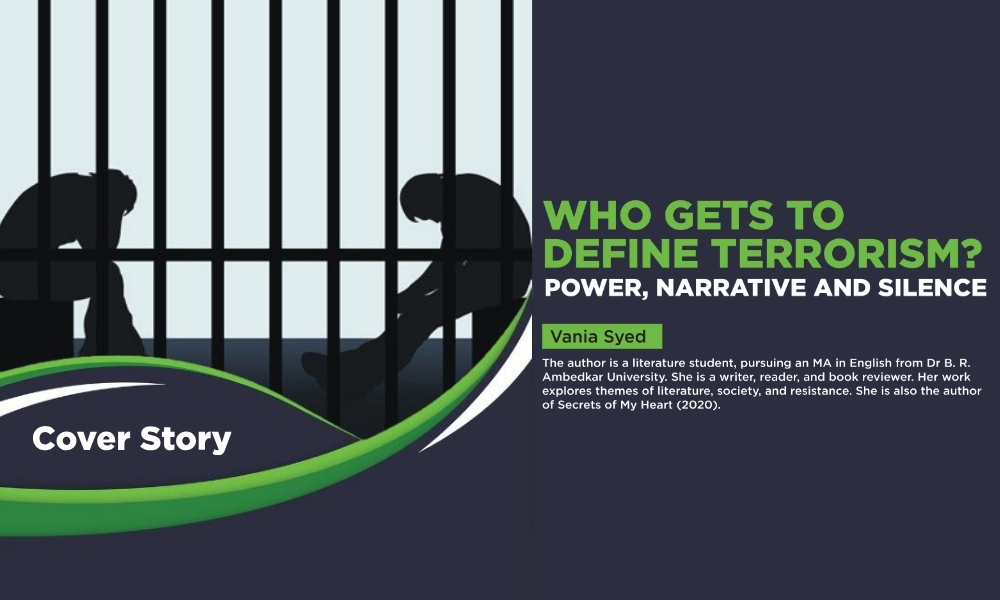
The author is a literature student, pursuing an MA in English from Dr B. R. Ambedkar University. She is a writer, reader, and book reviewer. Her work explores themes of literature, society, and resistance. She is also the author of Secrets of My Heart (2020).
Terrorism is often treated as a fixed category, a label that immediately evokes moral clarity. It is assumed to describe a particular kind of violence, one that is irrational, extreme, and unjustifiable. However, this clarity begins to unravel as soon as we ask the question, “Who defines terrorism?” The term itself is far from neutral. It is shaped by political interests, institutional powers, and ideological agendas. Rather than simply describing violence objectively, it often reflects the perspective of those who hold authority.
There is no universally accepted definition of terrorism. What exists instead are multiple and conflicting interpretations, many of which are produced and circulated by the state. In this case, violence carried out by selected people is termed “terrorism”, while violence enacted by the state itself is labelled as “security” or “law and order”. This selective labelling exposes that terrorism is not just about the act itself, but about who is allowed to name it. It is a process where similar acts are judged differently based on the identity and position of the individual.
Media Narratives and Construction of Threat
Media does not only report violence; it shapes how violence is understood. Through language and repetition, it constructs a hierarchy of legitimacy. Words like “terrorists”, “anti-national”, and “militant” are not used randomly; they carry political weight. Certain groups are immediately framed as threats, while others are granted nuance or even justification. The constant circulation of these narratives by the media creates an understanding of who is dangerous and who is not.
Media visibility is highly selective. Some stories are amplified, repeated, and emotionally framed to demand public outrage, while others are minimised or ignored. This selective attention does not only inform audiences; it disciplines them into feeling empathy in particular directions, determining whose suffering is recognised as tragedy and whose is dismissed. Louis Althusser’s Ideological State Apparatus comes into play here, as he puts media as one of the ways through which dominant power controls people. It inculcates such an ideology, making us believe that we are freely choosing what is being imposed on us. He coined the term “interpellation” for the way an individual is forced to see themselves as a being free and independent of social forces, which is not truly the case.
The Making of a Stereotype
One of the most persistent and damaging outcomes of these narratives is the deep association between Islam and terrorism. Over time, media and political discourse have repeatedly framed Muslim identity through the lens of suspicion, danger, and extremism. This association does not emerge accidentally; it is carefully produced through selective reporting, visual imagery, and the constant linking of Muslim names, bodies, and spaces with violence. A telling example of this can be seen in the aftermath of global terror incidents, where the identity of the perpetrator becomes central only when they are Muslim. Religion is foregrounded, scrutinised, and held collectively accountable. In contrast, when similar acts of violence are carried out by a non-Muslim, they are described in individual terms, such as their mental health, personal reasons, and isolation, rather than as reflections of a larger community or belief system. Terrorism is thus selectively constructed.
As a result, Muslims are not just represented as individuals who may commit acts of violence; they are perceived as common practitioners of it. This generalisation collapses the distinction between identity and action, turning an entire community into a site of potential threat. The consequences of this are far-reaching, from everyday discrimination and surveillance to the normalisation of state violence against Muslim populations and hate-mongering from those who accept this description. In such a context, the label of “terrorism” becomes easier to assign and harder to challenge because it is already supported by deeply rooted cultural bias and dominant discourses.
Kashmir, Palestine and the Politics of Labelling
The consequences of these narratives become painfully visible when we look at lived realities. In Kashmir, for instance, the label of “terrorist” is imposed on individuals who are asserting their claims to dignity, land, and self-determination. The complexity of their political struggle is easily reduced to a single narrative of threat and violence. This reduction not only delegitimises their demands but also justifies the systemic violence inflicted upon them. Ather Zia, a Kashmiri author, anthropologist, and social activist, writes in her book Resisting Disappearance: Military Occupation and Women’s Activism in Kashmir, how Kashmiris are treated as “others”, as those who do not belong. Kashmiris who have been resisting the occupation are labelled as “terrorists”. She writes:
“The Kashmiri body, in the Indian perception, is cast primarily as the Other—a Muslim and, by extension, even a Pakistani or a traitor body. The body with ‘certain otherness’, which can harm the nation, makes it possible for the government to carry out extrajudicial abuses” (Zia 53).
Once a population is framed through the lens of terrorism, their grievances are no longer heard; they are instead controlled and suppressed. The same goes for Palestine. In dominant media and political discourse, Palestinian resistance is presented through the vocabulary of terror, while state violence is framed as security or self-defence. The everyday realities of Palestinian life, such as restricted movement, loss of homes and property, loss of lives, and displacement, rarely receive the same attention as moments of spectacular violence. When they do, they are mostly detached from the political framework that produces them. In such cases, the label of “terrorism” operates not only as a description but as a tool of erasure.
Criminalising Dissent: The Case of Political Prisoners
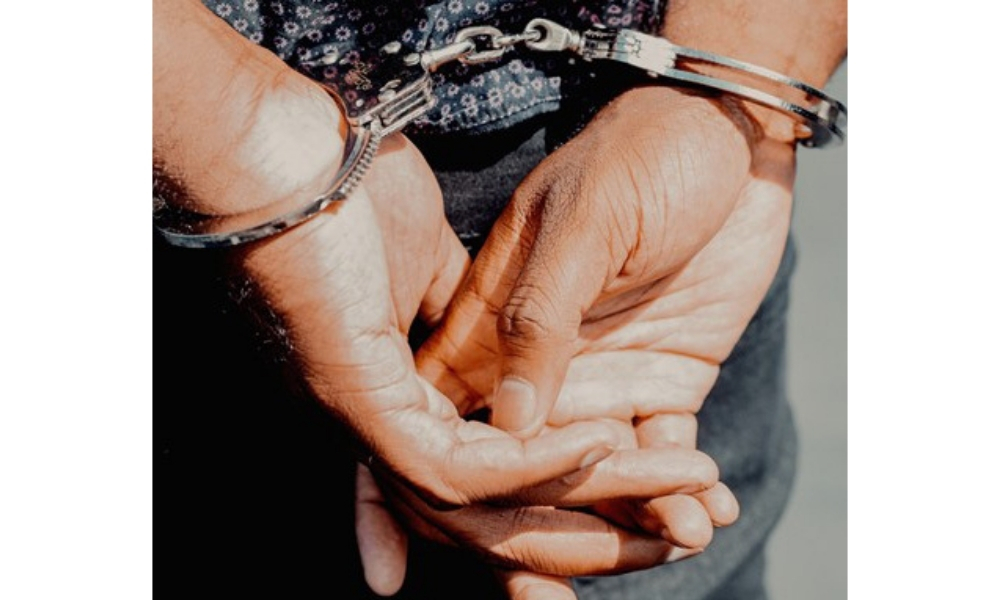
A similar pattern emerges in the treatment of political dissenters, where the language of terrorism is extended beyond acts of violence to encompass speech, protests, and ideological opposition. Thus, the label of “terrorism” is not used to describe an act, but to redefine dissent as a form of threat. The cases of Umar Khalid and Sharjeel Imam illustrate how this process unfolds. Both have been associated with anti-government protests and political speech, advocating for human rights and standing up against draconian laws like the CAA-NRC. Yet, through legal frameworks and media narratives, they have been placed within the discourse of terrorism and even labelled as “anti-national”. This becomes significant as it transforms political disagreement into a matter of national security. Once dissent is framed in this way, it no longer leaves room for debate or engagement; it calls for control and punishment.
By repeatedly associating dissenting voices with terms like “anti-national”, media constructs a public perception of danger. This not only shapes how the individuals are viewed but also influences the broader public imagination, making it easier to accept their continued incarceration as justified. The consequences extend beyond the individual dissenters. When dissent is criminalised, it sends a message that discourages criticism and narrows the space for democratic expression. The fear is not only of legal action but also of social and political isolation. The labelling of political prisoners as “terrorists” serves a dual role: it silences specific voices while warning others against speaking.
This process becomes a way through which democracy and the ideas of equality, liberty, and fraternity are hollowed out from within, and the ruling elite does not even shy away from suggesting that we no longer need this façade. What is impressive to see today is that despite the crackdown on progressive voices, people still come forward to take a stand against oppressive acts, including Muslim students and activists. The first wave of protests against the CAA-NRC came from young Muslim students from universities like Jamia and AMU. Even Muslim women came forward from different backgrounds—working professionals, homemakers, young and old alike. This remarkable shift has shaken dominant authority, as they previously perceived Muslims as weak, uneducated, and unaware.
The Human Cost of Violence
Violence, in all its forms, extends far beyond the moments of occurrence. It reshapes lives, communities, futures, and sometimes even generations to come. Civilian populations often bear the brunt of both state and non-state violence, facing displacement, loss, and deep psychological trauma. Families are torn apart, everyday life is disrupted, and instability becomes a permanent condition. Yet, not all suffering is recognised equally. Some lives are publicly mourned, their stories told with depth and empathy. Others are reduced to numbers; their deaths do not even get acknowledged. This suggests that violence determines not just who lives or who dies, but whose pain is considered worthy of attention.
Trauma does not end when the event is over; it lingers in memory, shaping how individuals relate to their surroundings and to one another. The constant presence of surveillance, militarisation, and threat produces a state of psychological strain, where ordinary acts like communication and movement are marked by anxiety. Children growing up in such environments inherit these conditions in profound ways. Education, play, and development are disrupted, creating long-term consequences that extend across generations. Violence, in this sense, is not an isolated event, but a continuing process that reproduces itself through lived experiences.
Whose Voices are Heard and Whose are Silenced?
The amplification of voices is rarely neutral. Political leaders, state institutions, and mainstream media dominate the discourse on terrorism. Their perspectives are presented as authoritative, rational, and necessary. The authority of these voices ensures that their version of events circulates widely, becoming the only version that is heard. In contrast, the voices of those directly affected by violence, such as civilians, families, and grassroots activists, are often absent or marginalised. When these voices do appear, they are filtered through frameworks that strip them of agency. This creates a hierarchy of visibility, where some narratives are elevated and others are pushed into silence. The result is a distorted understanding of violence, one that privileges power over lived experience.
The issue is not only that certain voices are absent, but that they are actively replaced by narratives that speak on their behalf, distorting their realities in the process. When certain perspectives are persistently amplified and others are systematically suppressed, our understanding of terrorism or violence becomes incomplete and uneven. The question, therefore, is not only about inclusion, but about justice—about creating conditions where those most affected by violence are allowed to speak, are heard, and are recognised on their own terms. To ask whose voices are heard and whose are silenced is to confront the deeper politics of narrative itself. It is to recognise that silence is not natural; it is produced. And until that silence is challenged, the discourse on terrorism will continue to reflect not truth, but power.
Conclusion: Rethinking the Language of Terrorism
To engage critically with the idea of terrorism is not simply to debate definitions. It is to question the structures that produce those definitions and the narratives that sustain them. It requires us to look beyond official accounts and listen to voices that are often pushed to the margins. Most importantly, it demands that we confront the uncomfortable possibility that the language of terrorism does not just describe violence—it participates in it, by legitimising some forms while erasing others. One of the most significant sites to question the notion of “terrorism” is universities.
Universities are social and intellectual institutions, different from the rest. As Romila Thapar asserts, even people in positions of authority and power, those who control institutions, do not understand what education at the university level means. It is only in a university that one has the liberty to think freely, speak freely, and engage freely. She goes on to say that this freedom is important for the construction of creative men and women, who go on to challenge structures of power. Universities hold the potential to nurture critical inquiry and political consciousness. It is within these spaces that dominant narratives can be interrogated and alternative perspectives can emerge. Students and scholars are able to examine how language operates, how power shapes meaning, and how certain ideas come to be accepted as truth.
Until we begin to question who gets to define terror, and whose suffering is allowed to matter, the narrative itself will remain a site of injustice.
Louis Althusser’s Ideological State Apparatus comes into play here, as he puts media as one of the ways through which dominant power controls people. It inculcates such an ideology, making us believe that we are freely choosing what is being imposed on us.
Login is always fast and secure. I don’t have to worry about my account getting locked out. jiliflogin makes the whole process stress free.
The app experience is just top notch. It is so much more convenient than using a browser. Definitely download okadaplayapp if you want to play on the go.
[401]Deskgame Casino: Login, Slots APK & App Download | Free Bonus,Join Deskgame Casino, the #1 betting site in the Philippines! Login to play slots, download the APK or app, and claim your free bonus. Start winning today at Deskgame. visit: deskgame
Love the variety of slots available. It feels very fair and the customer support is actually helpful. Give pkxs777 a try!