
The author is a freelance writer with a background in content writing. After writing in niches like tech, finance and digital marketing, she has now pivoted towards social and political issues.
Artificial intelligence has successfully transitioned from a tech experiment to a core business utility with an estimated 78% of companies having integrated it into one or more of their business functions. India has the highest rate of AI adoption(around 59% of companies). The global AI market is expected to reach $1.85 trillion by the year 2030. The global market for Enterprise-Grade Large Language Models was worth $5.6 billion in 2024 and is expected to grow by 36.9% per year from 2025 to 2030. Leading tech giants like Meta, Google,Microsoft and Amazon are investing heavily in it. Global investment bank, Goldman Sachs expects a combined $5.3 trillion of capital expenditure between 2025 and 2030 for the four largest hyperscalers – Microsoft, Meta, Amazon and Alphabet.
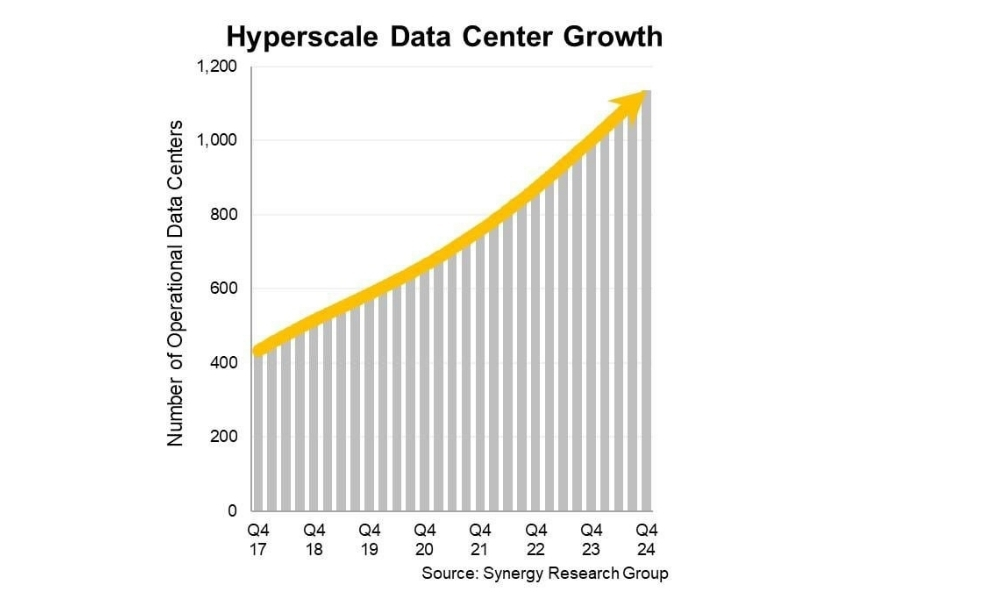
The competition among tech giants to produce cutting-edge artificial intelligence models has propelled the growth of AI data centers. It is the driving force behind a massive infrastructure boom. An AI data center is a specialized facility built to store, process and train massive artificial intelligence models. Unlike traditional data centers that focus on general purpose cloud computing like hosting web services, running business software and storing files using CPUs, AI data centres are built to train and run large scale AI models. They require specialized chips like GPUs(Graphics Processing Unit) and TPUs(Tensor Processing Unit. Artificial intelligence tools trained with large language models such as ChatGPT use exponentially more computing power as compared to traditional cloud services. To handle extreme workloads they require massive power capacity and liquid cooling. The growth of AI data centers has simultaneously created demand for land, water and electricity needed to power these centers.
According to Goldman Sachs, demand in the global data center market is expected to grow substantially in the next half decade or so. The expected current demand is 62 gigawatts (GW), which comprises cloud workloads (58%), traditional workloads (29%), and AI workloads (13%). AI is expected to grow to 28% of the overall market share while cloud falls to 50% and traditional workloads drop to 21%. Global power demand from data centers is expected to grow 165% by 2030(from 2023 levels). It is estimated that 40% of the power demand from data centers will be met by renewable energy followed by a modest share of nuclear energy. However, the bulk of the remaining 60% is expected to be powered by natural gas which will increase global carbon emissions by 215-220 million tonnes through 2030 which equates to 0.6% of global energy emissions.
AI data centers require constant supply of large volumes of water to prevent powerful servers from overheating. An operational data center functions round the clock, generating considerable heat, requiring their hardware to be cooled in order to maintain optimum performance and longevity. Data centers employ a variety of approaches to cool their hardware, nearly all of them require heavy water consumption. Additionally, data centers consume water indirectly through electricity usage. Energy, be it coal, natural gas or nuclear uses water in steam generators to convert heat energy into electric energy.
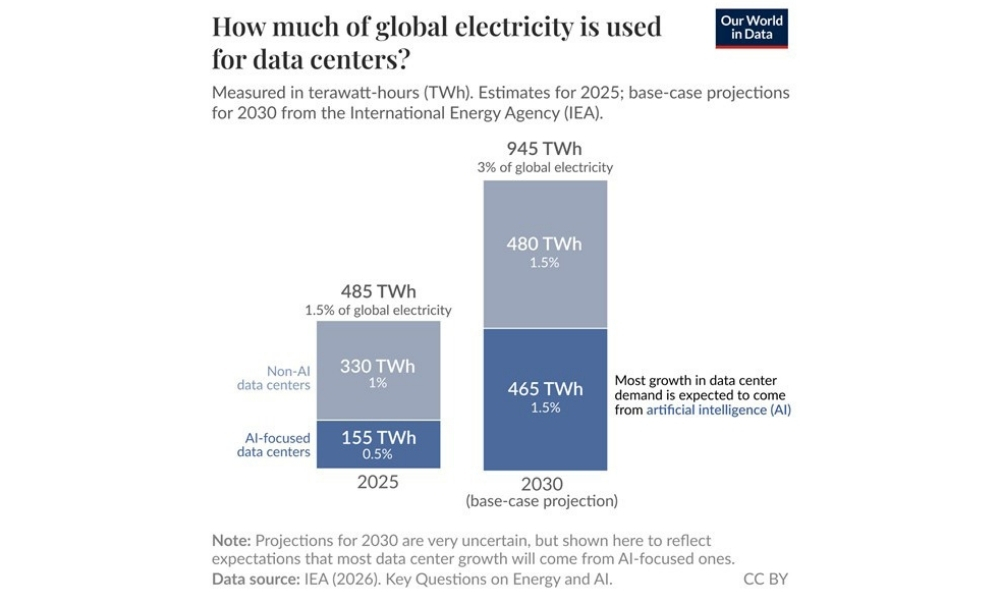
While a mid-sized AI data center consumes as much water as 27,000 urban Indian homes, a single 100 MW hyperscale facility can consume up to 2 million litres of water daily for evaporative cooling. A new AI-focused hyperscale data center can draw as much energy as 100,000 Indian homes. A report by the United Nations University Institute for Water, Environment and Health (UNU-INWEH) warns that AI data centres will consume water equal to the needs of 1.3 billion people by 2030. According to a report by Time magazine, the global data centers powering AI are expected to consume 945 terawatt-hours (TWh) of electricity which is nearly triple the combined annual electricity consumption of Pakistan, Bangladesh and Nigeria.
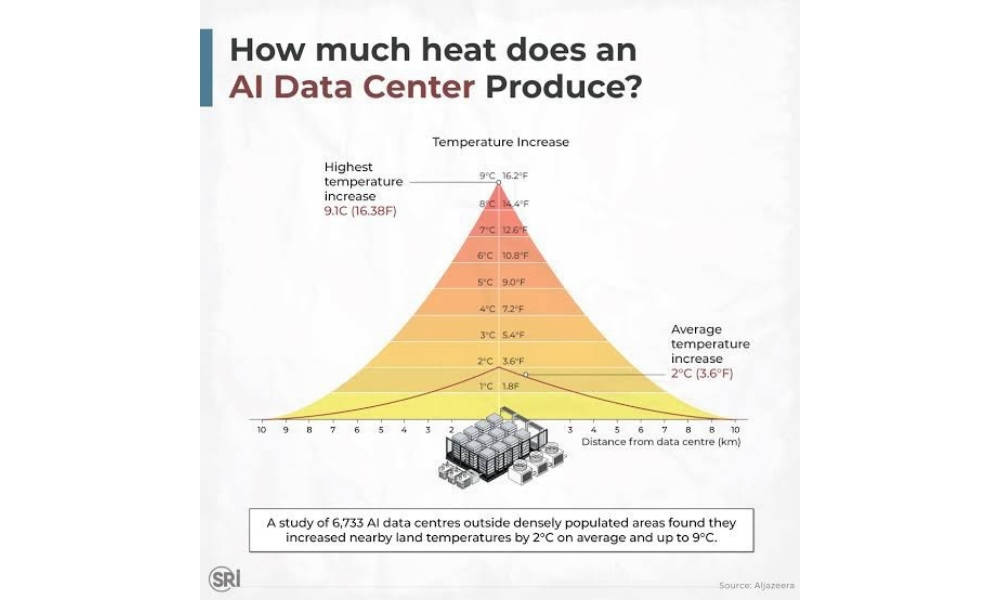
Some of the largest AI data centers being built today will cover hundreds of acres of land- land that will no longer be available for farming, housing or any other purpose. It will also require new transmission line corridors and related infrastructure. As per a yet-to-be-peer-reviewed study by Andrea Marinoni, associate professor with the Earth Observation Group at the University of Cambridge, these data centers create a “data heat island effect.” Once they start operations, land surface temperatures around data centers rise by 3.6 degree Fahrenheit on an average. In extreme cases, nearby temperatures increase by up to 16.4 degree Fahrenheit. This rise in temperature can affect areas up to 6.2 miles away, thereby affecting the health, energy demand and overall wellbeing of more than 340 million people.
The rapid expansion of AI data centers can put an enormous strain on local and regional resources – burdens that many of the host communities are simply not prepared for. Let’s take an example of Northern Virginia which has the highest concentration of more than 300 data centers spread across four counties. Nearly two thirds of the world’s internet traffic passes through Northern Virginia. Many more facilities are planned or are in development in the region ready to take up the available farmland, water and electricity and emboldened by incentives that save companies $130 million in sales.
Data centers employ a two level approach to maintain optimal temperatures and prevent damage to chips. At the server level, there are two types of methods:
- Air cooling: Air cooling is an open loop and water intensive cooling system which uses fans and air conditioning to move hot air out and cool air in.
- Liquid cooling: A closed-loop cooling system where the cooling liquid is sent directly over processing chips where it absorbs heat, after which it is cooled and recirculated.
At the building level again there are two approaches:
- Air based: Uses fans and air-conditioning to reject heat to the outside environment.
- Evaporative cooling: Uses fans and water that is converted to vapor and is released to the outside.
While heavy electricity and water consumption by AI data centers has received ample attention, a less talked about aspect is electronic waste generated by these facilities. Data centers require frequent hardware upgrades – servers and GPUs are typically replaced every 2 to 5 years generating millions of tonnes of waste of which 80% is discarded. As per a study published by Nature, generative AI alone could generate accumulated e-waste up to 1.2-5 million tonnes between 2020-2030. A research from Mandoli industrial area from New Delhi,published in Pub Med by Jatindra Kumar Pradhan et al., found heavy metal concentrations in groundwater from informal e-waste recycling sites, exceeding both Indian standards and WHO permissible limits for drinking water. India generated e-waste up to 1.75 lakh metric tonnes in the FY 2023-2024. Improper disposal and handling of e-waste poses serious environmental and public health hazards as they release toxic pollutants contaminating the air, water, dust and soil at recycling sites and in the neighboring communities.
Given the huge economic and environmental cost that AI data centres entail, it becomes imperative to look at energy efficient AI solutions. For common tasks like simple Q&A, drafting emails, text summarization, translation, reformatting and basic math, one does not need premium AI models like GPT-5.4 or Claude Opus 4.6. Lighter models like GPT-4o mini, Gemini 2.5 Flash, Claude Haiku, Llama 3.18B, Mistral small etc., handle simple everyday tasks very well. A query to GPT-4o Mini uses almost ten times less energy than a query to GPT-5.4. Image generation uses more energy than a text query and video generation uses the most. Creating a five second AI video uses as much energy as running a microwave for an hour. The energy usage depends upon the prompt length, output length and server infrastructure.
In a constantly evolving tech space, choosing the right AI tools is crucial for both individuals as well as businesses. Open-source AI has emerged as a powerful alternative to big tech solutions like ChatGPT. Open-source AI refers to artificial intelligence models whose source code is publicly accessible for users to inspect, study, modify and use as per their requirements. Some popular open-source large language models include Llama, Qwen, Gemma and DeepSeek. Training an AI model from scratch consumes great amounts of electricity. Open-source models reduce costs by allowing developers to build on existing models and customize them.
Open-source models are not inherently more ethical or environment friendly. The environmental impact of AI models depends upon model size and infrastructure. For example, a large open-source model like Llama 405B consumes more energy than a small proprietary model like GPT-4o mini. For running artificial intelligence in an environment-friendly way, small open models like Llama and Phi can be used directly on local devices with the the help of local tools like Ollama. Installing local AI whether at the company’s servers or nearby devices reduces energy intensive data transfers and the need for large-scale cooling systems. It also keeps the user’s data safe.
Considering the costs and benefits of AI data center development, shouldn’t we be asking ourselves if our use of AI is worth the price of land, water and power it consumes. Both businesses and consumers need to be frugal in their use of AI as the cost associated with the technology is extremely huge. Not every task requires AI . Traditional automation tools are already built in existing systems. These tools excel at handling structured, repetitive and deterministic tasks and can deliver massive cost savings if implemented well. Examples of traditional automation include scheduled email dispatchers, industrial robots, automated payroll systems and so on. Combining traditional automation and AI enables companies to reduce costs and maximize efficiency.
As of now, AI data centres rely heavily on fossil fuels and water. The shift towards renewable sources of energy like wind and solar can drastically reduce water consumption. Soaring energy prices, decarbonisation targets and pressure from investors have pushed tech companies to look for low carbon energy alternatives. AI data centers are powered by a combination of local electricity grid,onsite green hydrogen and natural gas, intermittent renewables with developing storage solutions, geothermal energy and nuclear fusion. Small modular reactors are another low carbon source that companies are looking at. Google has partnered with ReNew Energy to develop a 150 MW solar project in Rajasthan, India. Likewise, Meta has teamed up with CleanMax to secure their environmental attributes from an 837 MW portfolio of wind and solar parks for their operations in Rajasthan and Karnataka.
Apart from investing in clean energy,companies can reduce the carbon footprints of AI data centers by switching to advanced cooling systems. Liquid cooling is far more efficient than traditional air cooling.High efficiency technologies including spray-based and direct-to-chip systems reduce fan energy, airflow requirements and overall power consumption. Closed-loop architectures, immersion solutions, advanced mechanical cooling and hybrid/direct-to-chip based systems help in maximizing sustainability gains.
No technology is inherently evil or good. It is the owners who decide how it is used, distributed and its impact on the environment. Even as technologies become more efficient, the gains are shared by the owners of capital,not the public. Strong legislations, ethical AI development practices, transparency and accountability measures and public awareness and education is the need of the hour. Technology is evolving at a pace that humans simply cannot match. The challenges are numerous and time is running out. The planet has enough for everyone’s needs but not for everyone’s greed. The onus is now upon us to not let the greed of a few people dictate the future of our planet.
Finally found a platform that understands what local players actually want. The odds are fair and the sign-up process was a breeze. Highly recommend pkbet9ja.
A wonderful platform!