
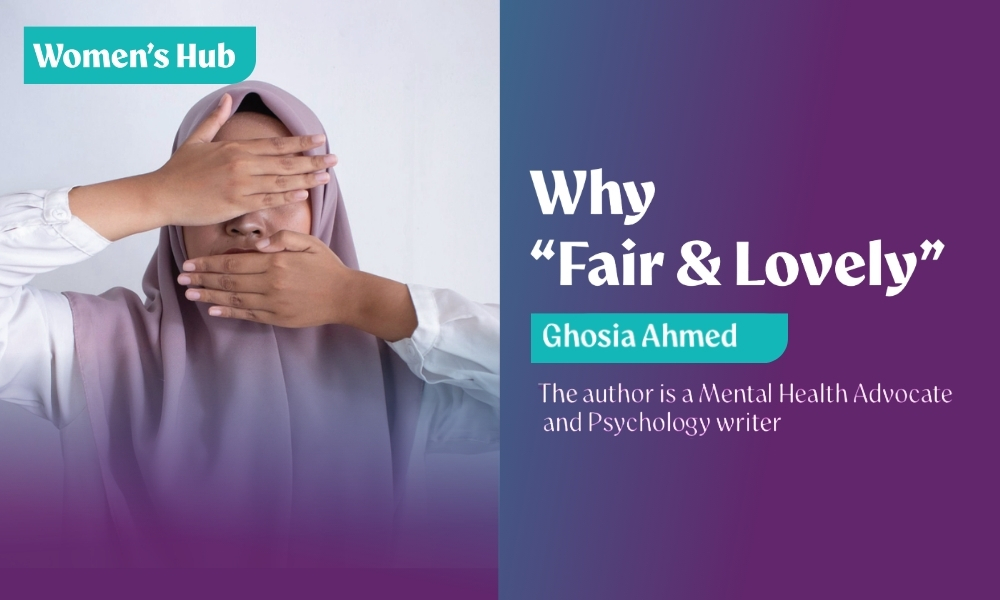
The author is a Mental Health Advocate and Psychology Writer
The Price of “Flawless”
Years back, I was rushing for college, late as usual. I wore whatever I could grab easily. When it came to footwear, I picked an old pair of shoes. It seriously didn’t matter to me. But my brother, who was supposed to drop me off, insisted I wear “pretty” footwear, not some rough “boys’ shoes.” I dismissed his request at first and wore my shoes anyway, undisturbed.
Then, he said something that made me pause. It was a pause that forced me to bring out everything I had been holding onto all these years. He said, “A girl should look beautiful.”
Apparently, that is what we are supposed to be. Pretty. Naive. Cute. Gentle.
But what if we are not? What if I want to look regular and ordinary? What if society’s beauty standards don’t match how I want to look?
Why have we been applying skin-lightening and brightening creams like “Fair & Lovely” for decades on brown skin? Why do we always want to be stuck at age 18? Why do parents of girls with more weight have to fear marriage proposals? Why do I have to look pretty and perfect all the time?
The Normalisation of Mockery
I remember attending a cultural program at my sister’s college. A girl came onto the stage for a classical dance performance, and students in the back started shouting, “Moti… moti…” (Fatty… fatty…). She was a brilliant dancer. I still remember her face. She didn’t cry or break down. Her face remained steady. But she wasn’t happy either. She was confident, but not joyful. Her face told the story of how many times she had already heard that word used against her.
Another memory was of my college’s kabaddi tournament where, to demoralise a female player, the opposing team’s supporters started shouting, “Kaali… kaali…” (Black… black…).
Why has this become so normal? Who made it normal? Maybe it’s the countless movies and reality shows that treat larger women as jokes. Or maybe it’s the movies and dramas where the lead actress must always be the fairest. Maybe it’s us, who laugh without guilt and enjoy the joke. How did we lose our kindness so much that we fail to see the beauty of the moon, and get stuck only looking at its scars?
These painful incidents made me realise why Allah SWT included such basic social etiquette in the Qur’an—teaching us not to mock others or call them hurtful names.
The Qur’an gave us a very clear warning about how we treat one another:
O believers! Do not let some men ridicule others, they may be better than them; nor let women ridicule other women, they may be better than them. Do not defame one another, nor call each other by offensive nicknames…
— Qur’an (49:11)
This verse hits right at the heart of the problem. We often judge or make fun of people based on how they look, completely forgetting that they might be far better than us in the eyes of Allah.
Inventing the Flaw
We no longer choose clothes and makeup that fit our bodies. Now, we try to force our bodies to fit into “perfect” clothes. Every brand comes up with a brand-new solution to a problem that does not even exist. Why do I need a lipstick that stays on for 16 hours, eye makeup that lasts for 24 hours, or day-long mascara? Where does my real, natural face get to exist?
The numbers behind this are shocking. The cosmetic industry is expected to make over 130 billion dollars globally by 2027. To keep growing, marketing cannot just sell a product; it must first invent a body flaw. They take normal human skin textures and label them as medical problems. “Try this for large pores,” “let’s remove fine lines,” “say bye-bye to dullness and uneven tone.”
Modern marketing has shifted from “Fix this flaw” to “You deserve this self-care.” This trick is harmful: it frames spending money on changing your face as a form of freedom and confidence, while the end goal remains exactly the same—hiding your real human features.
Because of standardized makeup styles and filler trends, women are pushed toward a single facial look: hyper-smooth skin, perfectly even brows, and calculated lip shapes. The raw beauty of unique features, freckles, real skin texture, and natural aging is completely erased. High-definition makeup is made to copy the digital blur of a social media filter. In trying to achieve this in the real world, women layer products that suffocate the skin’s natural glow, replacing the living look of human skin with a flat, painted canvas.
Designed for the 1%
The fashion industry works on the exact same flawed logic. High-fashion models are usually picked at a body weight that the World Health Organization classifies as dangerously underweight. Clothing is literally designed for body shapes that represent less than 1% of the global female population.
This confusion forces women to tie their self-worth to a completely random number on a clothing tag, causing changing-room anxiety and body hatred by design. High fashion routinely makes tight clothing and painful shoes seem normal, even though they restrict breathing, ruin natural posture, and cause physical pain.
The message is clear: the clothes do not adapt to the woman; the woman must painfully change her body to fit the clothes.
The Digital Magnifying Glass
Social media and entertainment media only make this crisis faster. Research shows that comparing how you look on social media is vastly damaging to body image. Because the images look like “everyday life,” the brain thinks the standard is achievable, making the failure to meet it feel like a deeply personal disappointment.
For the first time in human history, women are actively comparing themselves to digitally changed, fake versions of themselves. Beauty filters instantly thin noses, enlarge eyes, lift cheekbones, and erase skin pores. Plastic surgeons around the world have reported a massive rise in patients bringing in filtered selfies of their own faces as examples for cosmetic surgery.
Meanwhile, movies and TV shows maintain the illusion of perfect, natural beauty. The most standard beautiful character is almost always cast as the lead. Characters who are plain, larger, or don’t fit the standard appear only as side characters or jokes. It creates a deep sense of being less than others in women who don’t fit the mold. We are surrounded by movies and songs that focus strictly on a woman’s body and beauty, as if that is the only thing about her that matters. Plus-size women are used as jokes on national television, making a silent mark of insecurity on all plus-size females.
Another factor that creates this illusion is the “transformation myth.” In many reality shows, dramas, and movies, the female lead gets ignored by everyone until she undergoes a tremendous makeover, after which everything changes for her. Remember the movie Main Hoon Na? When the female lead, Sanju, was feeling left out, ignored, and unloved, she went through a complete makeover—and suddenly, her life changed, she was noticed, and everything became pleasing. It makes a silent but heavy impact on the mind, falsely teaching young girls that changing their body image is the only key to changing their destiny.
It is incredibly suffocating. We apply layer upon layer to achieve perfection and match the standard. But until when? Does this perfection have a final stop or a destiny to achieve? I haven’t found it. Every single year comes with a different demand.
The Cost of the Illusion
This environment damages more than just physical health; it breaks down mental well-being. A woman’s raw self no longer gives her enough confidence to face the world. Many feel worthless when they aren’t approached by men, spending their lives waiting for a fictional, movie-like “flying dupatta” moment. And when no such thing happens, they view their lives as boring.
The psychological cost is real. A global study of over 21,000 young people found that 55% are actively unhappy with their bodies, with most girls stating they feel “larger than ideal.” Who decided these ideal appearances?
Data shows that 46% of teenage girls report that their body image causes them to worry “often” or “always.” Social appearances have made people so stuck in building their ideal self that they are losing their true self. Body anxiety drives medical choices early in life, with 13% of adult women and 10% of teenage girls actively considering cosmetic surgery or Botox just to stop the worry. Looking pretty has become a 24/7 job for women now.
This illusion of beauty also gives unrealistic expectations to men, who grow up assuming women should flawlessly manage their lives while permanently looking pretty, pleasing, and perfect. Sometimes, marital life suffers when a man feels deceived over what he expected.
Breaking the Bind
In ancient China, the trend of foot binding began with a young queen who bandaged her feet tightly so they looked like a crescent moon. She danced to please the king, which made the other queens jealous. They followed her example. Then royal family females copied it, followed by rich families, middle-class families, and at last, even the poor. Everyone wanted their feet bound to make them look beautiful.
Over time, this trend became normal for both the rich and the poor. Little girls had their feet crushed and bound in childhood; many suffered permanent damage, and some died from infections caused by this harsh treatment. The cost of looking beautiful was sometimes their very life. Isn’t it cruel?
Today, we see a million-dollar business selling makeup to young children so they can look “good.” Do they really need these Sephora “no-makeup makeup” kits and collections? What are we actually giving them? A habit, a need, a lifelong dependency. We are teaching them that their appearance is more important than their self-acceptance, true self, and authenticity.
The terrifying part is that it doesn’t even stop there. A famous clothing brand recently launched their school uniform collection with the headline, “Make those heads turn in H&M’s back to school fashion.” Is this some kind of a joke? Why do these little girls need people’s gazes for their physical appearance? Why are we sexualizing childhood beauty?
When will it all end? When will we start accepting our raw beauty? When will we celebrate growing older, and not just birthdays? When will we welcome women of different colors, sizes, and textures with open hearts? When will we let people accept their originality and authenticity?
How can we forget to tell them that their true strength is their principles and character? Their heart and their soul. Their true femininity.
I wish we could actually feel the weight of this beautiful hadith: “Verily, Allah does not look at your appearance or your wealth, but He looks at your hearts and your actions.” (Sahih Muslim – Book 45, Hadith 42) .
History warns us where unchecked beauty standards lead. True beauty is the beauty of words, nature, and the heart. Let’s take a pledge to stand against these superficial stereotypes.
Because being not fair can be lovely too.
DID YOU KNOW ?
A 2011 WHO report found 61% of India’s dermatological market consisted of skin-whitening products.
“Colourism” — bias based on skin tone within the same ethnic group — was first coined as a term by author Alice Walker in 1982.
Melanin, the pigment behind skin tone, also plays a protective role against UV damage — darker skin isn’t just colour, it’s biology doing its job.
OMG! That line “lipstick that stays 16 hours” was just so relatable to me . I just never apply long lasting lipsticks because I don’t like their texture, but from past couple of months I have been seeing girls in my college having lipstick on their lips for the freakin’ full day and mine didn’t last a few hours. I was planning to buy a long lasting lipstick but that line and the article made me take a pause, and rethink about my choices! Were they truly mine or I was being forced?! I truly wanna thank the author to bring this information back to my life .
Installation was a breeze and the performance is stable. It is much better than playing in a mobile browser. Check out smjiliappapk for the best mobile gaming.