
The author is an emerging writer with a growing interest in literary criticism, Current Affairs and reflective reading. She aspires to contribute thoughtful perspectives through her writing.
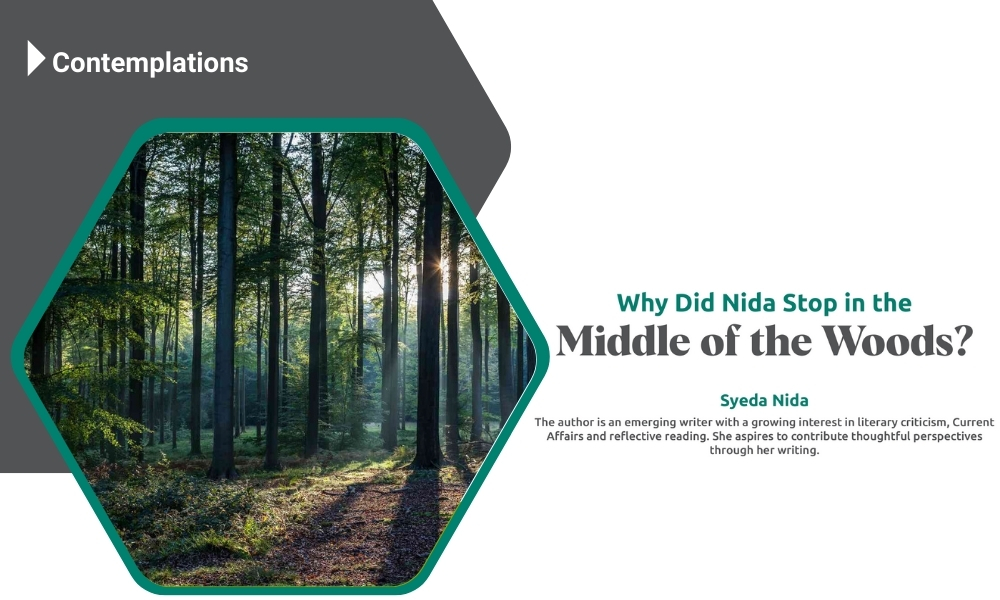
The morning had barely begun when the forest woke up to an unusual silence. No soft flutter of wings, no rustling of leaves, not even the gentle hum of insects. Only a thick, heavy stillness – as if nature herself was holding her breath. A young girl named Nida walked through the woods with a basket of seeds. Every dawn, this was her routine: place her tiny handfuls of hope on the ground and watch birds gather around her. But today, she found only emptiness.
The old peepal tree stood bare, its branches stretched out like arms searching for lost children.
“Where are they?” she whispered.
An elderly shepherd resting nearby pointed toward the dry riverbed. “They’re gone, child,” he sighed. “The heat… the smoke… the dust from the mines. They couldn’t survive.”
Nida’s heart clenched. She remembered the little sparrow who hopped onto her palm every morning – now nowhere to be found. Something inside her broke, as if she’d suddenly understood that the world was changing, quietly, painfully, and no one was stopping it.
That empty forest is not a fantasy. It is the beginning of our reality.
Far away from Nida’s village, the Arctic – once a world of pure white – is melting. The ice that cooled our planet for thousands of years is disappearing faster than ever. Polar bears wander for hundreds of kilometres in search of stable ice. Seals lose their breeding grounds. Entire communities that lived in harmony with snow watch their world collapse beneath their feet. With the melting of each glacier, the Earth loses a piece of its strength, its balance, its protection.
But the melting ice is only one part of the wound. Deep under the forests, machines roar day and night, chewing through mountains for gold, oil, coal, lithium… anything that can be sold. In the name of progress and wealth, we carve open the Earth like a body without consent. Rivers become toxic. Trees are uprooted. Villages breathe dust instead of clean air. Mining doesn’t just take minerals – it steals forests, silence, beauty, and the ancient harmony of nature. The first victims are always the ones who cannot speak: birds, insects, animals. Nida’s missing sparrows are only one of countless stories disappearing every day.
Across the world, species are vanishing quietly. Birds fall from the sky during heatwaves. Turtles fail to hatch because beaches are shrinking. Butterflies disappear because pesticides poison their paths. Coral reefs fade from vibrant colours to ghost-white skeletons. Snow leopards lose their cold homes. Every extinct species is a melody erased from the world forever – not by fate, but by human greed.
And then the Earth begins to shout in ways we can no longer ignore. Cities drown in floods that arrive without warning. Forest fires turn entire skies red. Heatwaves break new records every year. Storms rip apart homes in a single night. Droughts split the land open like cracked skin. These are not natural disasters anymore – these are human-made consequences, the Earth’s exhausted cries for rest.
Climate change is cruel because it punishes the innocent first. Farmers lose crops. Children breathe air thick with smoke. Workers faint in the heat. Families migrate because their homes become deserts or sink into the water. And future generations, who did not burn a single forest or build a single mine, will inherit a planet scarred by decisions they never made.
Yet the story need not end in tragedy. Nida goes back to the empty forest every morning, still carrying her basket of seeds – not out of habit, but out of hope. One morning, she hears a faint chirp. A tiny survivor sits on a branch, watching her. One bird cannot fix the world. But it reminds us of something vital: nature heals the moment we stop hurting it.
If we reduce our greed, the forests will return. If we respect boundaries, rivers will breathe again. If we choose renewable energy over destruction, the ice will recover. If we protect wildlife, our skies will fill with wings once more. The Earth is not asking for miracles; it is asking for mercy.
Climate change is not a distant scientific theory. It is a story, a painful one – written by our own hands. But stories can change. Just like Nida planting tiny seeds of hope, we must plant seeds of responsibility: living sustainably, protecting forests, saving species, reducing pollution, and choosing kindness over greed.
Every tree planted, every bird saved, every lake cleaned, every glacier protected, pulls our world back from the edge.
Because when we destroy nature, we destroy ourselves. And when we save it, we save every innocent life that depends on this planet, including our own.
0 Comments