
Akola, Maharashtra
The Meaning of True Freedom in Islam
In today’s world, the word “freedom” is echoed everywhere. People protest on the streets, raise their voices on social media, and demand their rights. But before joining this global conversation, we must pause and ask: what is freedom, really?
The Modern Concept of Freedom
The modern idea of freedom, largely shaped by Western thought, suggests that a person has the right to speak, choose, and act without any constraint — to live entirely according to personal desire, with no boundaries. A person may wear, eat, study, or earn in any way they wish, without anyone else having a say. Freedom begins with the individual and ends with the individual.
However, this understanding often pushes society towards extreme individualism, weakening social responsibility. While popular in the West, this notion is a misinterpretation of true freedom. When everyone lives without limits, human behaviour becomes driven by impulses, ignoring the moral values that distinguish human beings from other creatures.
As humans, we are gifted with consciousness — the ability to recognise right from wrong. We possess a moral instinct meant to guide our lives.
Unlimited Freedom or Slavery to Desire?
While modern freedom promotes life without limits, Islam views such unrestricted freedom as slavery to one’s own desires. A person becomes controlled by emotions, impulses, and worldly attachments.
Ironically, those who believe they are “free” often become trapped in the endless pursuit of pleasure, perfection, and validation. They spend their lives trying to master the world — only to be mastered by it.
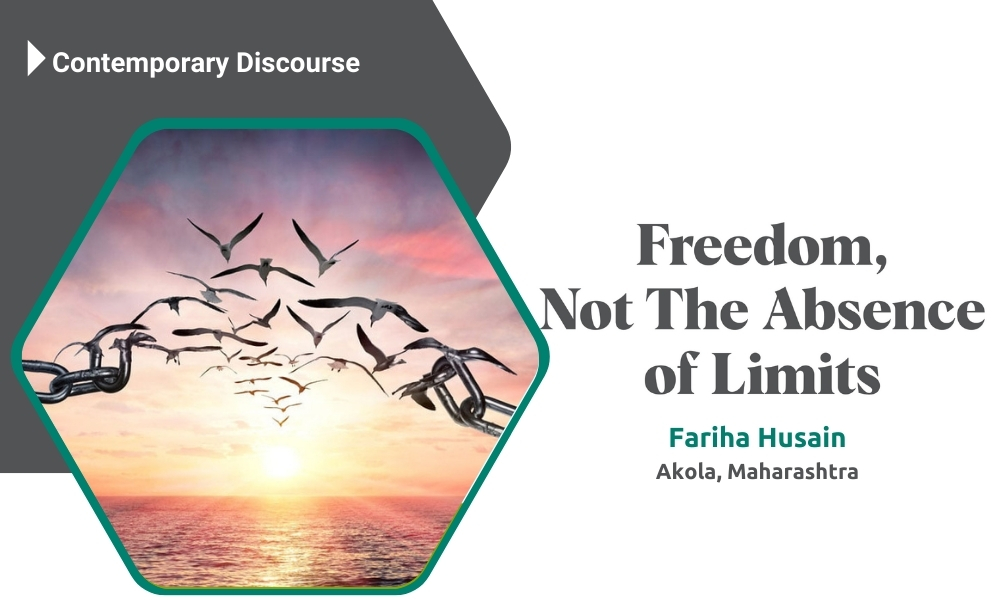
Islam, on the other hand, seeks to liberate the human soul — not enslave it. It offers freedom with responsibility, where a person controls the self rather than being controlled by it.
To understand this freedom, we must first understand Islam itself.
What Is Islam?
Islam is not merely a religion; it is a complete way of life revealed by the Creator and Sustainer of the universe, Allah (SWT), through Prophet Muhammad ﷺ, in the form of the Qur’an.
The word Islam means submission — submission to Allah alone. When a person accepts Islam, they willingly submit their life to Allah (SWT). Through this submission, they are freed from the chains of desire, fear of people’s opinions, greed for wealth, sadness, anxiety, and worldly pressure.
Does Islam Imprison Human Beings?
Does this mean Muslims have no control over their lives? That they cannot enjoy the beauty of the world? That women are treated as slaves?
Absolutely not.
Allah (SWT) has honoured human beings by appointing them as Khalifah (caretakers) on earth. Everything in this world has been created for human benefit, comfort, and growth. Allah wants people to enjoy His blessings — but with awareness of what is beneficial and what is harmful.
Islam does not teach blind denial of pleasure; it teaches balance. Life is not only about worldly enjoyment — it is also about preparing for the Hereafter.
Freedom from Desires and Ego
Allah (SWT) describes the reality of worldly life in the Qur’an:
“Know that the life of this world is but amusement and diversion.” (Qur’an 57:20)
This verse reveals the temporary nature of worldly pleasures. While humans chase success, status, and enjoyment, Allah reminds them that this world is a distraction from their true purpose.
Understanding this reality frees a person from ego and desire-driven living. When one shifts focus to the Hereafter, attachment to temporary pleasures weakens, and inner peace begins.
Freedom from Anger, Sorrow, Fear, and Greed
The Qur’an further reminds us:
“Indeed, to Allah we belong, and to Him we shall return.” (Qur’an 2:156)
This verse liberates the heart from fear, anxiety, sorrow, and greed. When one realises that nothing truly belongs to them — not wealth, success, or even loved ones — attachment loosens.
This does not remove emotion from life; it strengthens the heart. One continues to love, work, and strive — but without becoming enslaved by outcomes. Trust replaces fear.
True freedom begins when attachment shifts from the temporary world to the Eternal Creator.
Freedom of Choice
Islam recognises human free will. The Qur’an states:
“Whoever does good, it is for their own benefit, and whoever does evil, it is against themselves.”
(Qur’an 45:15)
Allah (SWT) grants humans the freedom to choose their actions. No one is forced. However, accountability accompanies choice. This responsibility prevents freedom from turning into chaos and gives life moral direction.
The Right to Justice
Injustice dominates much of the modern world. Victims wait years for justice, while the weak struggle to be heard. This is why people protest — because basic rights are denied.
Islam, however, is uncompromising on justice. Allah (SWT) commands:
“O you who believe! Stand firmly for justice as witnesses for Allah, even if it is against yourselves, your parents, or your relatives…”
(Qur’an 4:135)
Justice in Islam does not bend for wealth, status, or emotion. Truth stands above all.
The Right to Equality
Islam affirms the equality of all human beings:
“O mankind! We created you from a male and a female…”
(Qur’an 49:13)
No race, gender, colour, or social status gives superiority. What distinguishes people is their conduct and character.
Equality between men and women is also clearly stated:
“Men will be rewarded according to their deeds, and women equally according to theirs.”
(Qur’an 4:32)
This verse refutes claims that Islam devalues women. Both men and women are equally accountable and honoured by Allah.
The Right to Education
The Qur’an was revealed with the command:
“Read, in the name of your Lord who created…”
(Qur’an 96:1–5)
Allah further states:
“Allah elevates those who have knowledge.”
(Qur’an 58:11)
The Prophet ﷺ declared that seeking knowledge is obligatory for every Muslim — male and female (Ibn Mājah 224).
Education in Islam is a right and a responsibility. There is no restriction on women seeking knowledge. Any cultural practice that denies this right contradicts Islam and will be answerable on the Day of Judgement.
Western Freedom vs Islamic Freedom
Western freedom centres on unrestricted personal choice — even if it defies nature or harms society. Individual pleasure is prioritised above moral responsibility.
Islamic freedom, however, balances rights with responsibility. It protects individual dignity while safeguarding society, morality, and faith.
If a form of freedom harms others, corrupts values, or destroys moral foundations, Islam does not recognise it as freedom.
Conclusion: True Freedom Defined
In Islam, true freedom lies in servitude to Allah (SWT) — not to desire, society, or ego.
Freedom in Islam means:
- a purposeful life
- moral responsibility
- inner peace
- accountability
- and dignity

0 Comments