
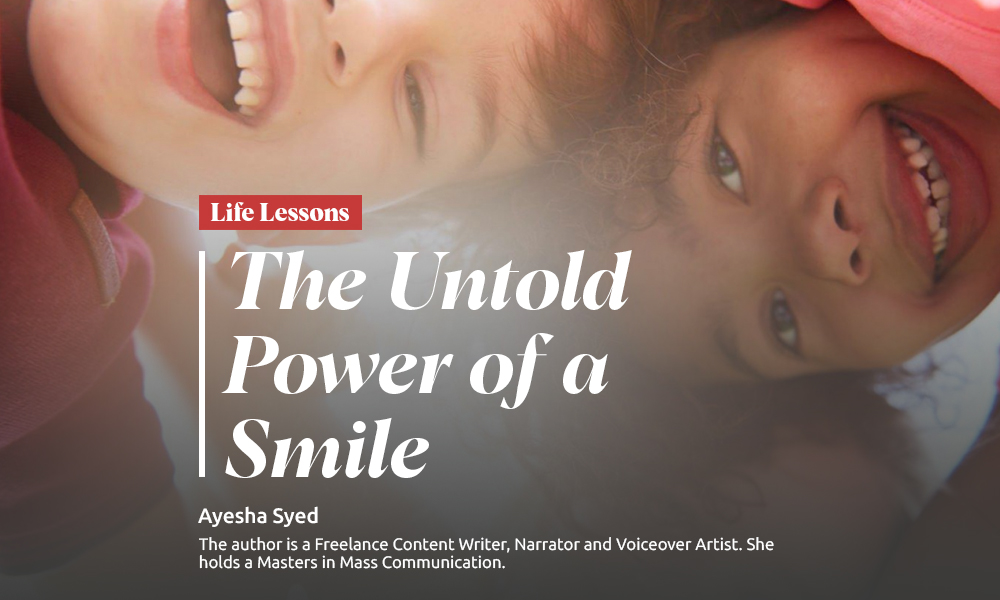
The author is a Freelance Content Writer, Narrator and Voiceover Artist. She holds a Masters in Mass Communication.
Who do you remember with fondness: the people you have had a verbal sparring match with or the ones you have shared a hearty laugh with? The answer is likely the latter, assuming the reader does not thrive on heated arguments.
Laughter has many benefits, both psychological and physical. People often say “Laughing increases blood flow.” It sounded questionable back then, especially since all we did was laugh. But as adulthood has settled in, marring our fragile souls, there seems to be some level of truth to the statement.

Here’s a fun fact: children laugh around 300 times daily, while adults only manage about 17. That’s quite a drastic shift—from childhood’s bubbling joy to adulthood’s sombre quiet.
During anxious moments, a simple smile from a stranger can lift the grey clouds fogging our minds. Laughter does not only help relieve tension; it also helps build relationships or even strengthen them. Sharing a good laugh is far more healing than sharing words that can wound for a lifetime, and the psychological benefits are immense.
The Science Behind Laughter
Laughter is not just a simple act; it leads to a symphony of responses that include neural activity, emotional processing, and physical response. It triggers chemical events in the brain, releasing chemicals that affect multiple areas.
Dopamine, commonly known as the ‘reward’ chemical, is associated with the enhancement of mood and motivation. It gives us the “buzz” or “high” we feel after laughing. Studies suggest that group laughter increases endorphin levels, creating a sense of emotional bonding (Dunbar et al., 2012). Endorphins are the body’s natural painkillers, and promote a sense of calm and euphoria. The body’s primary stress hormone, cortisol, drops significantly during and after laughter. This leads to muscle relaxation, a general sense of peace, and lowered blood pressure.
Interestingly, our brain cannot distinguish between real and fake laughter. Even when we intentionally laugh (fake laugh), the body still experiences many of the same benefits. This principle forms the foundation of laughter yoga. It is a practice where people laugh without relying on humour simply to reap its benefits.
A 2019 study published in the International Journal of Environmental Research and Public Health found that simulated laughter significantly reduced depression and anxiety levels among participants in just four weeks. The research suggests that laughter without the corresponding emotion can still trigger the same neurochemical benefits.
Building Relationships with Laughter
Laughter is not just a personal emotion but a social signal and communicative tool. It conveys safety, belongingness, acceptance, and understanding. It can be grouped with non-verbal communication tools like nodding, shaking, and eye contact. We are 30 times more likely to laugh in group settings than alone, even when watching the same content. Robert Provine writes in his book Laughter: A Scientific Investigation, people laugh not just at jokes, but even during ordinary conversations. This tells us that laughter is not only about humour but communication and building a bond.
Laughter releases oxytocin, often called the ‘bonding hormone. ‘ It is known to build trust in all types of relationships—friendships, families, or work teams. It also helps de-escalate emotionally charged situations and opens doors to conflict resolution

The Role of Humour in Resilience
There’s a saying: “People who laugh the most are the saddest.” At first, this statement seems contradictory; however, when we consider it through the lens of resilience, it begins to make sense. Psychologists and neuroscientists have found that laughter under pressure is a deeply adaptive coping mechanism that contributes to emotional and psychological resilience.
Even during extreme situations, people turn to laughter not only as a coping mechanism but also as a way of expression and strength. One example is the people of Palestine. Palestinian-American comedian and activist Amer Zahr explains how humour allows Palestinians to ‘reclaim their narrative’. Laughter in such contexts does not trivialise the pain; rather, it is a conscious act of resistance.
In oppressive conditions, laughter becomes a form of micro-rebellion, a tool to refuse complete dehumanisation. It becomes a way to process collective trauma without succumbing to despair and a tool for preserving dignity. And let’s not forget the science: laughter lowers cortisol and increases endorphins. This shift in chemicals helps people cope better with chronic stress, offering a brief respite from emotional burnout.
The Generosity of Joy
As a hadith goes, ‘ Your smile for your brother is a charity’ (Tirmidhi). To smile at someone or to laugh with them (not at them) is an act of sadaqah, a sacred act of giving joy. It contributes to the emotional and spiritual economy of the world. This is probably the most profound thing about laughter. It is not just an escape; it is a means of connection, kindness, and belonging.
So when you offer someone a smile or share in their laughter, you are not just lightening the moment. You are offering something of yourself. You are leaving behind your essence.
In a world where we rush from deadline to deadline, where disconnection and distress are common, joy can often feel almost rebellious. But maybe it is not rebellion at all. Maybe it is simply about existing in the moment, unguarded, savouring our true selves, and cherishing each other, especially when we truly see each other.
0 Comments