

The author is a veteran award-winning journalist.
Gross Inequality in Wages and Working Conditions
The minimum wage in Kerala is Rs. 700 a day. Still, the Accredited Social Health Activists (ASHAs), the backbone of Kerala’s acclaimed health care system, are paid an honorarium of Rs. 7,000 a month — which means they earn just Rs. 232 a day.
During COVID-19, the ASHAs—whom the media described as Angels of Hope—were foot soldiers who fought from the front, barefoot and without Personal Protective Equipment (PPE). From conducting door-to-door surveys to ensuring proper quarantine facilities for international travelers and COVID-affected people, ASHAs were present everywhere.
Despite their immense contributions to healthcare, the floods of 2018, and the Wayanad landslide of July 2024, the ASHAs are not treated as government employees but as volunteers. Instead of wages or salaries, they receive honorariums and performance-based incentives — the first fixed and paid by the state government, and the second paid by the Union government.
ASHAs in Kerala—mostly women belonging to the lower strata of society—have been demanding that they be treated as workers and paid the minimum wage of Rs. 21,000 a month. They also want to be given the option to retire between the ages of 62 and 65, be paid a retirement allowance of Rs. 5 lakhs, and be provided with a pension scheme.
Expanding Responsibilities and State Neglect
The ASHAs were introduced by the Government of India under the National Rural Health Mission (NRHM) in 2005. According to government guidelines, ASHA would be the first port of call for any health-related demands of deprived sections of the population — especially women and children — who find it difficult to access health services. She would be a promoter of good health practices. She will also provide a minimum package of curative care that is appropriate and feasible for that level and make timely referrals. Her roles and responsibilities would be as follows:
- Create Awareness: ASHA will take steps to raise community awareness and provide information on determinants of health, such as nutrition, basic sanitation and hygienic practices, healthy living and working conditions, information on existing health services, and the need to timely use health and family welfare services.
- Counsel Women: She will counsel women on birth preparedness, the importance of safe delivery, breastfeeding and complementary feeding, immunisation, contraception, and prevention of common infections, including Reproductive Tract Infection, Sexually Transmitted Infections, and care of the young child.
Regarding compensation to ASHA, the guidelines say:
“ASHA would be an honorary volunteer and would not receive any salary or honorarium. Her work would be so tailored that it does not interfere with her normal livelihood!”
In the beginning, ASHAs worked only one or two hours, but their workload has increased over the years, and sometimes, they have to work 8 to 10 hours or more. Various trade unions and associations have been demanding that ASHAs be recognised as “workers” and paid minimum wages.
The 26,000 ASHAs in Kerala hoped that the Left Democratic Government in Kerala, led by Pinarayi Vijayan, would make provisions in the 2025 state budget to meet their demands. But the ASHAs were not mentioned in the state budget presented on 7 February 2025. Upset at the government’s neglect, the Kerala ASHA Health Workers’ Association (KAHWA) started a protest demonstration in front of the Secretariat building in Thiruvananthapuram on 10 February 2025.
A Full-Time Job Without Recognition
When NRHM was introduced, ASHAs were recruited as voluntary workers. Their work focused on immunisation, promoting hospital births, and reducing child and maternal mortality. However, over the years, ASHAs have been called upon to carry out more work.
One protester told an interviewer that now being an ASHA is a full-time job:
“Everyone calls ASHAs for various tasks — ward members, police officers, block development officials, or Panchayat or village officials. They all want us to be available on call 24 hours, but nobody wants to pay.”
ASHAs often have to pay out of their own pocket for their patients. Sometimes, this is to transport pregnant women to the clinic or hospital or to buy essential medicines for poor patients. Many times, they do not even get the Rs. 7,000 honorarium because they are fined if they miss any assignment.
There is a fine of Rs. 500 for missing ASHA meetings, Rs. 700 for missing Panchayat meetings, and Rs. 500 for missing Centre duty. There is also a fine for delay in submitting data or reports. ASHAs are also sometimes asked to collect confidential and embarrassing personal data like the number of drug addicts or alcoholics in the community!
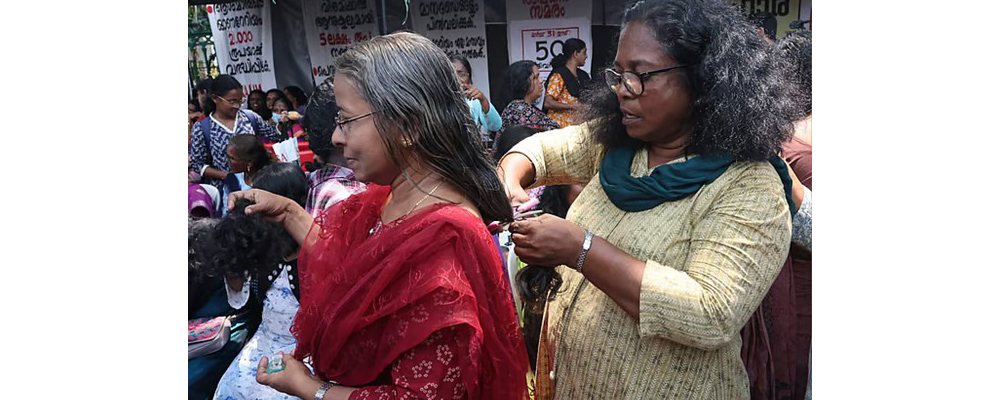
ASHA workers cut hair as a mark of protest
The Fight for Recognition and Fair Compensation
At the 45th Indian Labour Conference in New Delhi in May 2013, representatives of various trade unions demanded the recognition of ASHAs as “workers” so that they would become eligible for minimum wages. At the same time, nothing stops the state government from increasing the honorarium of the ASHAs because the matter is under the purview of the state government and is not contingent upon recognising ASHAs as “workers.”
Unfortunately, the ASHAs are placed between a devil and the deep sea. On the one hand, the Union government is blaming the states for the sad plight of the ASHAs throughout the country (numbering one million). In contrast, the state governments have blamed on the Union government’s lack of financial support — even for centrally introduced schemes.
Exploiting Women’s Labour
In the case of the ASHA workers, one also has to consider the question of the state exploiting women’s cheap labour. There is no doubt that these women are overworked and underpaid. Considering that the ASHA workers mostly belong to marginalised sections of society, the delay in meeting their demand for minimum wages cannot be justified any longer.
0 Comments