
The writer is an M.Sc. candidate and serves as an educator at Scholars Group of Institutions
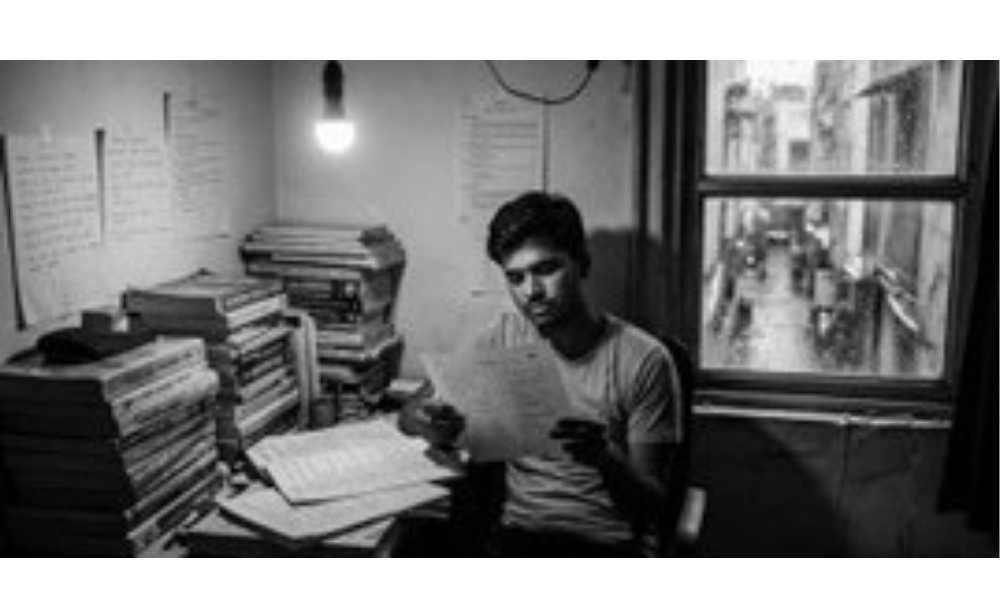
The monsoon rains lashed down on Old Rajinder Nagar, turning the narrow lanes into rivers of mud and garbage. In a cramped room on the third floor of a crumbling building, Arjun, a twenty‑seven‑year‑old from Bihar, sat under a single, flickering bulb, staring at a mock‑test paper he had already taken nine times. Six years earlier, he had arrived in Delhi with an engineering degree and a dream his parents had mortgaged their land to fund. Now, at an age when his classmates were buying homes and getting promotions, he was still memorising the dates of medieval battles and the complications of Article 368. Three blocks away, a few months prior, another young aspirant had left her final words scrawled on a wall: “The dream killed me before the exam could.” Arjun knew that feeling. He kept wondering whether the glory everyone chased was worth this slow, quiet erasure of his twenties.
These two stories are the binary poles of the Union Public Service Commission (UPSC) journey. One represents the ultimate social elevator in India; the other represents a quiet, national tragedy. The Civil Services Examination, once a noble gateway to nation-building, has morphed into a pressure cooker; one that consumes the prime years of a million young lives annually while producing fewer than a thousand survivors. It is fueled by societal obsession, commercial greed, and a framework that rewards endurance over excellence. What starts as youthful ambition ends, for most, in a landscape of burnout, stigma, squandered potential, and a life path that feels unplanned and unfulfilled.
The statistics of scarce seats:
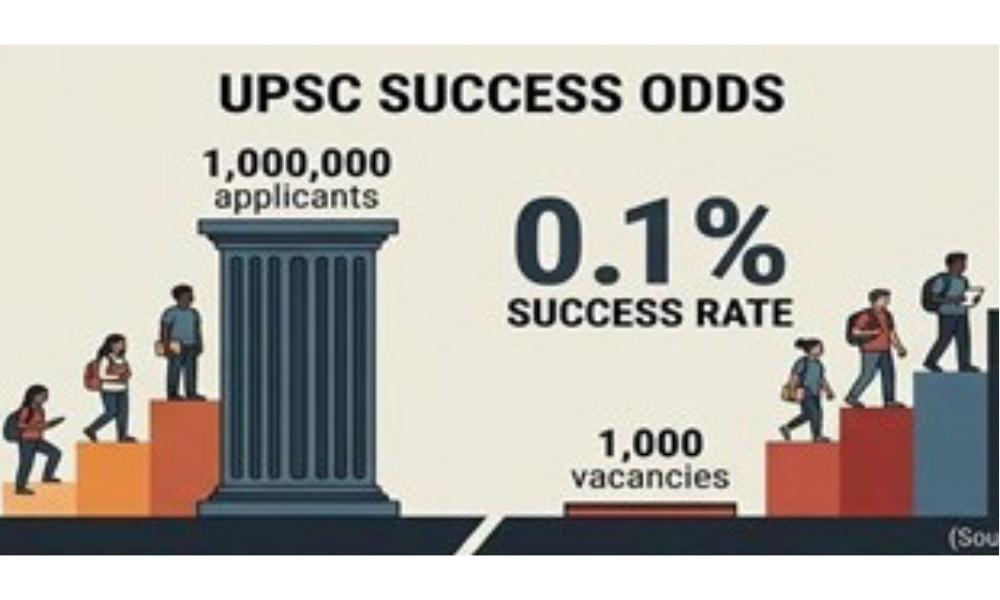
The numbers alone form a story of statistical cruelty. Around 10 lakh candidates apply for the UPSC Civil Services Examination every year, competing for roughly 1,000–1,100 vacancies. This translates into a success rate of about 0.1 percent—a figure so low that, outside the UPSC ecosystem, such odds would usually be treated as fantasy. In 2024, UPSC notified around 1,050–1,100 posts, drawing near‑10‑lakh applicants, reinforcing the pattern of the previous decade.
In 2000, about 365 candidates competed for each vacancy; by 2023, that ratio had ballooned to over 1,200. The exam stretches over nearly a year—Prelims, Mains, and Interview—over a syllabus large enough to fill several volumes. Because the process is so exhaustive, most of those who clear it do so only after multiple attempts, with many spending five to eight years in “coaching‑basement‑mode.”
Relentless Exam Preparation:
This marathon stretches across nearly a year, encompassing Prelims, Mains, and Interviews with a syllabus vast enough to fill libraries. Because the process is so exhaustive, over 93 percent of successful candidates require multiple attempts, with many spending five to eight years in the trenches.
“It’s a massive misallocation of talent… Why chase a 99.9 percent failure rate when entrepreneurship offers better odds?” — Sanjeev Sanyal, Economist (2024)
The long-term preparation often leads to what economist Sanjeev Sanyal called a “massive misallocation of talent” in a 2024 podcast. He questioned why so many chase a 99.9 percent failure rate when sectors like entrepreneurship offer better odds. By the fourth or fifth attempt, bright graduates can become human‑index machines, able to recite Supreme Court judgments but ill‑equipped for the technical or analytical roles that private‑sector firms value. Business Today highlighted this in 2024, noting how a 32-year-old engineering graduate, skilled only in General Studies notes, can emerge effectively unemployable in fields like coding or analysis.
Ultimately, this regime of rote memorisation can suffocate genuine intellectual curiosity. As 2014 topper Ira Singhal described in a 2026 interview, the process is the “greatest level of torture” one can impose on themselves. It is a system where India’s demographic dividend often drains into windowless libraries, chasing a target that feels increasingly like a moving target.
The Coaching Economy:
Selling the Mirage:
Supporting this entire edifice is a coaching industry of staggering proportions, valued at approximately ₹54,400 crore in 2024 and projected by IMARC Group and Business Today to nearly triple by 2033. In Old Rajinder Nagar and Mukherjee Nagar, aspirants are greeted by billboards of smiling toppers, each promising that a classroom seat can turn a commoner into a collector. Major players like Drishti IAS reported an operating revenue of ₹364 crore for fiscal year 2025, while edtech giants like PhysicsWallah are fueling the fire, recently acquiring a 40 percent stake in Sarrthi IAS at a ₹250 crore valuation.
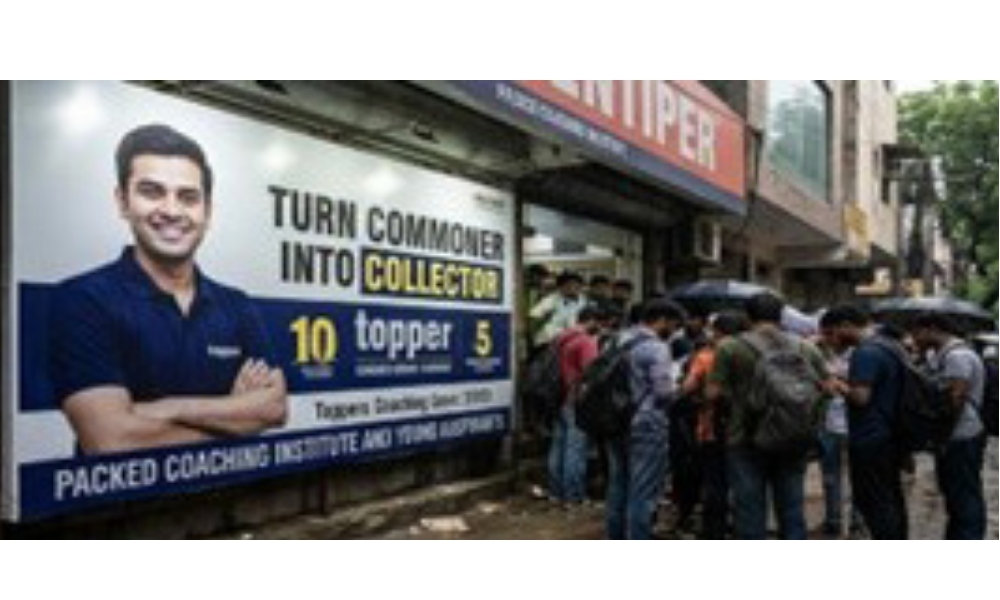
However, behind the polished advertisements lies a reality that veteran educator Dr. Vijender Singh Chauhan describes as a “coaching mafia” preying on fear. The business model is calculated: Institutes often subsidise the top 10 percent of students to produce the “topper faces” needed for marketing, then use those images to lure the remaining 90 percent. These students who sometimes refer to themselves as “milking cows” are charged massive fees, typically ranging from ₹2.5 to ₹4.5 lakh annually. These costs are often sustained over several years through multi-year programs, turning the desperation of the majority into a highly profitable revenue stream. This exploitation was laid bare in February 2026 when the Central Consumer Protection Authority (CCPA) fined the Vajirao & Reddy Institute for claiming 645 selections out of 1016 vacancies. An investigation revealed that 431 of those candidates had never enrolled in any program at the institute; many had simply attended a single mock interview after already clearing the Mains on their own.
Beyond the financial drain, the physical toll is visible in the windowless basements where students study 12–14 hours a day, often in poorly ventilated rooms. In July 2024, three students died after being trapped in a flooded basement at Rau’s IAS Study Circle in Old Rajinder Nagar, exposing the shoddy conditions in some coaching‑centred neighbourhoods. The tragedy became a symbol of how the “safety” of the library can, in practice, mean confinement in hazardous, isolated spaces. For many families, the stakes involve mortgaging futures or borrowing from loan sharks to cover annual costs of ₹3-5 lakhs. It is a system that thrives on a 90 percent failure rate, enriching a few while the country’s youth stagnates in pursuit of a carefully sold mirage.
Burnout’s Hidden Toll: Psychologists and researchers have begun to talk about the “library trap,” a state in which an aspirant’s entire social world shrinks to the size of a reading room and a WhatsApp group. Deprived of sunlight and meaningful connection, many succumb to chronic anxiety. A 2024 survey‑based study in IJRASET found that 70 percent of UPSC‑CSE aspirants
reported emotional distress severe enough to impair daily functioning, and about 40 percent described symptoms consistent with depression. Around 40–45 percent of respondents said they experienced prolonged low mood or anxiety lasting more than two weeks, indicating clinically significant mental‑health strain. In the coaching hubs of Delhi, these numbers take on a hauntingly personal face. In Delhi’s coaching hubs, the human face of this strain is tragically visible. In August 2024, a UPSC aspirant from Maharashtra died by suicide in Old Rajinder Nagar, leaving a note that spoke of relentless pressure, high rent, and the suffocating weight of a single‑mind dream: “My only dream was UPSC in first attempt from then only.” in the following year that is May 2025, a twenty-five-year-old woman left a twenty-page suicide note that served as a methodical indictment of this national pathology. Having spent a decade in pursuit of a dream that eventually exhausted her soul. Her final words were “You can’t be an IAS just like that…”. These words captured the reality of a psychological toll that had finally exceeded her capacity to pay.
The Stigma of the “Almost”:
In the Indian middle-class imagination, the IAS officer is not merely a civil servant; they are a social demigod. This cultural obsession creates a world with no room for the “almost.” An aspirant who reaches the interview stage is undoubtedly among the most knowledgeable people in the country, yet if they fail that final hurdle, they often find themselves unemployable yet overqualified for entry-level corporate roles
but lacking the technical skills required for the modern economy. Failure in the UPSC is rarely viewed as a personal setback; it is a scarlet letter. As economist Sanjeev Sanyal has noted, while “Collector status” means marriage prospects and social standing soar, those who fall short face a life of pity or social exile.
The stigma is backed by enormous financial pressure. A 2026 analysis of UPSC‑preparation costs suggests that 40–50 percent of aspirants spend between ₹1–3 lakh per year on coaching, with many coming from families earning less than ₹30,000 per month or relying on farming as their main income. Many take part‑time jobs or borrow from informal lenders; one‑seventh say they must clear the exam “no matter what.”
When that “no matter what” fails, the identity crisis can be severe. In 2025, several individuals were exposed for faking UPSC ranks and being publicly felicitated by politicians, only to be unmasked later. These were not just frauds; they were cries for validation from people who found it easier to live a lie than to face the whispers of their neighbours. Sanjeev Sanyal has summed this up bluntly: “Now tell me how many things are there with a 99.9 percent failure rate that you would recommend somebody to do?”. In a culture where the “almost” is ghosted and
only the winner is worshipped, the human cost is a generation trapped between a dream and a debt they can never repay.
The Ethical Irony and Post-Clearance Pressures:
For the tiny minority who finally clear the gates, a new and more complex struggle begins. While the Indian bureaucracy was built on the principle of neutrality, that foundation is increasingly under siege. The Constitutional Conduct Group, a body of former civil servants, warned in 2023 of a systematic attempt to shift the character of the IAS and IPS toward a “committed bureaucracy,” where loyalty to particular political narratives can shape postings.
In March 2026, just after the Election Commission announced Assembly polls in West Bengal, a sweeping administrative reshuffle removed the state’s chief secretary, home secretary, DGP, and Kolkata police commissioner within hours. Chief Minister Mamata Banerjee wrote to the Election Commission, alleging that the moves undermined cooperative federalism and could be weaponised to tilt the political balance.
This “Sword of Damocles” hangs over every officer: those who speak truth to power or probe poll violations often face punishment transfers, suspension, or administrative sidelining.
There is a profound irony in this trajectory that should give every Indian pause. Aspirants spend years cramming for “GS Paper IV,” memorising the ethics of Gandhi, Kant, and Aristotle to write essays on conscience and protecting the marginalised. Yet, the path they take to get there is paved with the unethical exploitation of coaching mafias and a system that profits from their repeated failure. By selecting candidates through a system that rewards repetitive memorisation over original thinking, we are essentially choosing survivors rather than leaders. We end up producing “compliant cogs” and then expect them to suddenly show the empathy and courage needed to guide a democracy. It is a paradox to ask for bold, ethical leadership from individuals whose very path to success required them to suppress those same traits.
Frameworks in Need of Repair:
Is this the only way to recruit civil servants? Other democracies suggest otherwise. In the United Kingdom, the “Fast Stream” focuses on psychometric evaluations and simulations of actual bureaucratic work rather than a marathon of rote memorisation. Their system values specialisation and performance over the “generalist” model inherited from the colonial era. France’s system, while rigorous, is highly professionalized, ensuring that those who enter are trained for specific administrative roles rather than being treated as masters of all trades.
These systems recognize that the “District Collector” is no longer a colonial monarch but a public manager in a complex, digital economy. India remains one of the few places where a single, massive gatekeeper exam determines a person’s entire trajectory for thirty years. By moving toward a more specialized recruitment model and limiting the number of attempts to two or three, we could force a healthier pivot to other sectors, ensuring that our youth aren’t left stranded at age thirty-two with nothing but a stack of old textbooks.
The First Steps Toward Balance and Shift:
The UPSC has finally begun to acknowledge the dysfunction. In February 2026, it announced that serving IAS and IFS officers are now barred from reappearing unless they resign. IPS and other Group A officers get just one chance to improve. This is a long-overdue correction, a move that forces candidates to choose between the service they have and the “better one” they are seeking. As Atish Mathur notes, “It is not an abrupt step. It has been in the making for years.”
But this single reform is insufficient. A truly balanced approach requires multiple simultaneous interventions: capping attempts for all candidates at three, not just for those already in service; mandating full transparency in coaching advertisements, including clear disclaimers about the exact courses toppers actually took; creating viable “Plan Bs” within the education system so that a failed attempt does not mean a failed life; and most fundamentally, changing the way we talk about success and worth as a society.
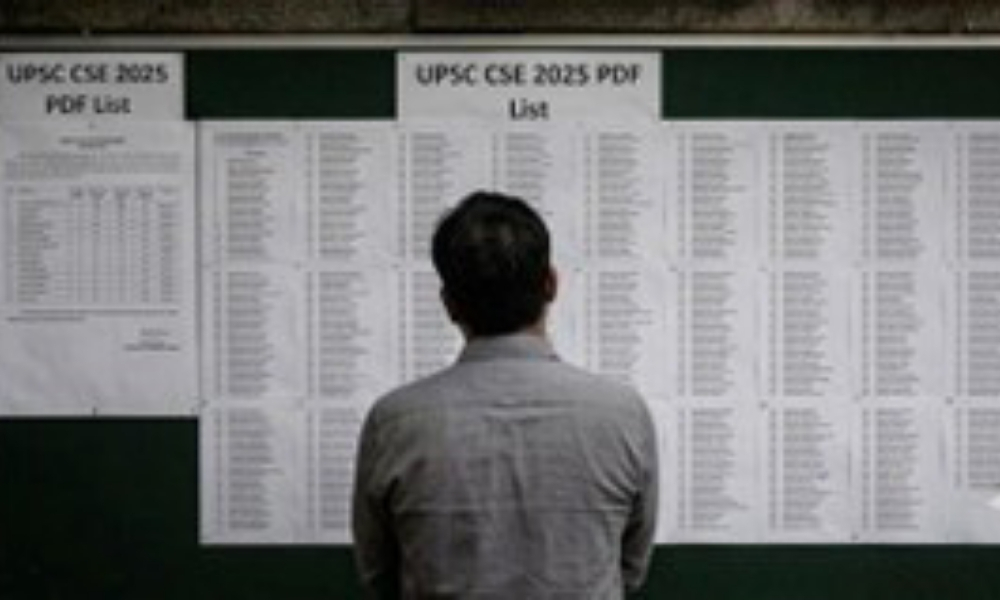
One or two attempts is fine but, spending your entire twenties on it is unhealthy. We need to tell our young people that their value to the nation is not determined by a three-digit rank in a PDF file, that there are a thousand ways to serve India without becoming a Collector, that a life spent building a business or teaching children or practising medicine is no less worthy than a life spent in the Secretariat.
In conclusion, the monsoon rains will come again to Old Rajinder Nagar, and the basements will flood, and the single bulbs will flicker over countless mock test papers. The firecrackers will crackle for the 2026 toppers, and the families will distribute ladoos, and the billboards will feature new smiling faces. And somewhere, in a room no larger than a pantry, another young person will wonder if the dream is worth the slow erasure.
Arjun, on his sixth attempt, still doesn’t know whether his name will appear on that final PDF list. His parents have stopped asking when he’ll come home. His classmates have stopped inviting him to weddings. His world has shrunk to the dimensions of a rented room and the pages of a dozen textbooks. He is one of over a million, a statistic in a system that consumes youth and calls it preparation.
If the path to upholding the Constitution requires first shattering lives through endless repetition, if the preparation for the “Ethics” paper is funded by an industry that profits from exploitation, if the “Steel Frame” we celebrate is forged in the crucible of burnout and despair, what exactly are we building? Are we recruiting leaders for India’s future, or are we merely celebrating the survivors of a system we chose to break rather than build?
References:
The Indian Express Dikshant IAS.
Free Press Journal he Economic Times
Beyond the financial drain, the physical toll is visible in the windowless basements where students study 12–14 hours a day, often in poorly ventilated rooms. In July 2024, three students died after being trapped in a flooded basement at Rau’s IAS Study Circle in Old Rajinder Nagar, exposing the shoddy conditions in some coaching‑centred neighbourhoods. The tragedy became a symbol of how the “safety” of the library can, in practice, mean confinement in hazardous, isolated spaces. For many families, the stakes involve mortgaging futures or borrowing from loan sharks to cover annual costs of ₹3-5 lakhs. It is a system that thrives on a 90 percent failure rate, enriching a few while the country’s youth stagnates in pursuit of a carefully sold mirage.
The app version is so much more convenient than the browser. I can play anywhere now without any glitches. Get the sagjiliapp
Downloading the APK was very straightforward. The installation was quick and the app runs smoothly on my Android. Best sagjiliapk
Finally found a working link for the APK. Everything is set up and ready for some big wins tonight. Check pk111linkapk