
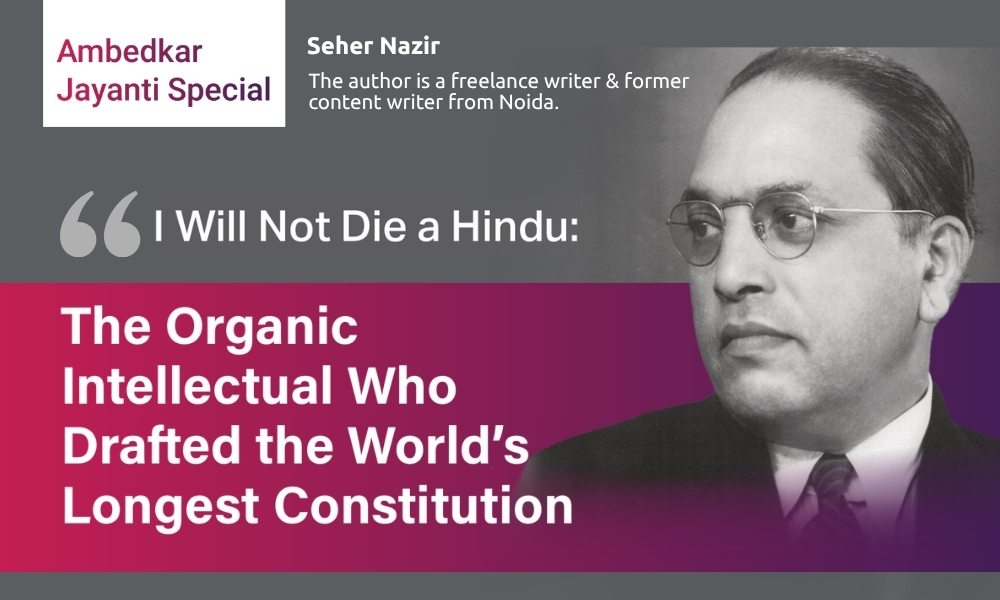
The author is a freelance writer & former content writer from Noida.
Born denied water, he died having written the world’s longest constitution. The Ambedkar story will change how you see India. They called him “untouchable”; he became untouchable in power. Meet Dr. B. R. Ambedkar.
Ambedkar: The unseen architect who built India not with bricks, but with ideas.
“One man’s revolutionary ideas transformed a nation of 1.4 billion people.”
Imagine growing up in a society that told you where you could sit, what water you could drink, and which books you were “allowed” to read. Now imagine not just breaking those barriers, but rewriting the rules for an entire nation. In 1927, a man stood at a public water well in Mahad, Maharashtra, knowing he could be beaten, arrested, or worse for simply trying to drink water. That man was Dr. Bhimrao Ramji Ambedkar — a lawyer, economist, social revolutionary, and the chief architect of modern India’s Constitution. His story isn’t just history; it’s a masterclass in turning personal struggle into national transformation.
From Outcast to Nation-Builder
Born into what many have described as the harsh reality of caste discrimination, young Bheem fought for his dignity. He had a secret weapon — an unbreakable spirit and his father, who believed that education could shatter any chain. He went on to earn doctorates from Columbia University and the London School of Economics.
In 1947, the same society that had once shunned him appointed him to draft India’s Constitution for 350 million people.
“Every drop of water he was denied became an ocean of opportunity for millions.”
Every time an Indian votes, a woman files a legal case, or a worker demands minimum wages, they are enacting the vision of one man who was once denied water from a public well. Dr. B. R. Ambedkar didn’t just draft India’s Constitution; he embedded within it a blueprint for a revolution that continues to unfold today.
Dr. Ambedkar’s vision for social change centred strongly on education.
“Education was Ambedkar’s weapon against injustice.”
In a society bound by caste and inequality, he believed learning could liberate minds and transform society. He did not merely advocate for more schools; he reimagined what education should be, who deserved it, and what it could achieve.
Education as Revolution: The “Educate, Agitate, Organise” Formula
The triple strategy that changed everything
Dr. Ambedkar did not simply believe in education; he used it as a powerful tool for social change. His famous mantra reveals a systematic approach:
EDUCATE — Open minds to possibilities
AGITATE — Channel awareness into action
ORGANISE — Transform individual voices into collective power
Beyond Degrees: Building Character
While earning multiple doctorates from Columbia University and the London School of Economics, Ambedkar realised something crucial:
“Education without character is dangerous.”
He envisioned schools that did not just create graduates but citizens with backbone — people who could think critically, stand up to injustice, and refuse to accept “that’s how things are” as an answer.
Modern relevance: In today’s digital age, his emphasis on combining knowledge with moral courage feels more relevant than ever. Think about it: we have more information than any generation before us, but do we have the character to use it wisely?
The Architect of the Constitution
A genius who wrote rules for 350 million people.
Dr. B. R. Ambedkar: the mastermind behind India’s Constitution.
The brilliant legal mind who transformed India from a colonial territory into a democratic republic through the power of constitutional law. Ever wondered who crafted the world’s longest written constitution? Meet an “Untouchable constitutional hero”.
Born into a Dalit family facing severe caste discrimination, Ambedkar rose to become India’s first Law Minister and the Chairman of the Constitution Drafting Committee. His appointment on August 29, 1947, by a Congress-led Assembly demonstrated that merit could transcend social barriers.
The Impossible Task
Picture this: you are tasked with creating a legal framework for a country with:
- Over 560 princely states
- Hundreds of languages
- Multiple religions
- Centuries of social divisions
That was Dr. Ambedkar’s challenge as Chairman of the Constitutional Drafting Committee.
His Secret Weapon: Constitutional Morality
Ambedkar introduced a powerful concept: constitutional morality.
What it means: Everyone — from the Prime Minister to the street vendor — must follow not just the letter of the law but also its spirit.
Why it mattered: He understood that democracy in India was fragile. As he famously observed, democracy in India was like “top-dressing on an undemocratic soil.” The Constitution had to be the fertiliser that would allow democratic values to take root.
Ambedkar did not merely draft laws; he engineered social transformation. His Constitution became a tool against centuries of oppression, giving voice to the voiceless.
The Constitutional Revolution
As India approached independence, Ambedkar’s brilliance was recognised. Appointed Chairman of the Constitution Drafting Committee on August 29, 1947, he led a seven-member team to craft the world’s longest written constitution for a newly independent nation of more than 350 million people, diverse in languages, religions, cultures, and deep-seated inequalities, including more than 560 princely states.
The drafting process (1947–1949) involved intense debates, more than 7,000 amendments, and public input. Starting from B. N. Rau’s preliminary draft, Ambedkar guided the document to its adoption on November 26, 1949 (now celebrated as Constitution Day), with enforcement on January 26, 1950.
Ambedkar’s Game-Changing Contributions
Fundamental Rights that changed everything:
Article 15 — Prohibited discrimination based on caste, religion, or gender.
Article 17 — Abolished untouchability.
Article 19 — Guaranteed freedom of speech and expression.
Articles 330–342 — Introduced safeguards and reservations for marginalised communities.
Article 32: The crown jewel
Ambedkar called Article 32 — the Right to Constitutional Remedies — the “heart and soul” of the Constitution. It allows citizens to directly approach the Supreme Court when their fundamental rights are violated.
The Visionary’s Warning
In his final speech, Ambedkar cautioned:
“However good a constitution may be, if those implementing it are not good, it will prove to be bad.”
His words continue to resonate today.
Equality: Not a Slogan but a Daily Practice
Ambedkar redefined equality as substantive equality, not merely formal equality. Equal opportunity sometimes requires unequal support where historical injustice has created deeper imbalance.
We have among us a society established based on slavery. We have a society in which there is graded inequality of man.
— Dr. B. R. Ambedkar
Political equality: “One person, one vote, one value.”
In a society where birth often determined a person’s worth, Ambedkar ensured that every adult Indian had the same voting power — a revolutionary idea for its time.
Social equality: Beyond legal provisions.
He understood that real equality must exist in everyday life — in schools, workplaces, and neighbourhoods. Article 17 did not merely abolish untouchability on paper; it made discrimination a punishable offence.
Gender equality: Ahead of his time.
Through the Hindu Code Bill, Ambedkar championed women’s rights decades before global gender equality movements gained momentum. He fought for:
- Equal inheritance rights
- Property ownership for women
- Marriage and divorce rights
- Protection from domestic injustice
Ambedkar’s Legacy in the Modern World
Dr. B. R. Ambedkar (Babasaheb) remains extraordinarily relevant today (as of 2026), nearly seventy years after his death. His ideas, struggles, and constitutional vision continue to shape debates on social justice, democracy, equality, and governance in India and beyond.
In the Digital Age
In the digital age, imagine this: Babasaheb Ambedkar lives not in body, but in every scroll, every post, and every struggle for fairness online. His spirit echoes through our phones and screens.
Think critically: In a world full of misinformation, his habit of questioning blind belief helps people think independently.
Respect fair rules: Democracies face serious challenges today; his commitment to constitutional values — justice, equality, and rights — protects society from arbitrary power.
Education with character: As artificial intelligence changes education and employment, Ambedkar’s idea that education must develop both intellect and character remains deeply relevant.
For Today’s India
Reservations provide opportunity — They continue opening doors in education and employment for historically marginalised communities.
Courts protect rights — Article 32 enables citizens to approach the courts directly in matters involving rights such as privacy, equality, and environmental protection.
Women gain empowerment — His vision for gender equality continues influencing modern laws and policies.
Babasaheb is not merely a historical figure; his ideas remain alive in contemporary struggles for justice.
Ambedkar’s Final Message
Babasaheb passed away in 1956, but his final act was deeply symbolic: he embraced Buddhism, rejecting the religious system that had upheld caste hierarchies.
Buddhism offered equality, compassion, and — most importantly — a rejection of caste.
His powerful words remain widely remembered:
“I was born a Hindu because I had no choice, but I will not die a Hindu because I do have a choice.”
His message continues to inspire: true progress requires educating minds, agitating for justice, organising collective action, and practising constitutional morality every day.
The Ambedkar Question for Today
As you scroll through social media, attend virtual meetings, or debate politics with friends, ask yourself:
- Are we practising the equality Dr. Ambedkar envisioned?
- Do our educational choices build character alongside credentials?
- Are we practising constitutional morality in everyday life?
The Bottom Line
Dr. B. R. Ambedkar did not merely write India’s Constitution; he helped define the principles of dignity and equality within a diverse democracy.
His vision helped transform a hierarchical society into one where opportunity could extend to all citizens.
“You cannot build a nation if you betray its weakest citizens.”
Really impressed with the fast loading times and the smooth interface. Getting into my account is a breeze every single time. Highly recommend ah777login to everyone looking for a hassle-free experience.
Alright folks, if you’re looking for some sweet slots online, bbjlslots is where it’s at! The games are pretty good, and I’ve had some decent luck there. Give it a shot, you might just win big! bbjlslots
[2243]Woah99 | Link Vào Chính Thức – Casino Trực Tuyến Uy Tín Số 1,Woah99 cung cấp link vào chính thức để trải nghiệm casino trực tuyến uy tín. Hỗ trợ tải app APK nhanh chóng và nạp tiền qua ví Momo tiện lợi. Tham gia ngay hôm nay! visit: woah99