
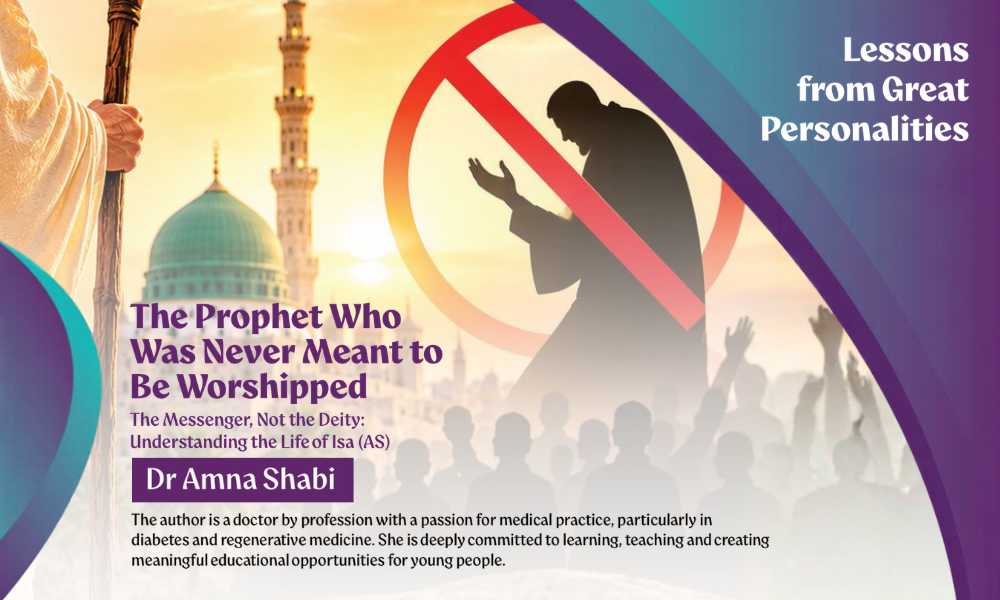
The author is a doctor by profession with a passion for medical practice, particularly in diabetes and regenerative medicine. She is deeply committed to learning, teaching and creating meaningful educational opportunities for young people.
Among the distinguished messengers sent to guide humanity towards the worship of one Almighty Creator, Prophet Isa (AS) occupies an exceptionally significant position in Islamic history. His life, characterised by a miraculous birth, extraordinary signs, unwavering devotion and profound spiritual teachings, is among the remarkable accounts preserved in the Qur’an.
Although his arrival into this world was accompanied by circumstances that transcended ordinary human experience, his identity was never defined by divinity, but by servitude to Allah and the responsibility of prophethood. The miracles bestowed upon him demonstrated the limitless power of the Creator, while his message consistently called humanity towards Tawheed—the absolute oneness of Allah.
His life must therefore be understood not merely as the biography of an extraordinary individual, but as a profound reminder that the messenger is to be honoured, while worship belongs exclusively to the Creator.
A Miraculous Birth
The extraordinary circumstances surrounding the birth of Prophet Isa (AS) were preceded by the exceptional purity and devotion of his mother, Maryam (AS), whose character has been honoured in the Qur’an. Having been chosen by Allah, she was distinguished through her faith, modesty and submission to divine will.
One day, the announcement of a child being bestowed upon her was delivered by Angel Jibreel (AS). Astonishment was expressed by Maryam (AS), since no marital relationship had taken place and no human father could be identified. Nevertheless, what appeared impossible according to human reasoning was brought into existence through the command of Allah.
Consequently, Isa (AS) was born without a father. This extraordinary event was established as a manifestation of divine power rather than evidence of divinity. The Qur’an draws a comparison with Prophet Adam (AS), who was created without either a father or a mother. Through both examples, the supremacy of the Creator over the limitations of human conception is demonstrated.
The miraculous birth of Isa (AS) therefore reminds humanity that the will of Allah is not restricted by the natural laws that govern human understanding.
Qur’anic references: Surah Maryam (19:16–22); Surah Aal-e-Imran (3:42–47).
Speech from the Cradle
The miraculous birth of Isa (AS) was followed by an extraordinary incident through which his innocence and prophethood were publicly established.
Upon returning to her community with the newborn child, Maryam (AS) was confronted with accusations and criticism. Rather than responding verbally, she pointed towards the infant, as she had been instructed. Her community was astonished, since an explanation was being expected from a child who had not yet acquired the ability to speak.
However, by the permission of Allah, the silence of the cradle was transformed into a declaration of divine truth. Isa (AS) began to speak, defending his mother’s honour and announcing his identity.
His first words were: “Indeed, I am the servant of Allah. He has given me the Scripture and made me a prophet.” (Surah Maryam, 19:30) Through this extraordinary declaration, his identity was firmly established as a servant of Allah and a prophet appointed by Him. Before his mission was further revealed, his servitude was affirmed and his prophetic status was clearly proclaimed.
His speech from the cradle was therefore not merely a miraculous occurrence intended to astonish those present; it was also a defence of Maryam’s honour and an affirmation of his divinely appointed mission.
Qur’anic reference: Surah Maryam (19:27–33).
Miracles by the Permission of Allah
The life of Prophet Isa (AS) was distinguished by a succession of miracles through which the limitations of human ability were surpassed and the authority of Allah was demonstrated. These miracles were not expressions of independent supernatural power possessed by the prophet; rather, they were signs bestowed upon him by the Creator.
Among the remarkable miracles mentioned in the Qur’an was the creation of a bird from clay, which was fashioned into the shape of a bird by Isa (AS) and brought to life by the permission of Allah, demonstrating the power of the Creator. Sight was restored to those who had been born blind, while individuals suffering from leprosy were miraculously healed, reflecting divine mercy and compassion. The dead were also brought back to life by the permission of Allah, reminding humanity that the authority over life and death belongs solely to the Creator. Furthermore, knowledge of matters beyond ordinary human perception was granted to Isa (AS), through which people were informed of what they had eaten and what they had stored in their homes. All these extraordinary miracles were bestowed upon him as signs of Allah’s power and as evidence of his prophethood. A recurring expression in the Qur’anic description of these miracles is “by the permission of Allah.” This emphasis is particularly significant. Every extraordinary occurrence was connected to the authority of the Creator, rather than attributed to independent divine power possessed by the messenger.
The miracles were signs of Allah’s greatness and confirmation of Isa’s prophethood, not evidence that he was to be worshipped.
Qur’anic references: Surah Aal-e-Imran (3:49); Surah Al-Ma’idah (5:110).
His Mission and Message
Prophet Isa (AS) was sent to guide the Children of Israel during a period when spiritual restoration and renewed guidance were needed. Having been entrusted with the Injil, he was appointed to reaffirm the fundamental principles of monotheism, righteousness and obedience to Allah. The teachings previously revealed through the Torah were affirmed, while certain restrictions were addressed through the guidance bestowed upon him. His mission was centred upon Tawheed—the belief that Allah alone is worthy of worship.
His followers were encouraged to uphold sincerity, compassion, humility and moral responsibility. Genuine faith was to be reflected not merely through outward religious practices, but through obedience, justice and spiritual purity. The message conveyed by Isa (AS) was never intended to establish a new object of worship. Rather, humanity was being directed towards the One who had created it, sustained it and governed every aspect of existence. In Surah Maryam, his declaration that Allah was his Lord and their Lord was recorded as a powerful affirmation of monotheism. Through this declaration, the central purpose of his prophethood was unmistakably established: the Creator was to be worshipped, while the messenger was to be respected, believed in and followed.
Qur’anic references: Surah Aal-e-Imran (3:50–51); Surah Maryam (19:36); Surah Al-Ma’idah (5:46).
The Disciples and the Heavenly Table
During his prophetic mission, a devoted group of followers emerged, known as the Hawariyyun, or disciples of Isa (AS). Their commitment was demonstrated through their willingness to support his message despite the opposition surrounding them. When Isa (AS) asked who would stand alongside him in the cause of Allah, the disciples declared their faith and submission. Their loyalty was not limited to verbal affirmation; it was reflected in their willingness to support a mission that was increasingly being resisted. An especially significant incident is recorded in the Qur’an through the account of Al-Ma’idah, the heavenly table spread. The disciples requested a table from heaven as a sign and reassurance. Their request was presented before Allah through the supplication of Isa (AS). The incident became an important reminder of gratitude, responsibility and sincere faith. A warning was also conveyed regarding the accountability of those who witness divine signs and subsequently reject them. The story of the disciples illustrates that when truth is recognised, it must be supported through conviction, sincerity and steadfast commitment.
Qur’anic references: Surah Aal-e-Imran (3:52–53); Surah Al-Ma’idah (5:111–115).
Opposition and Steadfastness
Although extraordinary miracles were bestowed upon Isa (AS), universal acceptance was not granted to his message. His teachings encountered resistance, particularly among those whose established practices and interests were challenged by his call towards sincere worship and spiritual accountability. The message of Isa (AS) was intended to restore spiritual integrity and remind people of their responsibilities towards Allah. However, where pride, prejudice and attachment to established practices prevailed, guidance was resisted rather than embraced. Despite the opposition encountered, his mission was not abandoned. Through patience, perseverance and complete reliance upon Allah, the responsibilities entrusted to him continued to be fulfilled. His experiences illustrate a recurring reality throughout prophetic history: the acceptance of truth is not always determined by the number of people who support it. Even when divine signs are witnessed and guidance is presented, resistance may still arise.
The life of Isa (AS) therefore stands as an enduring example of spiritual courage and steadfastness in the face of hostility and rejection.
A Messenger, Not a Deity
Perhaps the most significant theological distinction surrounding the life of Isa (AS) concerns the difference between his honoured position as a messenger of Allah and the belief in his divinity. Within Islam, Isa (AS) is regarded as one of the greatest messengers of Allah. His miraculous birth, extraordinary signs and elevated spiritual status are acknowledged and respected. However, divinity is not attributed to him, because the qualities of the Creator are understood to be entirely distinct from those of His creation.
The Qur’an repeatedly emphasises his humanity, servitude and prophethood. The miracles performed through him are consistently described as having occurred by the permission of Allah, establishing that the power belonged to the Creator and was never independently possessed by the messenger.
In Surah Al-Ma’idah, the worship of Isa (AS) and his mother Maryam (AS) is rejected within the Islamic understanding of monotheism. The Qur’an records Allah’s questioning of Isa (AS) regarding whether he had instructed people to worship him and his mother besides Allah. His response expresses his innocence of any such claim, while complete knowledge is attributed to Allah alone. A respectful distinction must also be recognised between Islamic and mainstream Christian theology. Although Isa (AS), or Jesus, is deeply revered in both traditions, his nature and status are understood differently. In mainstream Christianity, Jesus is regarded as divine and worshipped as the Son of God within the doctrine of the Trinity. In Islam, he is honoured as a human prophet and messenger, born miraculously through the command of Allah. The purpose of this distinction is not to diminish the honour of Isa (AS), but to understand his exalted position within the framework of Tawheed.
Qur’anic references: Surah Al-Ma’idah (5:72–75); Surah Maryam (19:30–36).
Raised by Allah
As opposition to his prophetic mission intensified, a conspiracy was devised against Isa (AS), through which his enemies intended to bring his life and mission to an end. His teachings had been rejected by certain influential individuals, and an attempt was made to silence the message entrusted to him. However, according to the Islamic account preserved in the Qur’an, the intended outcome of this conspiracy was not permitted to take place. In Surah An-Nisa, the claim that Isa (AS) had been killed or crucified is rejected, and it is declared that Allah raised him to Himself. The precise circumstances of the event are described as having been misunderstood by those who made the claims. Thus, the apparent triumph of his enemies was not allowed to become the final chapter of his prophetic journey. This episode reinforces an important lesson of prophetic history: the plans devised against Allah’s messengers cannot override the will of the Almighty.
Qur’anic reference: Surah An-Nisa (4:157–158).
His Return
According to Islamic belief, the story of Prophet Isa (AS) is not considered to have concluded with his being raised by Allah. Authentic prophetic traditions establish that he will return to the world before the establishment of the Last Hour. According to authentic Hadith, his return will be associated with the defeat of Al-Masih ad-Dajjal, whose appearance will bring widespread deception and spiritual trials. Through the events decreed by Allah, truth will be distinguished from falsehood and justice will be restored. It is also established in Islamic traditions that Isa (AS) will not return with a new scripture or an independent religious dispensation. Rather, he will follow the guidance brought through Prophet Muhammad (PBUH), while the finality of the prophethood of Muhammad (PBUH) will remain firmly established. His return is therefore regarded as a significant event in Islamic eschatology and a reminder of the continuing connection between his prophetic mission and the events preceding the Day of Judgement.
Hadith references: Sahih al-Bukhari and Sahih Muslim – narrations concerning the descent of Isa (AS) and the appearance of Dajjal.
Honour the Messenger, Worship the Creator
The life of Prophet Isa (AS) stands as one of the most extraordinary accounts of divine intervention, spiritual devotion and prophetic responsibility recorded in the Qur’an. From his miraculous birth and speech in the cradle to the miracles bestowed upon him and the challenges encountered during his mission, every significant episode points towards the power, wisdom and authority of Allah. Although his name has been associated with different theological interpretations throughout history, his position within Islam remains unmistakably clear: he was an honoured prophet, a devoted servant of Allah and a messenger entrusted with guiding humanity towards the truth. The greatest significance of his story lies not merely in the miracles witnessed, but in the message conveyed through them. The extraordinary was demonstrated through his life, yet worship was never intended for him. Prophets are sent to guide humanity towards the Creator; they are not sent to replace Him.
Ultimately, the true significance of Prophet Isa’s (AS) life is encapsulated in the very first words spoken by him in the cradle:
Indeed, I am the servant of Allah. He has given me the Scripture and made me a prophet.
(Surah Maryam, 19:30)
Through this extraordinary declaration, his identity was established, his servitude was affirmed and his prophetic mission was made clear. The miracles bestowed upon him were signs of Allah’s greatness, not his own divinity.
Thus, his life leaves humanity with an enduring truth: the messenger is to be honoured, remembered and loved, but the Creator alone is to be worshipped.
Indeed, I am the servant of Allah. He has given me the Scripture and made me a prophet.
(19:30)
DID YOU KNOW?
The name Isa (عيسى) appears exactly 25 times in the Quran across 15 different surahs. He is also referred to as Masih or Al-Masih 11 times (Qur’anic concordance)
0 Comments