
The author is a freelance writer with a Master’s in Journalism & Mass Communication, passionate about creating awareness and inspiring change through her words.
On 25 December, much of the world lights up, yet no mosque announces a special prayer, a sermon, or a festival. The strange part is that Muslims love the person at the heart of the day.
That person is Isa, Jesus, peace be upon him. The Qur’an tells of his miraculous birth to Maryam with great tenderness: a woman alone, a palm tree, and a newborn who speaks. But it never names the day, the month, or the season. The date of 25 December came from Christian tradition, settled centuries after Isa’s time. In Islam it carries no religious weight. So the Islamic position is simple.
The miracle is a matter of faith. The date is a matter of history and culture.
Muslims honour Isa as a mighty prophet of Allah, but they do not mark his birth with a ritual day. Scholars generally advise against joining the religious rites of other faiths.
Muslims are encouraged to treat people of other faiths justly. Kindness and good neighbourliness towards everyone are encouraged, as the Qur’an says (Surah Al-Mumtahanah, 60:8).
Most Muslims treat 25 December as an ordinary day, since Islam has no festival for Isa(peace be upon him)’s birth. Many show kindness to Christian friends and family, but they don’t join religious rituals.
That raises a bigger question. If Muslims do not celebrate 25 December, who do they believe Isa really was? The answer takes us to some of the most moving verses in the Qur’an, and it is where we go next.
Jesus in Islam: The Prophet Both Faiths Love
Here’s a surprise for many people. Jesus is not only loved by Christians. Muslims love him too because in Islam he is called Prophet Isa, peace be upon him, and he is one of the greatest messengers Allah ever sent.
In Arabic, his name is ʿIsa ibn Maryam, which means Jesus, son of Mary. In Islam, you can’t be a believer without believing in him. The Qur’an names him 25 times and tells his story with deep respect.
It also says clearly who he was, and who he was not. So what does Islam really say about Jesus? Let’s find out.
Who Is Īsā in the Qur’an?
His Special Names
The Qur’an gives him beautiful titles:
• Al-Masīḥ: the Messiah (3:45, 4:171)
• A Word from Allah (3:45, 4:171)
• A Spirit from Him (4:171)
• Servant of Allah (19:30)
• Prophet and Messenger (19:30, 61:6)
How Isa (AS) Is Understood in Islam
In Islam, Isa (Jesus), peace be upon him, is a beloved prophet and the Messiah (al-Masih), but he is not God or the son of God. Muslims see him as a human servant chosen by Allah for a great mission.
Miraculous birth: Born to the virgin Maryam by Allah’s command, just as Adam was created without a father (3:59).
Honoured titles: Called a word from Allah and a spirit from Him (4:171). These are marks of honour, not divinity.
Miracles by Allah’s permission: Healing the blind and lepers and raising the dead, never by his own power (3:49).
A message of one God: He brought the Injil (Gospel), confirmed the Torah, and called people to worship Allah alone (5:46).
Raised, not crucified: Muslims believe Allah raised him up rather than letting him be killed (4:157-158).
A promised return: He will come back near the end of time to defeat falsehood and establish justice (43:61).
Loving and respecting Isa is part of a Muslim’s faith, which is why “peace be upon him” follows his name.
A Birth Like No Other
It starts with his mother. Alone in a secluded place, in labour, she is far from anyone who can help. Maryam was given a simple sign: to shake the palm tree and let dates fall (Qur’an 19:25). Then came the child (peace be upon him), born by Allah’s command alone.
Maryam (Mary) is the only woman named in the Qur’an. A whole chapter carries her name: Sūrat Maryam, Chapter 19. Allah says He chose her “above the women of the worlds” (3:42).
One day, the angel Jibrīl (Gabriel) visits her with news: she will have a son. Maryam is shocked. No man has ever touched her. How can this be?
The answer is simple:
“Your Lord says, ‘It is easy for Me.’” (19:21)
Allah only has to say “Be,” and it is (3:47). The Qur’an compares this to Adam. Adam had no father and no mother. Allah made him from dust and said “Be,” and he was (3:59).
A Baby Who Spoke
“O Maryam, you have done something terrible!” Maryam heard the accusations like blows: “O sister of Harun, your father was not a man of evil and your mother was never unchaste!”
The words struck one after another, and the faces drew tighter around her. Shame rose first, hot and sudden. Then came the loneliness of knowing the truth and having no one believe her. She was commanded to remain silent and she trusted that Allah would answer for her. She lifted her hand carrying baby Isa and pointed to the baby.
Then something amazing happens. People accuse Maryam of wrongdoing. Baby Isa speaks up from his cradle to defend her:
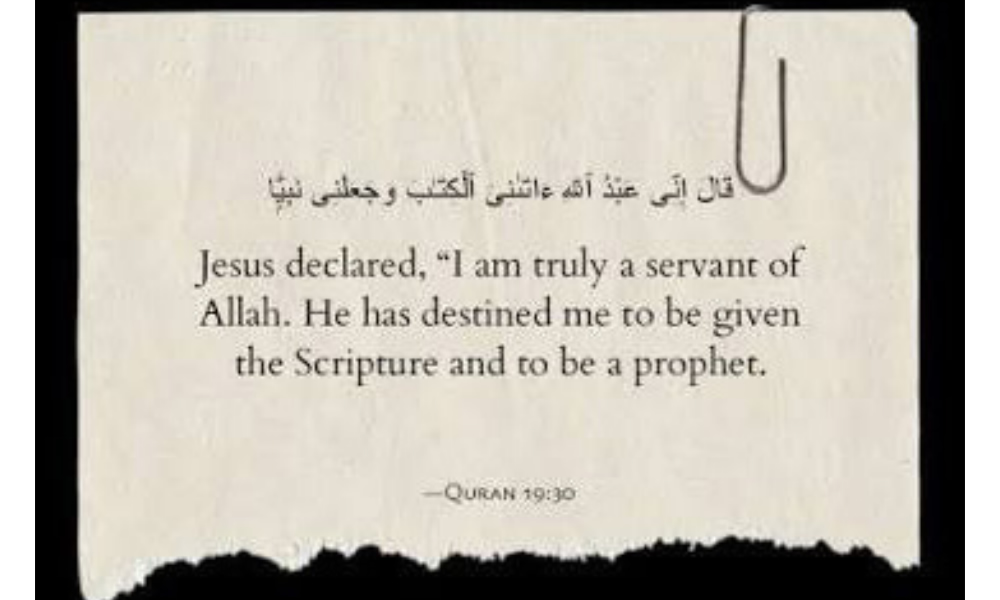
“Indeed, I am the servant of Allah. He has given me the Scripture and made me a prophet.” (19:30)
Before he could walk or speak to crowds, Isa spoke first to declare who he was: a servant of Allah, and nothing more.
Miracles, All by God’s Permission
A mu’jiza (miracle) is an extraordinary event that breaks the usual pattern of creation. Almighty gives it to prophets to support their message and people cannot imitate it.
Islam holds that a miracle is never the prophet’s own power. Allah does it and the prophet is the one through whom the miracle occurs. The Qur’an tells us Isa (AS) is a messenger, not the source of power. He said so himself: “I have come to you with a sign from your Lord” (Al-Imran, 3:49).
When he grew up, Īsā worked wonders. He shaped a bird from clay, breathed into it, and it flew; healed the blind; cured people with leprosy; and brought the dead back to life.
But one phrase keeps coming back: “by permission of Allah.” The power belonged to God. ʿĪsā was the one God worked through. If Isa (AS) had power in himself, he might be worshipped. The Qur’an calls him a servant and messenger (Al-Ma’idah, 5:75).
Christians who called him God are rejected in the same Surah (5:72, 5:116-117).
His Message
Isa (AS) was sent to the Children of Israel (3:49, 61:6). He confirmed the Torah that came before him (3:50). He was given the Gospel, the ‘Injīl’, which the Qur’an calls “guidance and light” (5:46). His message fits in one line: “Allah is my Lord and your Lord, so worship Him.” (3:51).
What Muslims Believe About Him: A Great Prophet, Not God
This is where Islam is very clear. Isa is deeply honoured, but he is not God. He is not God’s son. He is not part of a trinity. “The Messiah, Jesus, the son of Mary, was but a messenger of Allah… And do not say, ‘Three’… Allah is but one God.” (4:171)
On the Day of Judgment, Isa (AS) himself will say he only taught people to worship Allah (5:116–118).
Was He Crucified?
The Qur’an gives a different answer from the Christian one:
“They did not kill him, nor did they crucify him; but [another] was made to resemble him to them… Rather, Allah raised him to Himself.”
Surah An-Nisa (4:157–158).
Most Muslim scholars believe God raised him to heaven alive. A few read verse (3:55) a little differently. But Muslims agree on one point: he was not crucified.
Whatever people believed they saw that day, the Qur’an is clear: Isa was never in his enemies’ hands, but in Allah’s. He raised him up and, in His wisdom, He will send him back.
He Will Come Back
Yes, Muslims believe Jesus will return.
The Qur’an calls him “a sign of the Hour” (43:61). Trusted hadith in Ṣaḥīḥ al-Bukhārī and Ṣaḥīḥ Muslim say he will come back before the end of time. He will rule with justice and clear up the wrong beliefs about him.
True Stories from History of When Faith Built Bridges
History is full of moments when fear and differences divided people. But it also holds quieter stories and examples of some who chose kindness over cruelty, even across faith lines. Here are real stories of Christian-Muslim solidarity: a Christian king who sheltered Muslims and a Muslim leader who risked his life to save Christians.
1. The King Who Said No (c. 615 CE, Aksum, Ethiopia)
Muslims in Mecca were being hurt for their faith. A small group fled across the sea to Abyssinia, where a Christian king, the Najashi, ruled. Soon, messengers came from Mecca to bring them back. The king asked the Muslims to explain their faith. Ja’far ibn Abi Talib read the opening verses of Surah Maryam, which honour Mary and Jesus. The king was moved and wept. Tears ran down until his beard was wet and his bishops wept too, until their holy books were soaked. And he refused to send them away. The Qur’an describes a similar scene in Surah Al-Maidah (5:83).
Sources: Ibn Ishaq/Ibn Hisham, Sira; Ibn Sa’d, Tabaqat.
2. The Emir Who Opened His Doors (July 1860, Damascus)
When violence against Christians broke out in Damascus, Emir Abdelkader, an Algerian leader living in exile, acted. He and his men took Christians into his home and stood against the attackers. Many people later praised him for his courage.
Sources: Biographies of Abdelkader; contemporary historical records.
Two Faiths, One Message of Humanity
Isa (AS) holds a special place in the hearts of Muslims, just as Jesus holds a central place in Christianity. Our beliefs about him may differ, but respect, compassion and humanity should never become casualties of those differences.
A Christian king once opened his doors to protect persecuted Muslims. A Muslim leader once risked his life to save Christians. Perhaps these stories remind us of something the world needs to understand today: faith should inspire kindness, not hatred; compassion, not division.
We may not worship in the same way or celebrate the same occasions, but we can still stand together against injustice. After all, humanity is not measured by the faith of those we help, but by the kindness we show them.
So, when someone needs protection, whose door would we open?
0 Comments