
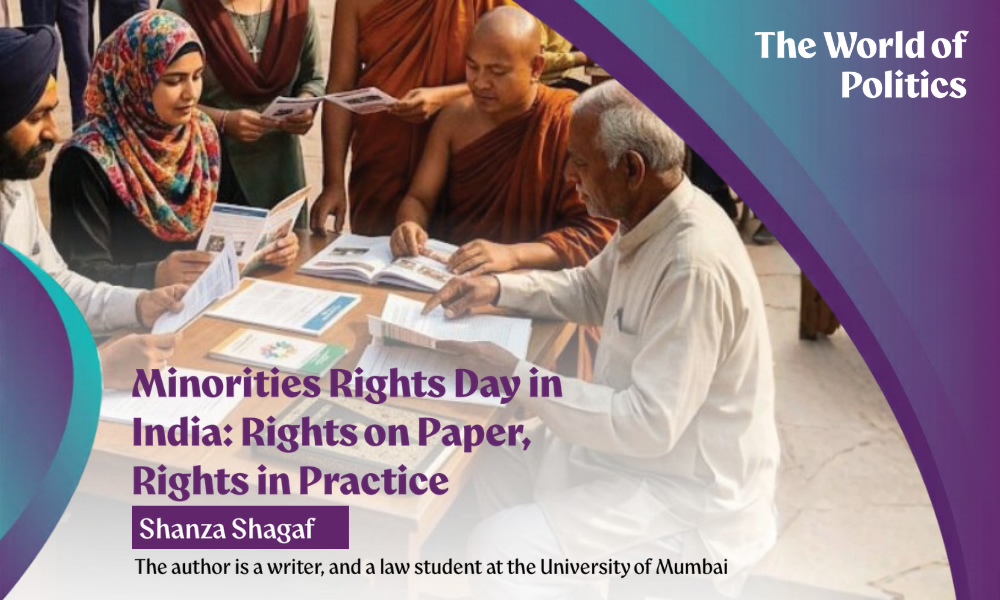
The author is a writer, and a law student at the University of Mumbai
Every December 18, India marks a day that begins with a United Nations text and ends, if it works, in a classroom, a rented flat or a courtroom. The date commemorates the 1992 UN Declaration on the Rights of Persons Belonging to National or Ethnic, Religious and Linguistic Minorities. In India the National Commission for Minorities (NCM) has observed it as Minorities Rights Day since 2013.
The day invites an honest question: how far do the promises in the Constitution reach into ordinary life? India’s answer is layered. Strong guarantees sit on paper, a patchwork of institutions tries to deliver them, and the courts keep redrawing the lines. This article walks through that framework and then looks at how it plays out for people on the ground.
For scale, the six communities notified as minorities at the national level (Muslims, Christians, Sikhs, Buddhists, Jains and Parsis) made up roughly 19 per cent of the population in the 2011 Census. Linguistic minorities, who are counted state by state, are a separate and larger story.
The constitutional framework
The Constitution never defines the word “minority”, yet it protects minorities from several directions at once. Some protections belong to everyone, and some belong specifically to religious and linguistic minorities.
Rights that every person holds
Equality (Articles 14 to 16): equality before the law, no discrimination by the State on grounds of religion, race, caste, sex or place of birth, and equal opportunity in public employment.
Freedom of religion (Articles 25 to 28): the freedom to profess, practise and propagate religion, subject to public order, morality and health. Article 26 lets every religious denomination manage its own affairs in matters of religion, and Article 28 limits religious instruction in State-funded schools.
Rights aimed at minorities
Article 29: any section of citizens with a distinct language, script or culture has the right to conserve it. Article 29(2) bars denial of admission to State-run or State-aided institutions on grounds of religion, race, caste or language.
Article 30: all minorities, religious or linguistic, may establish and administer educational institutions of their choice. Article 30(2) stops the State from discriminating against such institutions when giving aid.
Articles 350A and 350B: the State should provide primary education in the mother tongue, and a Special Officer for Linguistic Minorities is to be appointed.
The Preamble’s commitment to secularism, liberty of belief and fraternity ties these provisions together. The Supreme Court has treated secularism as part of the Constitution’s basic structure, which means Parliament cannot amend it away.
One design choice matters for everything that follows. Articles 29 and 30 are group rights with an individual face: they protect the community’s institutions, but a student or teacher is the one who feels the effect. That tension between community autonomy and individual rights runs through most of the litigation.
Two features of this machinery are worth noting. First, the notification of communities is an executive act. Muslims, Christians, Sikhs, Buddhists and Parsis were notified under the NCM Act, and Jains were added later, which is why the national list has six names. Second, the NCM’s recommendations are advisory, so its impact depends on the response of governments and courts rather than on any power of enforcement.
States run parallel bodies of their own, and many maintain separate minority commissions, finance corporations and scholarship schemes.
What the courts have decided
Because the text is short and the questions are hard, the Supreme Court has done much of the real work of defining minority rights. The cases below are the ones most often cited. Since independence, a handful of Supreme Court rulings have shaped how the Constitution treats minorities and secularism. In Kesavananda Bharati (1973), the Court held that Parliament cannot alter the basic structure of the Constitution. That doctrine was later used to protect secularism. A year later, in St. Xavier’s College v. State of Gujarat (1974), the Court read Article 30 as giving minority institutions real autonomy, while allowing the State to regulate them for standards and fairness.
In Shah Bano (1985), the Court held that a divorced Muslim woman could claim maintenance under the general criminal law. The ruling set off a long public debate that led to the Muslim Women (Protection of Rights on Divorce) Act, 1986. In S.R. Bommai v. Union of India (1994), the Court declared secularism part of the basic structure. It also held that the President’s power to dismiss State governments under Article 356 is open to judicial review. In T.M.A. Pai Foundation (2002), an eleven-judge bench held that minority status is judged state by state, and that minority institutions keep wide control over admissions and management, subject to reasonable regulation. In Shayara Bano (2017), the Court struck down instant triple talaq, showing how courts weigh community practice against equality and dignity.
Most recently, in Aligarh Muslim University v. Naresh Agarwal (2024), a seven-judge bench ruled 4:3 to overrule the 1967 Azeez Basha decision. It held that an institution does not lose minority status merely because a statute created it. The question of AMU’s own status was sent to a regular bench.
The thread through these rulings is a balance. Courts protect a minority’s right to run its own institutions and keep its identity, but they also insist that individual rights, merit and public order still apply. The 2024 AMU decision is a good example. The majority said Article 30 is mainly about non-discrimination and a special right, and it set out a “holistic and realistic” test for minority character. Three judges dissented sharply on how the university’s statute should be read.
How it plays out in everyday life
Law reaches people through schools, offices, neighbourhoods and police stations. Here is where the framework is most visible, and where it strains.
Schools and scholarships. Minority-run schools and colleges, from convent schools to madrasa-linked colleges to Sikh and Jain institutions, exist because of Article 30. The State also supports students directly. Ministry of Minority Affairs scholarships cover pre-matric, post-matric and merit-cum-means categories for the six notified communities. The Lok Sabha was told in February 2026 that over Rs 6,288 crore was released under the pre-matric scheme between 2017-18 and 2021-22, reaching about 2.75 crore scholarships. Applications go through the National Scholarship Portal, and families still report that documentation, Aadhaar-linked bank accounts and income certificates cause rejections.
Language. A Bengali-speaking family in Karnataka or a Kannada-speaking family in Tamil Nadu is a linguistic minority within that state. Articles 29 and 350A are what such families invoke to ask for mother-tongue primary schooling. Implementation depends heavily on state policy and on whether schools exist nearby.
Faith and family law. Marriage, divorce and inheritance follow personal laws for many communities, which creates both protection for religious practice and friction with gender equality. Debates over a Uniform Civil Code, which Article 44 lists as a directive principle, sit exactly here. Supporters see equal citizenship, and critics see a risk to cultural autonomy and to community consent.
Livelihood and housing. The 2006 Sachar Committee report documented that Muslims lagged on several measures of education, employment and public-sector presence, and it prompted a range of schemes. Discrimination in renting homes or hiring is hard to prove because it is rarely written down. Equality provisions bind the State directly, but private discrimination is reached mainly through ordinary criminal and civil law.
Safety and the law. Hate speech, mob violence and communal riots test whether constitutional promises mean anything at street level. The Supreme Court has issued directions on preventing mob lynching and expects states to act against hate speech. Whether those directions are followed varies, and observers disagree sharply on how serious the problem is. The NCM itself has been questioned in public debate over how it records and responds to incidents.
Representation. Minorities have no reserved seats in Parliament, and political voice comes through ordinary elections, the NCM and state bodies. Sikh, Christian and Buddhist communities are concentrated in particular states, which shapes how local politics treats them.
Open debates and recent developments
The Waqf (Amendment) Act, 2025. The law came into force on 8 April 2025 and changed how waqf property is created, registered and governed, including by ending the idea of waqf by user and altering the composition of waqf boards. The Union government says it curbs misuse and unauthorised claims over public land. Petitioners argue it interferes with a community’s right to manage its religious endowments under Articles 25, 26 and 30, among others. On 15 September 2025 the Supreme Court declined to stay the whole Act but paused certain provisions, including the five-year practising-Muslim condition for creating a waqf and the Collector’s power to decide whether a property is government land. The wider challenge was still pending in the sources reviewed for this piece, so readers should check the latest status.
Who counts as a minority. Since T.M.A. Pai, minority status is judged state by state, yet notification of national minorities is done by the Union. That mismatch fuels petitions about communities that are numerically small in a state but not a minority nationally, and about whether the notification power needs clearer criteria. Courts and the government have not settled it.
Minority institutions and State regulation. The 2024 AMU ruling widened the route to minority status for institutions created by statute, but each institution must still prove its character on the facts. Schools and colleges continue to argue over admissions quotas, teacher recruitment and the reach of education laws.
Personal law reform. The Uniform Civil Code debate has moved from principle to state-level legislation, so the argument over community consent and gender justice is now concrete rather than theoretical.
The arguments on each side are sincere. Those who favour tighter State oversight stress transparency, women’s rights and equal treatment. Those who favour strong minority autonomy stress that the original purpose of Articles 25 to 30 was to give small communities security against majority rule.
What December 18 asks of us
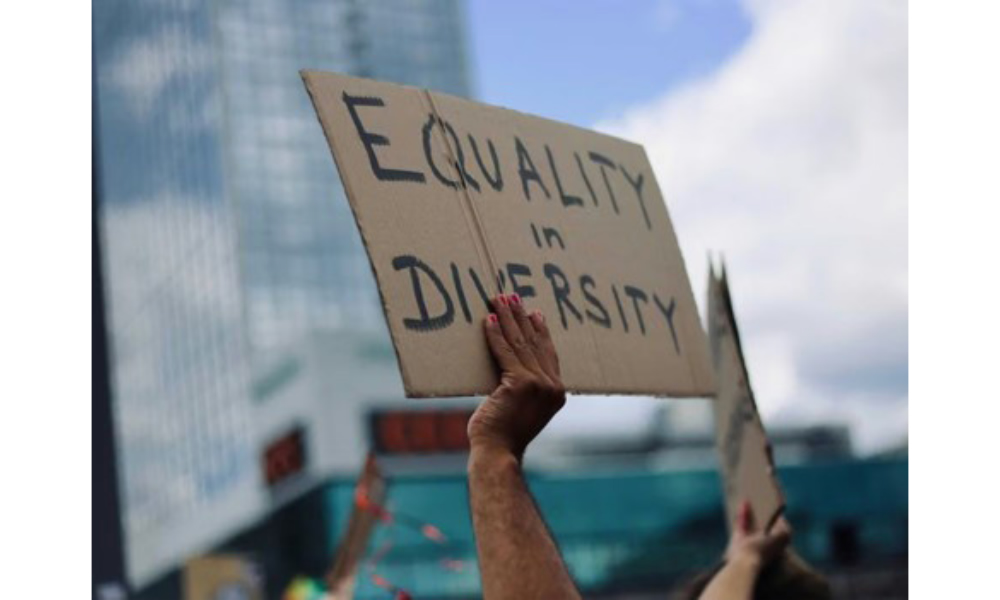
A right on paper becomes a right in life when someone can use it without fear or fuss: a child enrolled with a scholarship, a family renting a flat without being turned away, a school trust running its institution without arbitrary interference, a complaint that gets recorded and answered. The framework India has built is detailed and, in its text, generous. The measure of Minorities Rights Day is the distance between that text and the street.
For readers, the practical steps are modest. Learn what Articles 14, 15, 25 to 30 and 350A actually say. Know where to take a grievance, whether the NCM, a state commission, the NCMEI or a court. And treat a neighbour’s constitutional protections as part of your own, since the same equality clauses protect everyone.
DID YOU KNOW?
Laws and institutions
Below the Constitution sits a set of statutes and bodies that turn principles into procedure.
| Body or law | What it does |
|---|---|
| National Commission for Minorities (NCM) | Set up as a Minorities Commission in 1978 and given statutory status by the NCM Act, 1992. Monitors safeguards, studies grievances and advises the Union government. |
| National Commission for Minority Educational Institutions (NCMEI) | Created by the 2004 Act to protect the Article 30(1) rights of minority institutions and to decide disputes over minority status and affiliation. |
| Ministry of Minority Affairs | Runs welfare and scholarship schemes for the six notified communities. |
| Waqf laws | Govern Muslim religious and charitable endowments, most recently through the Waqf (Amendment) Act, 2025. |
| Personal laws and community statutes | Marriage, inheritance and adoption follow community-specific laws, including laws such as the Anand Marriage Act for Sikhs. |
Sources
ETV Bharat: Minority Rights Day and constitutional safeguards
Free Press Journal: What the day signifies
5 Dariya News: NCM celebrates Minorities Rights Day, 2024
SCC Online: AMU verdict
Supreme Court Observer: AMU judgment summary
Bar and Bench: Supreme Court on the Waqf (Amendment) Act, 2025
Supreme Court Observer: Waqf interim judgment matrix
iPleaders: Waqf (Amendment) Act, 2025 and the interim verdict
Kashmir Life: Pre-matric scholarship figures given to the Lok Sabha
Ministry of Minority Affairs scheme overview (PIB)
0 Comments