
The author is a renowned journalist
The Supreme Court of India on Thursday, 5 November 2026, in an order which will have far-reaching implications to protect the life and property of the citizens under Article 22(2) of the Constitution, said that there can be no artificial distinction between Arrest and Detention.
Article 22(1) says, “No person who is arrested shall be detained in custody without being informed, as soon as may be, of the grounds for such arrest nor shall he be denied the right to consult, and to be defended by, a legal practitioner of his choice.”
According to Article 22(2), “Every person who is arrested and detained in custody shall be produced before the nearest magistrate within a period of twenty-four hours of such arrest excluding the time necessary for the journey from the place of arrest to the court of the magistrate and no such person shall be detained in custody beyond the said period without the authority of a magistrate.”
The 24-Hour Clock Starts at Detention
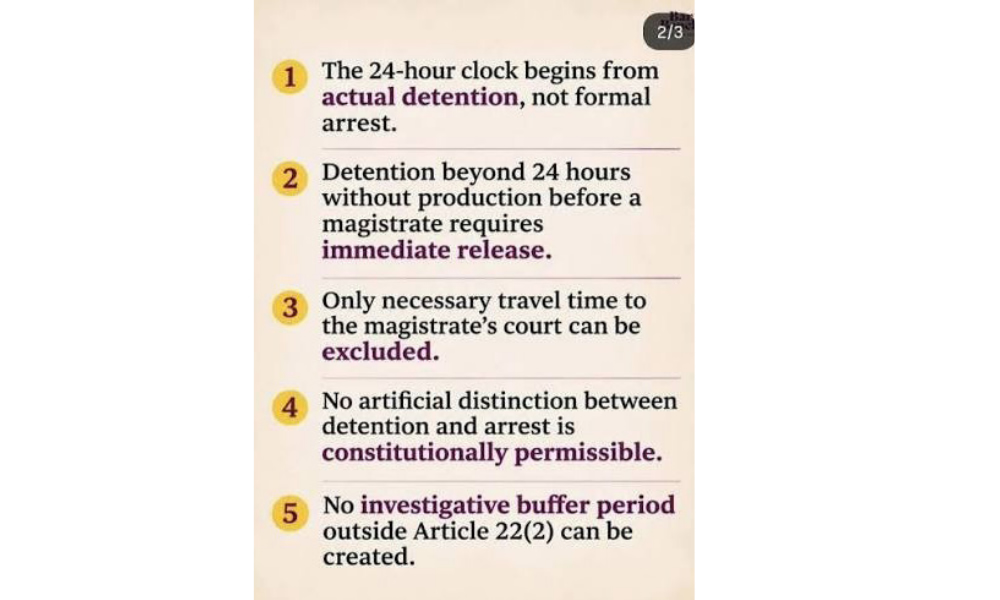
A bench of Justices Ujjal Bhuyan and Atul S. Chandurkar ruled that the 24-hour constitutional deadline for producing an arrested person before a magistrate begins from the moment the person is detained and not from the time the police ‘formally’ makes the arrest. Any interpretation allowing the police to exclude the period of pre-arrest detention would be contrary to the constitutional mandate.
“The view that 24 hours begins only from formal arrest is contrary to the constitutional mandate of Article 22(2) and Section 56 of BNSS,” the Bench clarified. The only period that can be excluded while computing the 24-hour deadline is the time reasonably required to travel from the place of arrest or detention to the magistrate’s court, the judges ruled. The time spent on inquiry, investigation, search or seizure before formal arrest cannot be excluded, the bench added.
The Supreme Court’s order has come at a time when protests by aggrieved youth of the country have been on a protest mode and the police have been arbitrarily detaining and brutally torturing them in custody and releasing them even without producing them before a magistrate. Several Cockroach Janata Party (CJP) protesters were brutally attacked by the Delhi police during the July 2026 Jantar Mantar protest.
Magistrates Must Examine Reasonableness
The SC order said that a Judicial Magistrate must examine whether the period of detention of an accused was reasonable, even if the accused is produced before the magistrate within the constitutionally mandated 24-hour period from the detention or arrest. If the magistrate finds that the detention exceeded what was reasonable in the circumstances of the case, the magistrate may decline remand.
“The magistrate shall also examine at the time of production whether the detention of the person produced, though within the time frame of 24 hours, has exceeded the period which can be construed to be reasonable in the circumstances of the case. If he is satisfied that the detention in custody has been for a longer period than what is reasonable, he may decline remand,” the court ruled.
When an accused is produced before a magistrate, the magistrate is duty-bound to record the actual date and time of detention and ascertain whether the mandate of Section 58 of the BNSS has been complied with. The Magistrate must also independently examine whether the duration of detention was reasonable in the circumstances of the case.
Even if there is technically no violation of the 24-hour deadline, the Magistrate may decline remand if satisfied that the detention was longer than what was reasonable. Consideration of remand cannot be a mechanical exercise, the judges pointed out.
A Silver Lining Amid Custodial Violence
The latest SC ruling is a silver lining in an otherwise tragic scenario where police brutality and custodial violence remain a very critical human rights concern in India. We are faced with extrajudicial encounter killings, custodial torture under illegal detention and crowd control excesses, as recently witnessed even in Delhi.
Police used tear gas, batons and arbitrary detentions against protesters from the CJP marching towards Parliament demanding examination reforms and the resignation of Union Education Minister Dharmendra Pradhan. Dozens of youth and journalists, including women journalists covering the protest, were injured in the indiscriminate attack by the security forces.
A High Powered Enquiry Committee (HPEC) headed by a former Supreme Court Judge, Justice R. Subhash Reddy, is investigating the 20 July 2026 police excesses.
A recent National Crime Records Bureau (NCRB) study showed thousands of police custody deaths over the years with a very low rate of police convictions. In fact, as a reporter who had covered crime for the Indian Express in the 80s, I can vouch that it is next to impossible to convict a policeman in India; one can count exceptions on your fingers.
In early 2026, UN Human Rights experts raised alarm over a pervasive pattern of excessive force and “encounters” in states like Uttar Pradesh and Assam. They also noted that India had not ratified the UN Convention Against Torture (UNCAT) and lacks explicit domestic criminalisation of torture.
DID YOU KNOW?
Bail, Torture and Detention: Landmark Rulings
The basic rule is bail, not jail (State of Rajasthan v Balchand, 1977). The Court restated this norm and issued fresh guidelines (Satender Kumar Antil v CBI, 2022).
Even under UAPA, courts can grant bail where prolonged incarceration has become so excessive as to infringe upon the accused’s fundamental right to a speedy trial (Union of India v KA Najeeb, 2021).
The Court made arrest memos, medical examinations and informing relatives mandatory on arrest (DK Basu v State of West Bengal, 1997). Yet India signed UNCAT in 1997 but has not ratified it yet (UN Convention against Torture, 1997)
0 Comments