
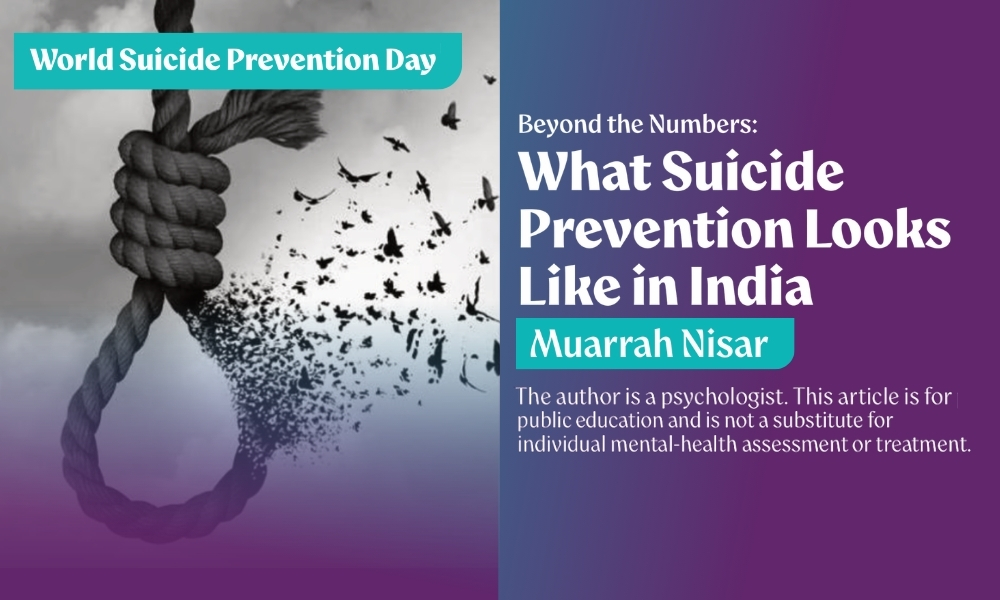
The author is a psychologist. This article is for public education and is not a substitute for individual mental-health assessment or treatment.
Suicide prevention does not begin only when a person reaches a crisis. It begins much earlier, in the way distress is recognised, in the language used to discuss mental health and in whether people feel safe enough to ask for help.
Every year, September 10 is observed as World Suicide Prevention Day. The day encourages communities to remember those who have died, support people affected by suicide and examine how families, institutions and health systems can respond more effectively.
In India, this conversation requires both data and empathy. Official figures help us understand the scale and distribution of suicide, but behind every number is a person whose distress may have remained unseen or unsupported.
What the Numbers Show
The National Crime Records Bureau’s Accidental Deaths and Suicides in India 2022 report recorded 170,924 suicides in India in 2022, compared with 164,033 in 2021. The reported suicide rate increased from 12.0 to 12.4 per lakh population during the same period.
The NCRB also reported a higher suicide rate in cities than across India as a whole. In 2022, the reported urban rate was 16.4 per lakh, compared with the national rate of 12.4 per lakh.
These figures are significant, but they must not be treated as a complete picture of suicidal distress in India.
The Limits of NCRB data
NCRB figures are compiled from cases reported to and recorded by police and other law-enforcement authorities. This means the data reflects registered deaths, not necessarily every suicide that occurs.
Several factors can affect the numbers:
- under-reporting: Families may avoid reporting a death as suicide because of stigma, shame, religious concerns or fear of social consequences.
- misclassification: Some deaths may be recorded as accidental or may remain undetermined, particularly when the available evidence is incomplete.
- Differences in reporting practices: States and Union territories may differ in police procedures, registration systems, documentation and the way suspected suicides are classified.
- Unequal access to institutions: Deaths in remote or underserved areas may be less likely to enter formal administrative records.
- population estimates: Suicide rates depend on population denominators, and differences in census projections or population estimates can affect comparisons.
- Limited information about suicidal distress: NCRB data generally records deaths. It does not capture the full number of people experiencing suicidal thoughts, making attempts, seeking help or living through a crisis without formal intervention.
These limitations do not make NCRB data irrelevant. The figures remain an important source for identifying broad patterns and informing public-health planning. However, year-to-year changes and differences between states should be interpreted cautiously rather than treated as exact measures of the prevalence of suicide.
NCRB figures should also not be directly compared with WHO estimates without examining how each source defines, collects and models the data. Different methods can produce different estimates, particularly in settings where deaths may be under-reported or misclassified.
The most responsible conclusion is that India’s official figures show a serious and persistent concern, while the true scale may be difficult to measure precisely.
An Uneven National Picture
India’s reported suicide rates vary widely between states and Union territories. In 2022, Sikkim recorded the highest reported rate at 43.1 per lakh, followed by the Andaman and Nicobar Islands at 42.8, Puducherry at 29.7 and Kerala at 28.5.
Such differences should not be used to label particular communities as inherently more vulnerable. Rates can be shaped by many factors, including age distribution, economic conditions, social isolation, access to mental-health services, help-seeking behaviour and local reporting practices.
A lower reported rate does not necessarily mean that a region has less distress. It may also reflect differences in registration, classification or access to reporting systems. Similarly, a higher reported rate may partly reflect more complete reporting.
The figures therefore underline the need for prevention strategies that are sensitive to local realities. A programme that works in a large city may not be equally accessible in a rural district, a small town or a community where psychological services are limited.
What Professionals Hear
Statistics tell us how many deaths are recorded. They do not always tell us how people arrive at a crisis.
As a psychologist, I have found that emotional distress rarely has one simple cause. A person may be dealing with family conflict, academic or workplace pressure, financial stress, relationship difficulties, chronic illness, grief, loneliness or a sense of failure. Often, several pressures overlap.
The visible crisis may appear sudden, but the person may have been struggling for a long time. They may also have been unsure whom to approach or worried that disclosure would lead to judgment, punishment or loss of control.
This is why it is dangerous to reduce suicide to one event or one explanation. A single incident may be the immediate context, but it does not necessarily explain the person’s entire experience. Prevention requires us to look at prolonged distress, social support, access to care and the barriers that prevent people from seeking help.
Sometimes, what looks like a sudden crisis is actually the point at which a person’s ability to cope has finally been exhausted.
And that is why prevention cannot begin only at the point of crisis.
Recognising Distress
There is no single warning sign, and not everyone who shows distress will attempt suicide. However, changes in behaviour and communication deserve attention, particularly when they are sudden, persistent or accompanied by withdrawal.
Possible signs include:
- Expressing intense hopelessness or feeling like a burden.
- Withdrawing from friends, family or activities that once mattered.
- Showing significant changes in mood, sleep or everyday functioning.
- Speaking about death, disappearing or not wanting to live.
- Giving away valued belongings or saying goodbye in an unusual way.
- Increasing alcohol or substance use.
- Appearing unusually agitated, overwhelmed or emotionally shut down.
These signs should not be treated as a diagnostic checklist. They are invitations to respond with care.
Starting a Conversation
People sometimes fear that asking directly about suicide will make matters worse. But asking calmly and directly about suicide does not, by itself, put the idea into someone’s mind. More importantly, it can communicate something a distressed person may desperately need to hear: someone has noticed, and someone is willing to listen.
A supportive conversation may involve:
- Choosing a private and appropriate time to talk.
- Asking what has been happening and listening without rushing to give advice.
- Avoiding statements such as “be strong”, “think positively” or “others have it worse”.
- Asking directly whether the person has been thinking about suicide.
- Helping them connect with a qualified mental-health professional or helpline.
- Involving a trusted family member or friend when appropriate.
- Staying with the person and seeking urgent help if there is immediate concern about their safety.
A friend, family member, teacher or colleague is not expected to provide therapy. Their role is to notice, listen, take the person seriously and help connect them with appropriate support.
Sometimes, the most helpful thing we can offer is not an answer, but enough safety for someone to finally say what they have been carrying.
Prevention beyond Crisis Care
Crisis intervention is essential, but suicide prevention cannot be limited to moments of emergency. It also involves creating conditions in which people can seek help earlier.
That means improving access to affordable psychological care, strengthening mental-health services in schools and workplaces, expanding support in regional languages and training community workers to recognise emotional distress.
It also means creating environments where people can speak about mental-health difficulties without being mocked, punished or treated as weak. Families and institutions need to respond to distress with curiosity and compassion rather than blame.
For mental-health professionals, prevention also requires self-reflection. We must ask whether our services are accessible beyond urban centres, whether our language is understandable and whether our interventions are culturally responsive. Mental-health care should not be available only to people who already know how to find it.
Prevention is not only about knowing what to do when someone says, “I want to die.”
It is also about building families, friendships, schools, workplaces and communities where a person can say, “I am not okay,” long before they reach that point.
Reporting with Responsibility
Public discussion about suicide must be careful. Graphic descriptions, speculation about personal motives, sensational headlines and details about methods can cause harm and should be avoided.
Responsible communication protects privacy, avoids reducing a death to a single cause and includes information about support and recovery. It also recognises the effect of suicide on families, friends, colleagues and communities.
Silence is not a prevention strategy. People need accurate information about emotional distress, professional support and ways to respond when someone appears unsafe. They also need to hear that seeking help is not a sign of weakness.
The most useful question may not be only, “Why did this happen?”
It may also be:
“What support could have reached this person earlier, and what can we change now?”
If You are Concerned about Someone…
Listen without judgment and take what the person says seriously. If you are worried about suicide, ask directly and calmly. Do not leave the person alone if you believe there is immediate danger; contact emergency services, a qualified mental-health professional or a trusted support person.
You do not need to have perfect words. You do not need to solve everything.
Sometimes, staying present, listening without judgment and helping someone reach appropriate support can be the first step towards safety.
Where to Seek Help
Tele-MANAS: Call 14416 or 1800-89-14416 for free, 24/7 mental-health support in India. The Government of India’s Tele-MANAS programme provides round-the-clock tele-mental-health support and links people to further care when required.
If you or someone else is in immediate danger, contact local emergency services or go to the nearest hospital emergency department.
Source: National Crime Records Bureau, Accidental Deaths and Suicides in India 2022.
This place feels like a favorite corner table where you know the staff will look after you. Quick responses, smooth gameplay across devices, and a community that keeps things positive and encouraging. I keep coming back because it genuinely makes my downtime better. Give it a spin at bosskucucilogin