
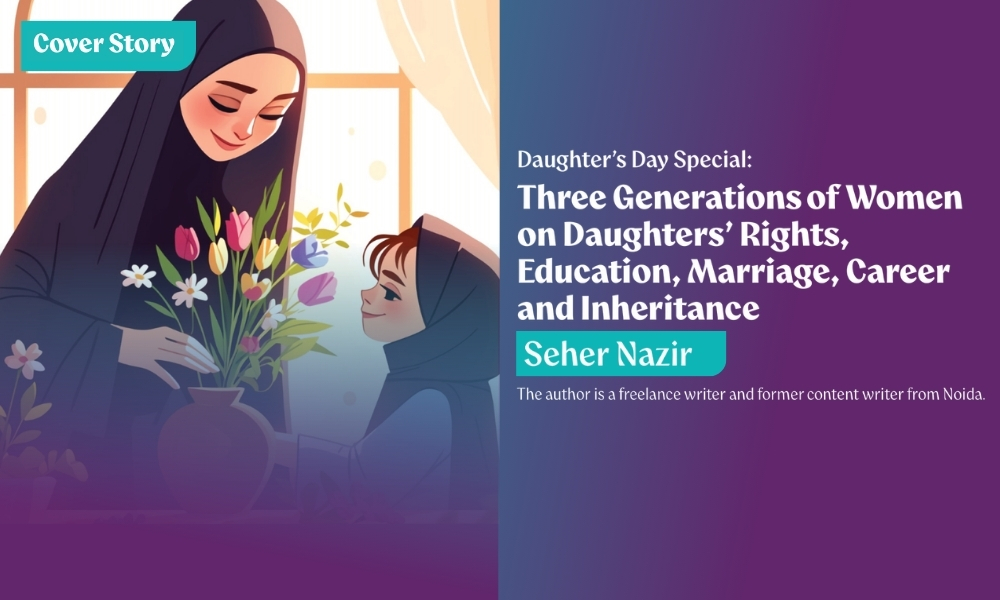
The author is a freelance writer and former content writer from Noida.
Prophet Muhammad ﷺ taught that raising daughters with love, dignity, and care is a path to Paradise. The greatest tribute to a daughter is not just celebrating her, but protecting her rights, nurturing her dreams, and treating her with justice every day.
Are we raising daughters with equality or merely celebrating them for a day?
Every generation wants the best for its daughters, but what “best” means has changed, from education and marriage to choice, independence, and inheritance. Yet many daughters still struggle for equality and opportunity.
A society cannot claim to honour daughters while denying the rights God has given them. Inheritance is not charity; accept that it is a daughter’s right.
More than 1,400 years ago, Islam recognised a daughter’s dignity by granting her right to inheritance, encouraging her education, and honouring her place in the family. Today, the Constitution of India and Indian laws uphold equality, education, property rights, and protection for women.
The Qur’an made a daughter’s inheritance a ‘Divine Right’, not a family favour. Respecting that right is an act of justice and
obedience to Allah.
Beloved Prophet Muhammad ﷺ says, “Give the shares of inheritance to those who are entitled to them.” – Sahih al-Bukhari
A Daughter’s Share: What Islam Says
For Muslim families today, this gives a beautiful example to the world; the Holy Qur’an clearly states that both men and women have a share in what parents and close relatives leave behind (Qur’an 4:7). The Qur’an further lays down the shares of daughters in inheritance (Qur’an 4:11), challenging deep-rooted cultural practices in which daughters are expected to forgive their entitlement in favour of their brothers after marriage.
The Constitution sees no difference between a son and a daughter… Yet, the real test begins at home, where traditions, beliefs, and family decisions often shape a daughter’s future more than laws alone.
The Qur’an recognised a daughter’s importance and their rights over 1,400 years ago, while the Constitution of India guarantees equality and protection against discrimination. Both underscore the importance of respecting the rights and dignity of daughters.
This Daughter’s Day, we bring together the voices of three women from the same family; each representing a different generation to understand how views on inheritance, education, marriage, career, and a daughter’s role have evolved.
Three generations, one question: when will mindsets match the Constitution?
From inheritance and education to marriage and career, every generation has seen change. I spoke to three women in my own family from three generations to understand how their views on a daughter’s life have changed. I found that their answers reflect not only changing times, but also the journey from tradition to equality. A daughter’s life is shaped not only by laws but also by the beliefs passed down through generations. Today, I’m bringing together voices to understand how these perspectives evolved.
Interview 1
First Generation (Grandmother)
Interviewer:
Q1. Tell us about yourself and what was life like for daughters when you were growing up?
Grandmother:
In our time, daughters were prepared for marriage, not careers. We married young, followed traditions, and had very few opportunities for education. I was married at 15, but I never gave up on my dream of learning. With your grandfather’s support, I continued my education and became a teacher and later a government school principal. I feel fortunate that I got a chance to build my own life.
Q2. What did being a daughter mean in your generation and what were your views on the birth of a daughter?
Ans.
In my generation, raising a daughter is a burden and she is someone else’s wealth. But I feel that my daughters are the pride of my family, not a burden. However, I also believe that the home stays incomplete without a son. Sons carry the family name and daughters should be adjusting and get married timely. According to traditions, giving unlimited independence and freedom to daughters can be a cause for ruining married life, so every parent should educate daughters and teach them to be submissive and learn skills for happy married life.
Q3. How were marriage decisions made in your generation and what age was marriage considered appropriate in your time?
Ans: We were too young to make decisions; it was completely decided by elders. Those days, children rarely questioned their parents’ choice. As you know, I was married in my early teens; it was normal. I don’t remember much about marriage and was unaware of what was the right age for marriage. I became a mother before I even became a woman; this was my ‘kismat’ fate.
Q4. What do you think about a daughter’s education, career and financial independence?
A woman must stand on her own feet so she never has to beg for her basic needs. Marriage is a sacred duty and a life without family is incomplete.
Q5. What is your view on a daughter’s inheritance rights?
Ans: I gave my daughter wings and roots; a daughter’s true inheritance is her education and husband’s property. Daughter becomes a part of another family and her security lies in her husband’s house. A son is ‘waris’ inheritor; he is the breadwinner of the family and his responsibilities are to take care of parents and his wife and children.
Q6. What message would you like to give today’s parents and daughters?
Ans: Every generation has its own way of thinking. We followed traditions and respect them. I believe every daughter should receive good education and confidence to stand on her own feet. Education is the greatest gift we can give our daughters.
Interview 2
Second Generation – Mother
Me:
Q1. How was your life and, for other girls in your time, how did society view the birth of a daughter?
Ans: Sadly, the birth of a girl is always a big disappointment. which as
It was a time when the birth of a boy was celebrated. A daughter was seen as a burden. I’m lucky; my parents valued my birth and encouraged my education and they loved their children equally. But, like others, my parents also viewed daughters as ‘paraya dhan’, someone else’s property seeming like daughters are temporary members of the family.
Q2. How important was education for girls in your time?
Ans: Those days, higher education for daughters was not essential, just get married early. People say that if you postpone marriage, it would be difficult to get good partners and difficult to adjust and, most importantly, bear a child.
As a woman, I believe that education for every daughter is essential because education provided me confidence, independence and respect in society.
Q3. At what age did you get married and what is your advice to daughters on marriage?
Ans: I was fortunate to get higher education, become a government teacher and earn a pension. Education gave me a career, confidence and better choices in life. I married at 26, and unlike most girls of my time, I was grateful for everything; my parents chose my partner. I trusted their decision.
I believe marriage is important, but it is not your whole life. Love and respect your partner, adjust when needed, but never lose your identity or accept injustice in the name of adjustment.
Q4. What do you think about daughters choosing their own careers and timing of marriage?
Ans: I strongly believe every child deserves the freedom to choose their own path. Parents should support their dreams, while offering the right guidance.
My experience has taught me one thing: daughters, don’t rush. Take your time, build your career, secure your finances and learn to live confidently. Marriage is a lifelong commitment, so enter it when you are emotionally and mentally ready, but not because of pressure or age.
Choose a life partner who respects your independence and supports your dreams. Remember, a good partner need not be rich in money, but rich in character.
I strongly believe individual choice is a priority before every child, so parents should support their child’s dreams, but guidance is a must.
Q5. What are your views on a daughter’s inheritance rights and what do you think about your mother not giving you any rights to property?
I’ve always felt family relationships matter more than money or property. My mother put the property in my brother’s name, and I never really worried about it since I’ve never been focused on inheritance or material things. To me, being a daughter has always meant love, respect, and staying close to my family. At the same time, I do understand that daughters have a rightful share in inheritance under our religion and Constitution, and I think those rights are fair and important.
Q6. What message would you like to give to today’s parents?
Today’s parents should raise daughters with love, confidence, and independence. They should be given good education so they can build their careers and make their own life choices. Marriage should not be forced or done in a hurry because of society’s pressure. Daughters should get equal respect, equal opportunities, and equal rights in inheritance. Times have changed and daughters should not be married off early; their dreams and future are just as important.
Interview 3
Millennial Mothers
Interviewer:
Q1. What does having a daughter mean to you in today’s world?
Ans.
Having a daughter today is a joy and duty. I want her to feel safe, loved and free to choose her path. My responsibility is to guide and support her dreams and passion. I want to raise her to be confident, independent and kind.
Q2. How important is higher education for a daughter, and would you support her dreams and choices?
Ans.
As a mother, I value higher education; this gives the door for better opportunities and skill-building. I want her to pick the path that gives independence, growth and happiness. Yes, I will always support and I will help her explore options, find possible resources and fund her passion. My priority is that she becomes capable, happy and able to stand on her feet.
Q3. What is essential – to marry at the ‘right age’ or become financially independent before marriage?
Ans.
As a mother, I believe financial independence should come before marriage. Marriage has no fixed “right age”; she should marry when she is emotionally ready, knows her partner well, and feels respected and safe. Financial independence gives her confidence and freedom to make her own choices.
Q4. If your daughter chooses not to marry, how would you respond?
Ans.
I would respect her decision and support her. Marriage is a personal choice, not a duty. I would only want her to be happy, safe, independent, and confident in her life.
Q5. Do you believe daughters should have the same rights to family property as sons? Why or why not?
Ans.
Yes, absolutely. As a mother, I believe daughters and sons should have equal rights to family property because both are equal members of the family. A daughter’s marriage should not take away her rights. It is also her legal right in India.
Q6. If you could give your daughter one piece of advice about her future, what would it be?
Ans.
I would tell her: Believe in yourself, become financially independent, and never be afraid to choose the life that makes you happy.
From Limited Choices to New Possibilities: Three Generations, One Unfinished Journey
The oldest generation grew up with limited choices, where a daughter’s education and career often came second to marriage and family. Tradition told them that daughters belonged to another home, while property and inheritance were meant for sons.
The next generation carried many of those beliefs, often choosing love, respect and emotional security over claiming their share. But when it came to their daughters, something began to change; they started believing that a daughter’s rightful share should not be denied.
Millennial mothers are taking that change further. They want their daughters to have the education, careers, property rights and choices they once wished for themselves.
The youngest generation has more freedom to study, build careers and choose their partners. Yet, across all three generations, daughters still face questions of safety, equality and acceptance.
The world has changed, but the journey is not over.
In every mother I spoke to, I found the same quiet dream: “My daughter should have the choices I never had.”
Perhaps that is the true meaning of Daughter’s Day: it is not simply to celebrate daughters, but to build a world where they never have to ask for what should have always been theirs: the right to dream, to choose, to inherit, and to live with dignity.
From Changing Mindsets to Equal Rights
But beyond changing attitudes, there is one question that determines a daughter’s equality and security: does she truly have an equal share in her family’s property?
What Does the Law Say?
For generations, daughters were often expected to leave their parents’ home after marriage, while family property was passed mainly to sons. But the Indian Constitution has changed this thinking and corrected this imbalance by giving equality before the law and prohibiting discrimination on the basis of sex.
Articles 14 and 15 of the Indian Constitution deal with the right to ensure equality before the law and prohibit discrimination. Everyone is treated fairly regardless of gender, caste or background. Together, they form the constitutional basis for recognising a daughter’s equal right to inherit property. Both of these articles lay a strong foundation for a historic Act:
Under the Hindu Succession (Amendment) Act, 2005, daughters were given the same rights as sons in ancestral/coparcenary property. The Supreme Court, in Vineeta Sharma v. Rakesh Sharma (2020), further clarified that a daughter has this right by birth, and her marriage does not take it away.
However, this does not mean every daughter automatically gets half of her parents’ entire property. Her share depends on the type of property, family circumstances and applicable inheritance law. The real challenge is often social: many daughters still hesitate to claim their share because they fear hurting family relationships.
A daughter’s right to inheritance is not a favour but it is a matter of equality and law…
Beyond Love; Give Her Equality
Equality is not only about giving a daughter wings to study, work and choose her future. It is also about accepting that she belongs to the family not just emotionally, but legally too.
“When we give our daughters equal rights, we aren’t changing our traditions but we are improving their future…”
Disclaimer
The views and opinions expressed in this article are those of the interviewees and do not necessarily reflect the official policy or position of the magazine as the interview has only been edited for style and grammar.
0 Comments