
and gardening.
The Significance of Hajj
Hajj is one of the Five Pillars of Islam, obligatory upon every able Muslim at least once in their lifetime.
The Holy Qur’an mentions:
“And [due] to Allah from the people is a pilgrimage to the House—for whoever is able to find thereto a way” (Qur’an 3:97).
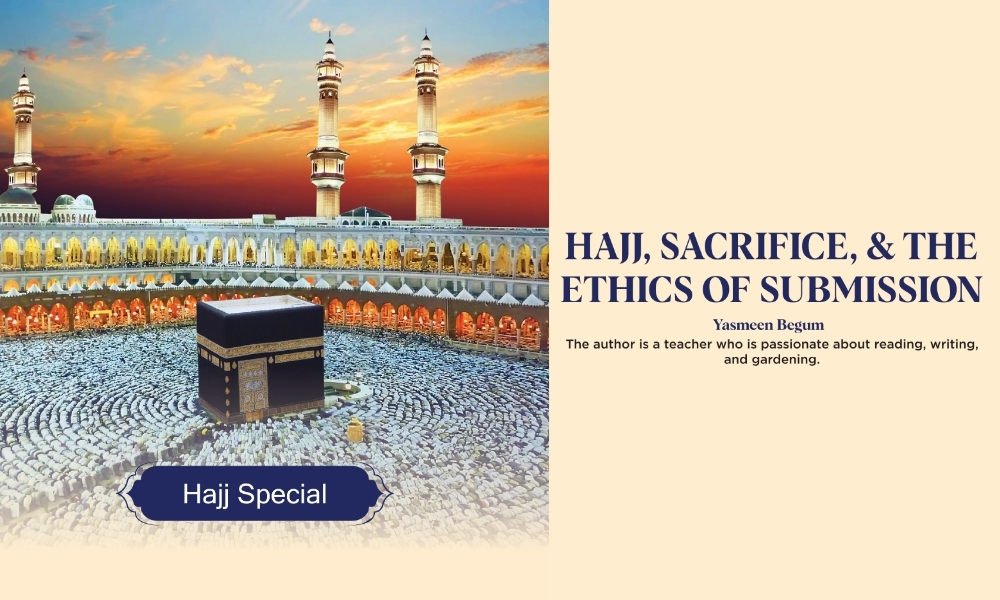
The rituals of Hajj—ihram, tawaf, sa‘i, standing at ‘Arafah and the stoning of the Jamaraat. It represents the ultimate form of submission: the pilgrim leaves behind worldly comforts, dons simple garments, and enters a state of ihram. There are no differences made based on social status, wealth and identity.
This equality reflects in the Qur’anic verse:
All humans are equal before Allah, distinguished only by their piety (49:13).
The Sacrifice in Islam
Sacrifice of an animal is the core of the festivities during Eid al-Adha. This act commemorates Ibrahim’s (A)willingness to sacrifice his beloved son, Ismaeel (A) in obedience to Allah Almighty’s command.
The Qur’an narrates this in the verse:
“And when he reached with him [the age of] exertion, he said, ‘O my son, indeed I have seen in a dream that I [must] sacrifice you, so see what you think.’ He said, ‘O my father, do as you are commanded. You will find me, if Allah wills, of the steadfast’” (Qur’an 37:102).
The whole matter is not about the act of sacrifice itself, but about the spirit of submission and trust in Allah. Ultimately, Allah replaces Ismaeel (A) with a ram, demonstrating that what is required is not blood, but sincerity and obedience:
The Holy Qur’an mentions:
“It is neither their meat nor their blood that reaches Allah, but it is piety(Taqwa) from you that reaches Him” (Qur’an 22:37).
Thus, sacrifice in Islam is symbolic of a deeper ethical principle: the willingness to surrender one’s desires, attachments and ego for the sake of Allah.
Ethics of Submission in Islam
Submission in Islam means the voluntary, sincere surrender of one’s will to Allah by following His commands and trusting His decree. To submit to Allah is to enter into a state of inner harmony and moral clarity.
The Qur’an consistently emphasises that true submission must be accompanied by virtue and morality.
“Woe to those who pray but are heedless of their prayer—those who make a show [of their deeds] and withhold small kindnesses” (Qur’an 107:4–7).
Hajj serves as a comprehensive training in ethical submission. Pilgrims must avoid arguments, obscenity, and sinful behaviour:
The Holy Qur’an mentions:
“There is to be no sexual relations and no disobedience and no disputing during Hajj” (Qur’an 2:197).
This ethical discipline cultivates patience, self-restraint, and compassion—qualities essential to a life of submission.
The life and teachings of Prophet Muhammad ﷺ provide a practical model for understanding Hajj and submission. His Farewell Pilgrimage is particularly significant, as it summarises the ethical vision of Islam.
In his final sermon, the Prophet emphasised the sanctity of life, property, and honour; the equality of all races and tribes; and the importance of justice and accountability.
He declared:“All mankind is from Adam and Hawwa. An Arab has no superiority over a non-Arab, nor a non-Arab over an Arab; also a white has no superiority over a black, nor a black over a white—except by piety and good action.”
This message resonates deeply with the Hajj experience, where millions gather in same garments, united in purpose and worship. The Sunnah thus transforms Hajj from a set of rituals into a lived ethic of equality, justice, and humility.
Beyond the Sacrifice
The Qur’an repeatedly links worship with care for the poor. The meat from the sacrifice is distributed among family, friends, and the needy. This act transforms personal devotion into social ethics.
Sacrifice in Islam includes the willingness to give up harmful habits, unjust practices, and selfish desires. It is a continuous process of self-purification (tazkiyah).
Conclusion
The story of Ibrahim’s (A) sacrifice teaches that Faith in Allah (Iman Billah) requires trust, courage and the willingness to surrender for the sake of Allah. Hajj gives the believers a chance to renew their faith (Imaan) and polish their character . Ultimately, Hajj becomes not just a journey to a sacred place, but a journey towards excellence and spiritual fulfillment.
DID YOU KNOW ?
🕰️ For centuries, pilgrims travelled in massive organised caravans like the Hajj caravans, some taking months or even years to reach Mecca.
🏰 The Ottoman Empire built forts, wells, and roads along Hajj routes to protect pilgrims from bandits and harsh desert conditions.
🚂 In the early 20th century, the Hejaz Railway was constructed to make the journey faster — a trip that once took weeks could be shortened dramatically
Finally found a link that actually works without any glitches. The game variety on 877jililink is just amazing, highly recommended for all players.