
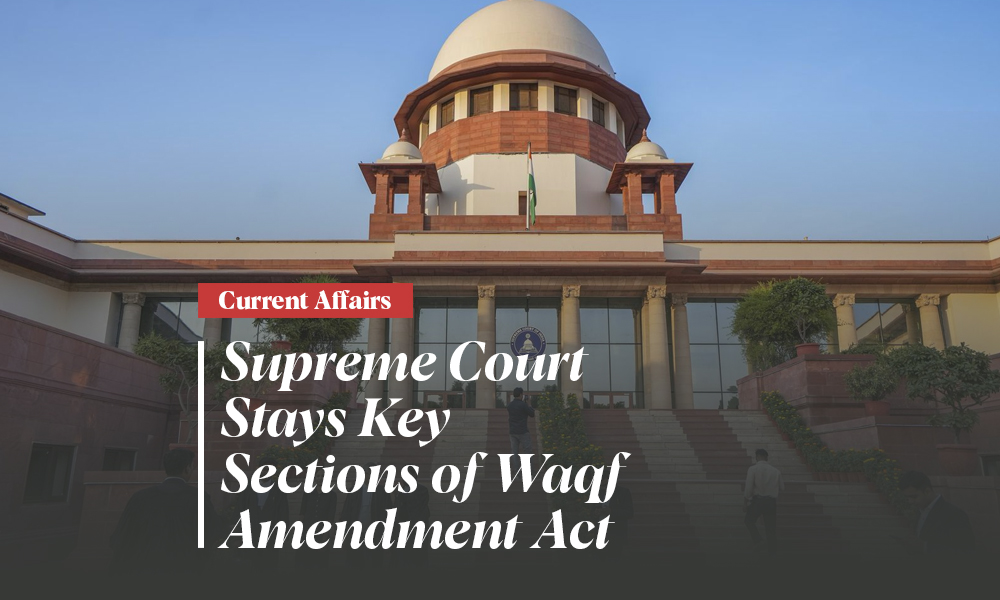
Court Halts Key Provisions of Waqf Law
In a major victory for secular forces in the country, the Supreme Court on Thursday ordered that no Waqf property will be denotified and no appointment will be made to the Central Waqf Council or the State Waqf Boards until the matter is taken up on the next date of hearing, scheduled for 5 May.
The order was issued by a Supreme Court bench headed by the Chief Justice of India (CJI), Sanjiv Khanna, and comprising Justices P.V. Sanjay Kumar and K.V. Viswanathan, on a batch of petitions challenging the constitutional validity of the Waqf (Amendment) Act, 2025.
The court also granted the Union Government
one week to file its response to the petitions challenging the constitutional validity of the controversial amendment to the Waqf law, which had witnessed fierce opposition in both houses of Parliament.
Key Provisions Under Judicial Scrutiny
At Wednesday’s hearing, the Supreme Court scrutinised some of the key provisions of the amendment, like the derecognition of the waqf-by-user category of Waqf properties, the inclusion of non-Muslims in Waqf administrative bodies like the Waqf Council and State Waqf Boards, and the power granted to the state to change the status of disputed Waqf properties.
The petitioners have contended that WAQFS, including their creation, management, and administration, CONSTITUTE AN INTEGRAL ASPECT OF THE PRACTICE OF ISLAM AND ARE THEREFORE ENTITLED TO CONSTITUTIONAL PROTECTION.
However, the Union Government has defended the amendment, arguing that it is intended to bring greater transparency and accountability to the management of Waqf properties. The Union Government notified the law after it received the President’s assent on 5 April 2025. The Lok Sabha passed the Amendment Bill with a majority of 56 votes, while in the Rajya Sabha it was passed with a margin of 33 votes.
Giving the stay order, the CJI said, “Normally, it is rare to stay a statute, but we are apprehensive that the situation could drastically change.”
Appearing on behalf of the Union Government, Solicitor General Tushar Mehta contended that a stay on the statute would be a “harsh step.” However, the Chief Justice proposed a three-point interim order to “balance equities” on all sides in the case.
Three-Point Interim Relief by the Supreme Court
Firstly, properties already declared Waqf by the courts need not, for the time being, be denotified or treated as non-Waqf properties. These would include properties categorised as waqf-by-user or Waqf by long usage without formal documentation or registration, as Well as Waqf by declaration or otherwise.
Secondly, the CJI suggested that the designated government officer could continue to investigate whether a property was Waqf or government property, but a connected provision freezing the use of the property as Waqf (a property dedicated to Allah for charitable or religious purposes under Islam) could be stayed in the meantime.
Thirdly, the Chief Justice proposed giving the go-ahead to the appointment of non-Muslims as ex officio members in the Central Waqf Council and Waqf Boards, provided the other members were Muslims.
The Supreme Court took strong note on Wednesday of an analogy drawn by the Union in support of including non-Muslims in Waqf Boards, and the argument that by that logic, a bench of Hindu judges should not hear pleas related to Waqf.
“Are you suggesting that minorities, including Muslims, should also be included in boards managing Hindu religious institutions? Please state that openly,” CJI Khanna asked.
Solicitor General Tushar Mehta defended the provisions and said if the objection to the presence of non-Muslims in the statutory Boards is accepted, then the present bench would also not be able to hear the matter, adding, “Then your Lordships cannot hear this matter if we go by that logic.”
The CJI replied, “No, sorry Mr. Mehta, we are not talking just about adjudication. When we sit here, we lose our religion. We are absolutely secular. For us, one side or the other is the same.”
Reactions from Religious and Political Circles
The All India Shia Personal Law Board (AISPLB) General Secretary, Maulana Yasoob Abbas, following the SC order, expressed hope in the Supreme Court and said the Court’s observations while hearing petitions challenging the constitutional validity of the Waqf Amendment Act 2025 have raised faith in the judiciary.
Stressing the importance of resolving issues within the constitutional framework, Maulana Abbas urged people to maintain unity and brotherhood, ensuring that peace in the country is not disrupted. “If the judiciary does not deliver justice, then where will people go? We are trying to resolve all matters within the framework of the Constitution,” he added.
Congress leader Pramod Tewari, welcoming the initial Supreme Court order on the Waqf Amendment Act, said the questions raised by the Supreme Court are the same issues the Congress Party raised on the matter in the Joint Parliamentary Committee.
0 Comments