
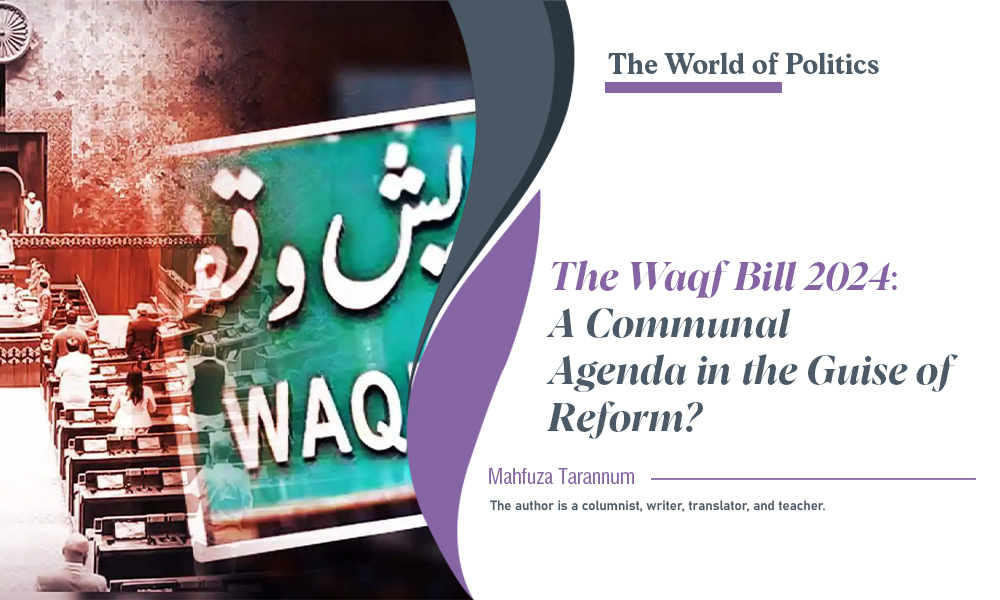
The author is a columnist, writer, translator, and teacher.
Understanding Waqf
Waqf is an Islamic institution where individuals donate property, land, or assets for religious, charitable, or social purposes. Once dedicated, the property becomes inalienable—it cannot be sold, inherited, or gifted. Its benefits are used for community welfare, and the concept is deeply rooted in Islamic law (Sharia).
While the Qur’an and Hadith do not explicitly mention Waqf, they encourage charitable acts. Verses such as:
- “Spend from the good things you have earned.” (Surah Al-Baqarah: 267)
“You will never achieve righteousness until you donate some of what you cherish.” (Surah Al-Imran: 92) - emphasise the importance of charity. Unlike Zakat, which is obligatory, Waqf is voluntary and open-ended, serving as a cornerstone of Islamic economic management.
Historical Context
Hadhrath Abu Talha (R.A.), inspired by the Qur’an, donated his beloved date garden, ‘Bairaha’, as Waqf after the Prophet (S.A.W.) advised him to distribute it among his relatives. Similarly, Hadhrath Umar (R.A.) dedicated his land in Khaybar as Waqf, specifying that its produce be used for the poor, relatives, and other charitable causes, with strict conditions against selling or inheriting it. Hadhrath Uthman (R.A.) purchased the ‘Ruma’ well and dedicated it as Waqf for Muslims, responding to the Prophet’s call.

Types of Waqf
There are three main types of Waqf:
- Family Waqf (Waqf Ahli) – Dedicated to supporting the donor’s family, with benefits eventually transferred to charitable purposes.
- Charitable Waqf (Waqf Khairi) – Entirely dedicated to charitable causes like building mosques, schools, or helping the poor.
- Mixed Waqf – Combines family and charitable purposes, with income divided between the donor’s family and charitable causes.
The History of Waqf in India
Waqf has a long history in India, dating back to the medieval period when Muslim rulers and nobles established Waqf properties for religious and charitable purposes. The Delhi Sultanate and the Mughal Empire played significant roles in this regard, building mosques, madrasas, and dargahs through Waqf endowments. During British rule, the Waqf system faced challenges due to the introduction of English law, though the British recognised Waqf properties in 1913 and established some legal frameworks.
Legal Evolution of Waqf in India
The first major legal step was the Wakf Act of 1954, which set up Central Wakf Councils and State Wakf Boards to oversee Waqf properties. This was updated in 1995 with stricter measures, requiring surveys of Waqf properties and the appointment of custodians (mutawallis) to manage them.
Further reforms in 2013 introduced digitisation of Waqf records and mechanisms to recover encroached properties. The 1995 amendments gave Waqf Boards extensive powers over properties, but a new bill now seeks to curtail these ‘extra powers’. Once passed, the 1995 Wakf Act will be renamed the “Unified Waqf Management, Empowerment, Efficiency, and Development Act.”
Waqf’s Contribution to Public Welfare
Waqf properties do not benefit only Muslims; they serve the broader public, providing essential facilities such as government offices, schools, hospitals, playgrounds, and community centres.
Examples of Waqf Contributions in India
- Educational Institutions
- Jamia Millia Islamia, Delhi – A premier university, with parts of its campus built on Waqf land, serving students from all communities.
- Anjuman-I-Islam Schools and Colleges, Mumbai – Established on Waqf land, providing education to thousands of students from diverse backgrounds.
- Hospitals and Clinics
- Owaisi Hospital, Hyderabad – Provides affordable healthcare to people from all communities.
- Saifee Hospital, Mumbai – A multi-speciality hospital serving patients regardless of religion.
- Playgrounds and Recreational Spaces
- Eidgah Grounds, Kolkata – Used for sports, public events, and community gatherings.
- Maulana Azad Stadium, Bhopal – A popular venue for sports and cultural events.
- Government Offices and Public Facilities
- Delhi Waqf Board Office, Delhi – Operates on Waqf land, overseeing the management of numerous Waqf properties.
- Municipal Offices, Hyderabad – Some offices are located on Waqf land, providing administrative services to residents.
- Community Centres and Mosques with Public Facilities
- Jama Masjid, Delhi – Surrounding Waqf land is used for public gatherings, markets, and community events.
- Haji Ali Dargah, Mumbai – Provides medical and educational services to people of all faiths.
Concerns Over the Waqf Bill 2024
The Waqf Bill 2024 has sparked significant concern among Muslims and secular-minded individuals in India. Many see it as part of the BJP’s political agenda to corner Muslims and polarise voters along communal lines. Critics argue that the bill, rather than genuinely addressing the issues of Waqf properties, could be used to marginalise the Muslim community and interfere in their religious and charitable institutions.
Why the Opposition to the Waqf Bill 2024?
- Political Agenda – The bill is seen as an attempt to gain political mileage by targeting Muslims. The BJP’s history with laws like the Triple Talaq Act, CAA, and NRC has created distrust, as these were perceived as attempts to interfere in Muslim personal laws.
- Fear of Government Control – There is concern that the bill will increase government interference in Waqf properties, diverting them from their intended religious and charitable purposes.
- Communal Polarisation – Critics argue that the bill is another tool to stoke communal tensions and consolidate the BJP’s Hindu vote bank by portraying Muslims as a privileged group.
The Need for Self-Reflection
While opposing the bill, the Muslim community must also acknowledge internal challenges, such as:
- Mismanagement – Poorly managed Waqf properties lead to encroachments, illegal occupation, and financial irregularities.
- Underutilisation – Many Waqf properties remain unused or underdeveloped, wasting their potential to benefit the community.
- Lack of Transparency – Corruption and lack of accountability within Waqf Boards hinder their effectiveness.
What Can Be Done?
- Professional Management – Appointing qualified administrators and mutawallis to manage Waqf properties efficiently.
- Transparency – Regular audits and public disclosure of financial records.
- Community Involvement – Encouraging participation among Muslims to take ownership of Waqf properties and their development.
- Legal Reforms – Advocating for laws that protect Waqf properties while ensuring community control.
Conclusion
The opposition to the Waqf Bill 2024 stems from deep distrust of the BJP’s intentions and fears of further marginalisation. However, internal reform within the Waqf system is also necessary. By ensuring transparency, accountability, and professional management, the community can safeguard its institutions while continuing to serve the broader public. Balancing resistance to external interference with internal reform is key to preserving the legacy and potential of Waqf properties in India.
0 Comments