
The author is a veteran and widely-published journalist.
Introduction
Even as the Union government led by Narendra Modi remains silent on the unprecedented trade and immigration wars unleashed by the Trump administration targeting India—threatening the entire economy—it has decided to weaponise the delimitation of parliamentary constituencies to create confusion and hide its failures.
While the governments of Canada, Mexico, and China have boldly declared that they will take retaliatory measures to counter Trump’s new tariffs, our own Vishwaguru has, it seems, meekly surrendered to Trump!
Delimitation as a Political Tool
However, when it comes to domestic affairs, the Union government is very strategic. In the last week of February, Union Home Minister Amit Shah stated in Tamil Nadu that the southern states would not lose a single parliamentary seat due to delimitation. However, he did not specify whether the delimitation would be based on the 1971 Census, as in the past, or the 2021 Census, which is yet to take place and was postponed due to COVID-19.
Reacting to Shah’s statement, Karnataka Chief Minister Siddaramaiah said that Shah’s remarks were intended to create confusion among the people. He accused the Bharatiya Janata Party (BJP) of using delimitation as a weapon to silence the southern states. Siddaramaiah also stated that Shah’s comments were aimed at creating division and polarization in the country.
“If the Union government genuinely wishes to ensure fairness to the southern states, the Home Minister must clarify whether delimitation will be based on the latest population ratio or on the current number of Lok Sabha seats,” he said.
Impact of Delimitation on Southern States
It is evident that if delimitation is carried out based on the latest population ratio, it will severely disadvantage the southern states. To prevent such injustice, previous delimitations were carried out using the 1971 Census as the basis, following a constitutional amendment.
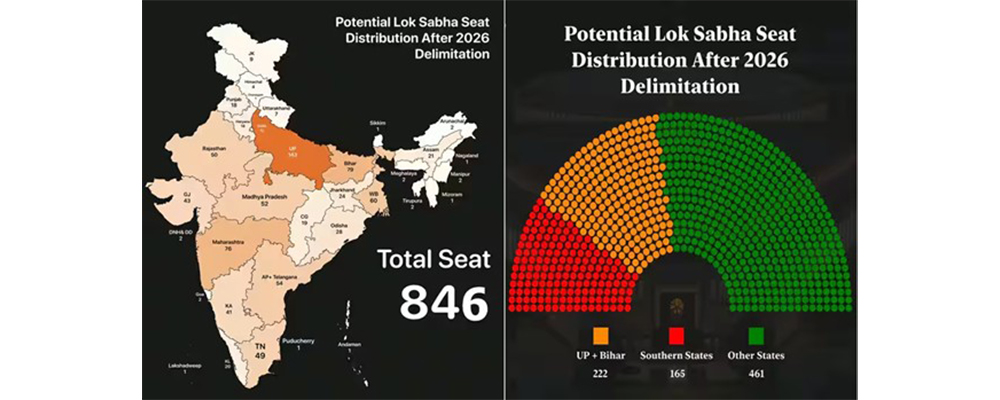
According to independent studies, if delimitation is conducted based on the present population, the number of Lok Sabha seats in Karnataka will decrease from 28 to 26. In Andhra Pradesh, the number of seats will drop from 42 to 34, in Kerala from 20 to 12, and in Tamil Nadu from 39 to 31.
At the same time, the number of Lok Sabha seats in Uttar Pradesh would increase from 80 to 91, Bihar from 40 to 50, and Madhya Pradesh from 29 to 33. In such an event, the voice of the southern states would be further weakened.
Political Opposition to Delimitation
In this context, on March 5, 2025, most political parties in Tamil Nadu convened at a meeting called by Chief Minister M. K. Stalin to discuss the delimitation exercise due in 2026. In a resolution, the parties urged the Union government to extend the 1971 Census-based delimitation framework for another 30 years to ensure fair representation for states that have effectively controlled their population.
Constitutional Provisions on Delimitation
The number of seats in Parliament and state assemblies is determined by population figures to ensure equal representation. The idea is that each Member of Parliament (MP) or Member of Legislative Assembly (MLA) should represent approximately the same number of people, in accordance with the principle of one citizen, one vote, one value, as laid down under Article 81 of the Constitution of India.
According to the Constitution, the number of seats in the houses of Parliament and assemblies must be readjusted after each Census. Article 82 of the Constitution states:
“Upon the completion of each Census, the allocation of seats in the House of the People and the States and the division of each State into territorial constituencies shall be readjusted by such authority and in such manner as Parliament may by law determine.”
Furthermore, Article 170(3) states:
“Upon the completion of each Census, the total number of seats in the Legislative Assembly of each State into territorial constituencies shall be readjusted by such authority and in such manner as Parliament may by law determine.”
Historical Context of Delimitation Freezes
The number of Lok Sabha seats was fixed at 494 after the 1951 Census and raised to 522 after the 1961 Census. However, since 1971, the number of Lok Sabha seats has remained fixed at 543, translating to approximately 10 lakh people per MP.
During the Emergency (June 25, 1975 – March 21, 1977), the Congress government led by Indira Gandhi passed the 42nd Amendment in 1976, freezing the number of Lok Sabha seats until after the first Census taken after 2000. In 2002, the National Democratic Alliance (NDA) government led by Atal Bihari Vajpayee extended this freeze for another 25 years, until 2026.
It is this freeze that opposition parties, led by M. K. Stalin of the DMK, are urging the Union government to extend for another 30 years—until 2056.
0 Comments