
Zesty Aromatic Spoon (ZAS) is a pseudonym for a writer whose readers are already familiar with her reflective take on life. Through vivid storytelling, ZAS explores the deeper connections in food, travel, & human interaction. Keep guessing.
As the sacred month of blessings ends, Eid-ul-Fitr arrives like a radiant dawn, marking the culmination of days filled with devotion, prayers, and heartfelt remembrance of our Most Merciful Creator. Every moment spent in worship, every whispered supplication, and the pursuit of the Night of Power, each was a treasure beyond measure. And now, as we embrace the joy of Eid, I am certain that our cherished readers have savored not only the spiritual rewards but also the barakah that graced their plates, a reflection of the countless blessings this month bestowed upon us all.
Yes, I completely understand, the women of the house, who spent more time preparing Suhoor and Iftaar than in deep contemplation of the Aakhirah. While others immersed themselves in prayers, you were immersed in dough, spices, and the never-ending symphony of chopping, blending, and kneading. But take heart, for Allah, the Most Merciful, surely counts every stir of the ladle, every perfectly rolled roti, and even the patient setting of the table as acts of devotion. And let’s not even get started on the ultimate jihad, waking up the family! Sprinting from the kitchen to the bedrooms, pleading, shaking, and, if necessary, resorting to dramatic threats surely, that too is a form of ibadah! May all our acts of worship be accepted and rewarded, and may we be blessed to witness another Ramadan.
Every Eid in my memory begins with our father transforming a corner of the living room into the grand “Eid Table”, a sacred space where our new clothes, accessories, and footwear were displayed like prized possessions. As we shopped, each item found its rightful place, neatly arranged under his watchful eye. The sons, of course, occupied a modest section, while the daughters’ ever-expanding collection of outfits, shoes, and matching accessories slowly took over the table.
Now, in true family tradition, we continue this ritual for our own children, because what is Eid without a little pre-festivity showcase and a silent competition of who outshopped whom?
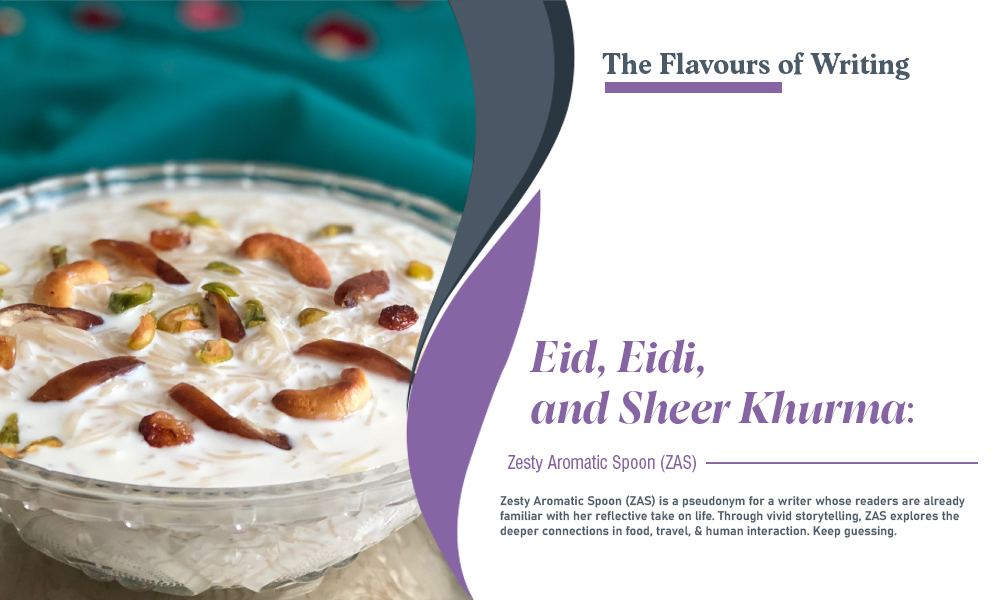
While the children were busy with mehandi and ironing of the clothes Ammi would be busy peeling onions, garlic, ginger (yes, we did not have the concept of ready-made gingergarlic paste). The ‘Eid ka khana’, as we call it even today, at our home was different from most. It wasn’t biryani. It was ‘Bagara Chawl’, Meat Akhni, tangy roasted chana dal chutney and the king was ‘sheer khurma’.
In every Muslim household across the Indian subcontinent, Eid celebrations come with a non-negotiable guest of honor, Sheer Khurma. This rich, slurp-worthy dessert isn’t just food; it’s a tradition, a legacy, and quite possibly, the one dish that can silence an entire room for a few blissful moments.
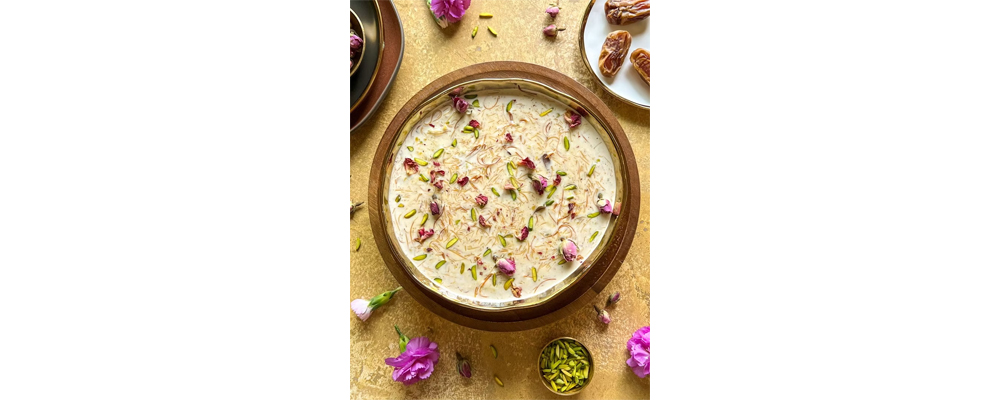
The name Sheer Khurma comes from Persian, Sheer meaning milk and Khurma meaning dates, because, of course, what’s better than combining two of the most beloved ingredients known to mankind? The magic begins with vermicelli sizzling in ghee until golden and fragrant, followed by a slow simmer in thickened milk, sweetened with sugar and dates. And just when you think it’s done, in come the toasted dry fruits—pistachios, almonds, chironji, cashews, and raisins, because no Sheer Khurma is complete without a little crunch.
Some add saffron, cardamom, clove, and rose water with the precision of a seasoned chef (or in most cases, an over-enthusiastic family elder who believes the recipe is stored in their soul). The process begins the night before Eid because Sheer Khurma isn’t a dish you rush—it’s a slow, delicate ritual that must taste the same every single year, or risk the collective disapproval of an entire household.
This dessert has traveled far and wide, tracing its origins back to the Arabian desert, where dates and milk sustained fasting Arabs. Vermicelli made its way to India thanks to Marco Polo (yes, the Marco Polo), who brought noodles from China. But it was the Mughal khansamas who turned this simple dish into the royal treat we now fight over at the Eid table.
In my home, Sheer Khurma isn’t just a dessert; it’s an inheritance. My Dadi had her signature way of making it, which she passed to my mother, and now, the legacy rests with me. Every year, as I stir the pot, carefully balancing flavors and praying I don’t mess up generations of perfection, I realize, this isn’t just about making dessert. It’s about upholding family honour, avoiding unsolicited feedback from elders, and most importantly, securing my fair share before the pot mysteriously empties!
Here’s my grandmother’s legendary Sheer Qorma recipe, an heirloom of flavors and, quite frankly, a test of patience.
Start by soaking three teaspoons of fennel seeds overnight (if you can get your hands on Lukhnawi fennel seeds, even better—yes, fennel has varieties, and yes, this matters). Along with it, soak two teaspoons of poppy seeds. The next morning, grind the soaked mix with half a freshly grated coconut and extract its rich, thick milk. Discard the pulp—this isn’t a zero-waste recipe, unfortunately.
Now, in a large vessel, pour three liters (or whatever amount you need to feed your army) of milk and wait for it to boil. Once it does, add a medium cup of thin, roasted vermicelli and let it swirl around like it owns the place. Sprinkle in cardamom powder and sugar, but remember—this is a slow process. No fast-tracking. The milk must reduce naturally by at least 500 ml, so breathe, meditate, or stare into the pot like it’s a life decision or just shout at the people around who are not yet ready for the Eid prayers!
Once you’ve reached that perfect consistency, stir in the extracted coconut-fennel milk, bring it to one final boil, and take it off the flame. Now, for the grand finale—heat some pure ghee in a pan, toss in five cloves, two pieces of cinnamon, roasted and peeled chironji, soaked and sliced dry dates, and almonds (soaked, peeled, and chopped). Add your preferred dry fruits—but not mentioning cashews, because I personally have a lifelong disagreement with them. Sauté everything until light brown, then pour this fragrant concoction over your milk-vermicelli masterpiece.
Serve hot, and now brace yourself for the great Sheer Khurma debate. At my in-laws’, the argument still rages on: do we drink it or eat it? According to my Ammi, it’s meant to be drunk. I, on the other hand, believe Sheer Khurma should be savored however one pleases.
When the men of the house march off for Eid-ul-Fitr Salah, you’d think the women would seize the moment to get all dolled up, right? Wrong. Instead of admiring themselves in the mirror, they’re busy sweeping, setting the table, and ensuring everything looks perfect—while they, ironically, remain in their most un-Eid-like clothes. By the time the men return, the house is sparkling, the food is ready, and the women? Well, they look like they just survived a battle, which, in a way, they did.
At my in-laws’ place, though, the Eid Salah is a family affair, with the women also attending prayers. This means one thing, my mother-in-law takes on her annual duty of calling out everyone’s names and issuing countdown reminders as if we’re all catching a flight instead of going to the mosque.
And then comes the post-Salah phenomenon. Everyone returns home ravenous, ready to collapse in hunger, but curiously, no one heads to the kitchen. Why? Because after a month of fasting, eating in daylight still feels wrong. Even sipping water on Eid feels suspiciously like breaking a fast, leaving us momentarily confused about whether we should be indulging or waiting for the Maghrib adhan!
Then comes the unstoppable Eidi army—a brigade of children on a mission, fueled by sheer determination (and the scent of crisp currency notes). Kids who conveniently forget certain relatives exist all year round suddenly transform into the most devoted visitors, making their rounds with military precision.
Between house-hopping, they pause to count their loot, eyes gleaming as they mentally calculate the next target. Little girls, dressed in their finest, clutch tiny, glittering handbags—perfectly sized for storing fortunes in the form of Eidi. Meanwhile, the boys, smug in their advantage, simply stuff their treasures into their deep, blessed pockets, ready to sprint to the next unsuspecting phuppo or mamu.
Eid has always been a time of reunion, a chance to reconnect with family, revisit childhood memories, and soak in the warmth of togetherness. Let’s not let that slip away. Set aside pride, mend broken ties, and hold on to the people who matter. May this Eid bring every family member closer, and let’s extend that love beyond, invite your non-Muslim friends to the feast, share the joy, and let peace and brotherhood take center stage.
As I type this, another Eid passes with me miles away from Ammi’s home and her legendary Eid ka khana, a bittersweet reminder of the irreplaceable comfort of home.
Eid Mubarak! And yes, Shawwal fasts are due!
Beautiful article
Such a beautiful and nostalgic artical…loved it and actually this article like a time machine took me back in those golden days when hearts were pure and love and care was showered upon us by the elders as an obligation….
Thankyou so much for a such a beautiful reminder of childhood memories…
What a pleasent interpretation of holy moments of Ramadan Month. Realy pleasing and astonishing facts of our beloved and most respectable friend Mr. Azeez Belgami saheb’s life.