
The author is a 3rd year MBBS student, NHLMMC, Ahmedabad
“Into whatsoever houses I enter, I will enter to help the sick.”
— Hippocratic Oath
Medicine in an Unwell World
These are not merely ceremonial words but an oath that every one of us took the very moment we stepped into this universe of altruism and rescue. A testimony that medicine, at its core, is humanitarianism.
Yet as we take this oath in the age of acceleration — what activists call the Anthropocene — the question that arises is: How do we justify the oath taken? The houses we are meant to enter are no longer just homes and hospital wards but refugee tents swallowed by destruction, healthcare systems trembling under bombardment, villages disappearing into floodwater, and cities where silence follows sirens and humans are struck by blood tides. The question is no longer whether to help the sick, but how — when the world itself is unwell.
As 2026 begins, more than 239 million people are in urgent need of humanitarian aid and protection. Conflicts are more violent against civilians and last longer than at any time since World War II. Climate change is no longer a forecast; it is a case of multi-organ failure. The 1.5°C threshold is being exceeded, leading to catastrophic climate events, including droughts and floods that destroy livelihoods. Epidemics are another factor that has increased the need for humanitarian aid.
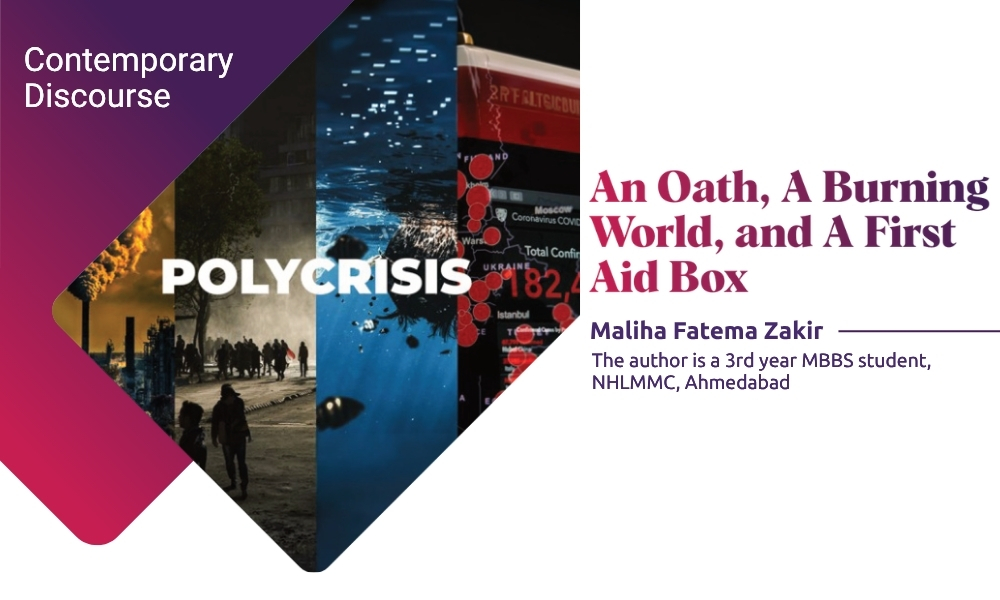
This convergence of crises — called polycrisis — is not only creating disease but reshaping it, bringing mutations and spreading as cancer does, causing wreckage to whatever comes in its way.
But between our oath and action stand walls.
Privilege, Witness, and Responsibility
As I write, my room remains intact, my light uninterrupted, my water unquestioned. Somewhere else, at this same second, a mother is measuring rice like medicine, a child learning the sound of drones before school bells, a doctor choosing between patients and probabilities.
The same sun touches my page and their tents. The same clock moves for me and for those counting minutes between shelling, between fevers, between breaths. Maps have already decided who plans a future and who negotiates a night.
This is geographical privilege.
And if this privilege keeps us alive, what do we owe?
Humanitarian aid is not stagnant. It is learning to localize — placing power back into the hands that feel the pain. Instead of international organizations running everything, we should be empowering local NGOs, community leaders, and local governments to lead response efforts. It is evolving through technology, with telemedicine reaching places where roads cannot. It is finally naming mental health as essential, not optional, alongside the survival kit of life. It also focuses on decreasing gender-based violence.
The Oath in Action
We are not only clinicians of cells and systems; we are witnesses. Advocates. Bridges between suffering and science. In a world where hospitals crumble before hope does, medicine becomes a movement — hands that stitch, voices that guide, eyes that witness, and the steady insistence that no life should be invisible.
Humanitarian aid today is the hand pressed to the fevered pulse of humanity itself — listening and refusing to let the world turn silently while it bleeds.
And every time we choose to listen, to show up, and to speak for those whose pain has been politicized or postponed, we fulfil the oath.
We enter the house.
Even when the house is the world.
Humanitarian aid is not stagnant. It is learning to localize — placing power back into the hands that feel the pain. Instead of international organizations running everything, we should be empowering local NGOs, community leaders, and local governments to lead response efforts. It is evolving through technology, with telemedicine reaching places where roads cannot. It is finally naming mental health as essential, not optional, alongside the survival kit of life. It also focuses on decreasing gender-based violence.
0 Comments