
The authors of this article are third-year law students from University College of Law, Osmania University, Hyderabad.
Introduction
The month of Muharram recently passed by. In Karbala, over fourteen centuries ago, a man stood with no army, no political backing, and no worldly chance of victory, yet the world still remembers his name. Imam Hussain Ibn Ali RA, the beloved grandson of Prophet Muhammad PBUH, chose to lay down his life rather than bow to a tyrant, declaring with his final breath that moral truth must never be subjugated by political might. Today, in the devastated alleys of Gaza, where children die thirst and hospitals lie in ruins, that same spirit breathes, and the comparison is historical, spiritual, and tragically real. This article aims to highlight how the legacy of Karbala as an ethical paradigm endures in occupied Palestine.
The Siege of Water from Euphrates to Gaza
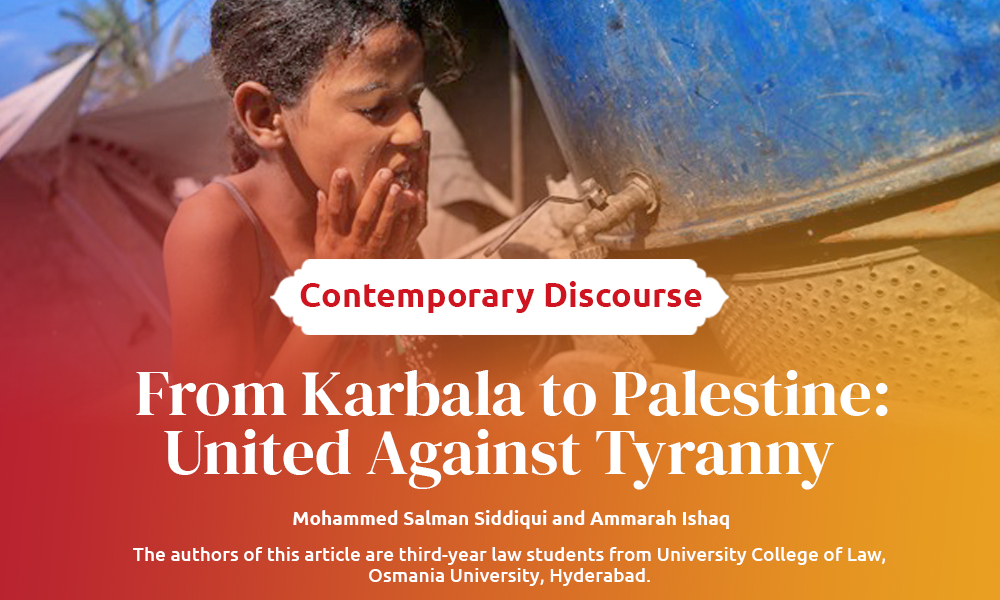
In both Karbala and Gaza, the simplest of needs became a weapon of war. In 61 AH, Yazid’s forces encircled the camp of Imam Hussain RA, denying him, his family, and even his infant son access to the Euphrates. This was not a collateral cruelty; instead, it was a calculated attempt to break the spirit before spilling the blood. Centuries later, in the besieged Gaza Strip, history repeats itself with haunting precision. Entire neighbourhoods survive on contaminated water. Children drink salt and sewage, and humanitarian convoys carrying basic supplies are bombed before arrival. According to a 2023 UN OCHA report, more than 90% of Gaza’s water is unsafe to drink, and hospitals often shut down due to lack of clean supply.
Dr Musharraf Hussain, in The Tragedy of Karbala, captures the anguish of thirst in Karbala when he writes, “The cries of the children were like knives piercing the heart of every believer.” The weaponisation of water is not new; it is a marker of tyrants, from the banks of the Euphrates to the gates of Rafah. And yet, as Hussain RA refused to plead to Yazid for mercy, today’s Palestinians refuse to beg for pity. Their resilience is not born of desperation, but of the same principle that made Imam Hussain say: “I did not rise for rebellion or corruption but I rose to reform the Ummah of my grandfather.” In their thirst, in their sujood amidst ruins, in their quiet resistance, the people of Gaza do not merely resemble Karbala, they relive it.
The Spirit of Zainab and the Legacy of Women
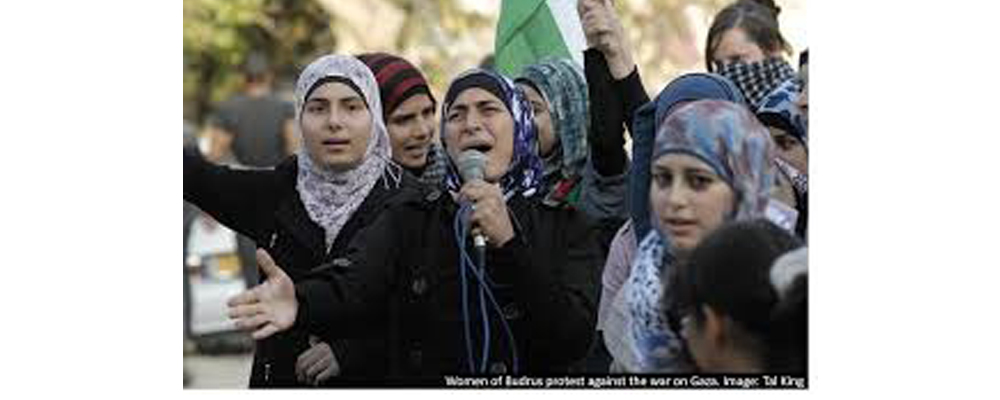
When the swords fell silent at Karbala and the plains were littered with the bodies of the Prophet’s family, it did not mark the end of the struggle; it gave birth to the beginning of its voice. That voice was Zainab RA, dragged in chains to the court of Yazid, her family massacred and her dignity violated. She stood before the tyrant and declared: “I swear by Allah, I saw nothing but beauty.” Her words shook the court. She did not merely endure tragedy, she narrated it into truth, converting grief into revolution. In The History of Islam, Akbar Shah Najeebabadi writes: “Sayyidah Zainab played a significant role in making the tragedy of Karbala reach the Muslim Ummah… She kept the memory of the martyrs alive and turned the sorrow into a lesson for generations.”
In Gaza today, Zainab walks again, not in royal courts, but among the ruins. In the grieving mother who names her martyred child Hussain. In the teenage girl holding Qur’anic verse banners while hearing bombings. In the widow who says Alhamdulillah over her husband’s shroud. These are not victims; they are narrators of our time. Her courage is a legacy followed today in Gaza’s women, reminding us that strength is not the absence of grief, it is the refusal to surrender your truth to it.
Moral Authority in the Age of Oppression
What made Karbala immortal wasn’t the clash of swords, but the moral clarity that stood unshaken due to betrayal, silence, and brute force. Imam Hussain RA knew that his martyrdom would not dethrone Yazid, yet he refused to legitimise tyranny through even passive silence. His stand was not for conquest; it was for conscience. As Maulana Maududi writes in Islam’s Political Order, “The deviation of the Muslim Ummah began not with the rise of a sword but with the fall of moral leadership.” Karbala was an attempt to restore that soul, to reclaim the prophetic spirit of governance that Yazid’s empire had defiled. That attempt did not die in 61 AH; it now bleeds, where the international community’s silence resembles the complicity of Kufa’s people who kept watching.
The Qur’an asks: “And incline not toward those who do wrong, lest the Fire should touch you…” {11:113}. When world leaders preach peace but fund warplanes, when Muslim nations turn away from the suffering of Palestine for political convenience, it is then that Yazidism survives not just in armies, but in apathy. Imam Hussain’s RA refusal to endorse injustice became a spiritual axis in Islamic thought, setting a precedent that allegiance to Allah requires disobedience to taghut (tyranny). What, then, becomes of us if our allegiance lies with neither?
Today’s Ali Asghars: Children of the Intifada
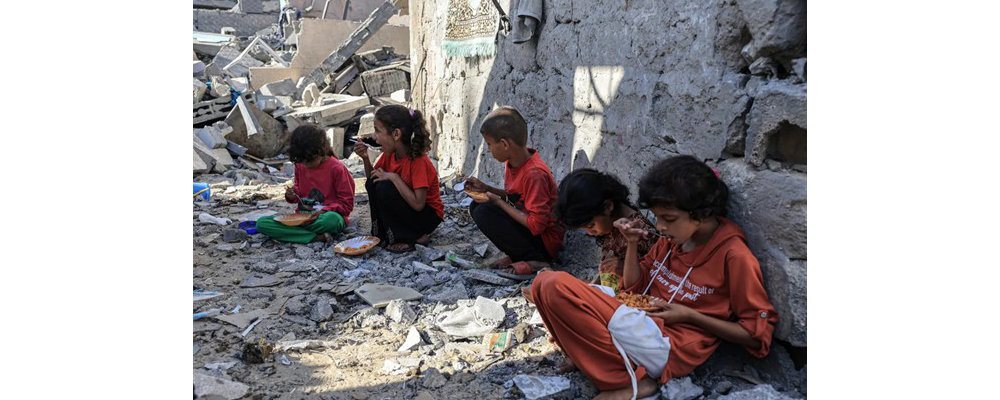
In Karbala, when Imam Hussain RA raised his six-month-old son, Ali Asghar, to the enemy ranks—parched, breathless, innocent—not as an appeal for pity but to expose the inhumanity of an empire. An archer named Harmala answered by loosing a three-pronged arrow that split the infant’s throat. In that moment, the battlefield collapsed into a cosmic moral indictment. More than 14,000 children have been killed since the siege intensified in 2023—babies pulled lifeless from rubble, infants dying in incubators when power is cut, toddlers laid in mass graves with their names handwritten on cardboard. Their names are not unknown to Allah. They are this era’s Ali Asghars, witnesses for the Day of Judgement.
Dr Musharraf Hussain, reflecting on Karbala, writes: “The martyrdom of Ali Asghar was a point of no return; it unveiled tyranny at its most raw and left the oppressors morally naked before the world.” This has returned. The shrouded bodies of Gaza’s children are not numbers but counted evidence. They testify to a political hypocrisy that chants rights while denying life. But they also testify to the resilience of a people who bury their dead with the tasbeeh on their lips. Palestine’s soil is heavy with small graves and tall legacies. These children, like Ali Asghar, speak not with words but with wounds. And their silence is louder than any speech.
Divine Resistance and the Power of Ṣabr
If Karbala taught the world anything, it is that victory is not always survival—sometimes, it is steadfastness. As the first verse of Surah Fath leaves us with the same lesson. Imam Hussain RA did not prevail by worldly standards. His family was slaughtered, his body trampled, his head paraded. But his ṣabr, his unshakable trust in Allah, his refusal to capitulate, immortalised his cause and humiliated his oppressors. This sacred ṣabr was not passive submission; it was prophetic defiance. Allah says, “Oh you who believe, seek help through patience and prayer. Indeed, Allah is with the steadfast.” {2:153}.
For over seven decades, Palestinians have lived under occupation, exile, surveillance, siege, and starvation. And yet, they have not surrendered their spirit. A mother kisses her child goodbye, knowing she may not return. A child recites Surah Yasin under drone fire. A teenager walks to Jummah knowing the sniper’s scope is trained on him. As Maulana Maududi writes, “Endurance in the path of truth is not defeat, it is the forging of the soul to withstand history’s heaviest tests.” And Gaza is withstanding them, daily.
The Prophet ﷺ said, “How wonderful is the affair of the believer. For there is good for him in every matter, and this is not the case with anyone except the believer. If he is happy, he thanks Allah and gains reward. If he is harmed, he shows patience and gains reward.” (Sahih Muslim, Hadith No. 2999). The Palestinian soul, like the Hussaini soul, does not rely on weapons or worldly allies; it relies on Allah alone and in that reliance lies a defiance no power can suppress. Karbala was a declaration that truth must never kneel, while Gaza shows that true believers bend only in sujood.
From Mourning to Marching with the Banner of Karbala
Karbala was never meant to be entombed in elegy. It was meant to be a mash‘al, a torch, a legacy, passed from hand to hand, era to era, generation to generation, until justice reigns and falsehood is extinguished. Today, as we scroll martyrdom clips and forget mass graves as quickly as headlines change, the believer is asked not simply to feel, but to stand. The Qur’an calls us without ambiguity: “Indeed, Allah commands you to uphold justice…” {16:90}. The command is not seasonal. It is timeless.
So what now? To honour Hussain RA is to embody him. To name our children after Zainab RA is to raise her voice too, even when the world prefers silence. Organise. Speak. Write. Prostrate. Donate. Educate. Refuse to forget. Make du‘a in the stillness of your night for every orphan, every captive, every limb torn from innocent flesh. But do not stop there. Build and shape narratives, support justice wherever it bleeds. For Hussain RA did not die for rituals and mourning ceremonies. And those souls now cry from the minarets of Al-Aqsa, from the mass graves of Khan Younis, from the hunger-lined faces of Rafah.
“ الِِذَلَّة ِمَّنَا هَيْهَاَتْ— We shall never be humiliated.” These are historic words. They are a living oath. And if we take it, sincerely and courageously, then Karbala is within us. And so is Gaza.
إِنَّ نَصْرَ اللَّهِ قَرِيِب
Indeed, the help of Allah is near. {2:214}
Mashallah, jazakallah for such a beautiful article may Allah bless you success here and hereafter
Brilliant comparison between Karbala and Gaza ..!!! Empathetic viewpoint for every one ..
Subhanallah, a needed juxtaposition and a poignant call to action!
“The deviation of the Muslim Ummah began not with the rise of a sword but with the fall of moral leadership.” Hits hard.