
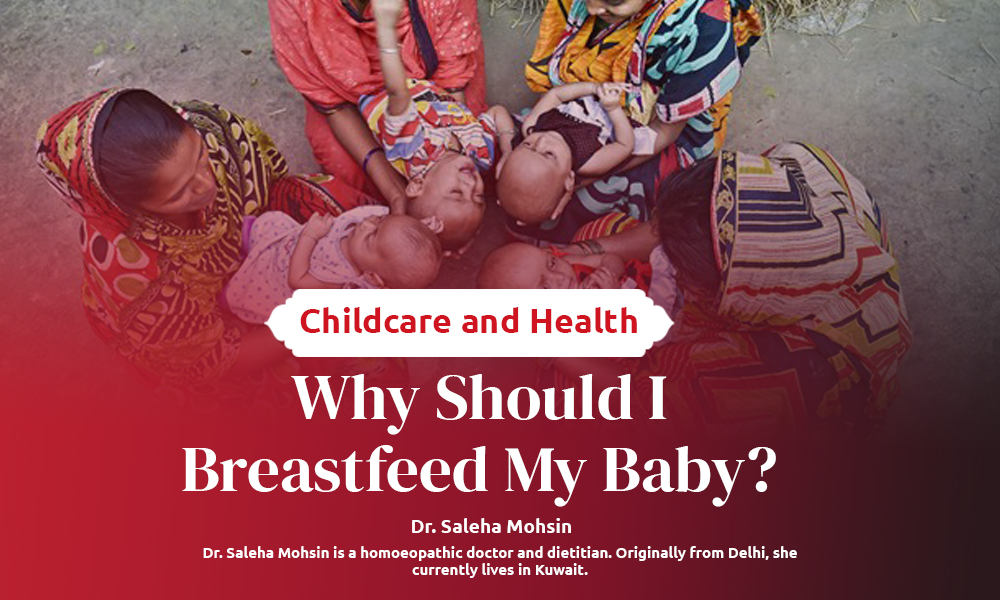
Dr. Saleha Mohsin is a homoeopathic doctor and dietitian. Originally from Delhi, she currently lives in Kuwait.
Breast milk is the ideal food for a newborn baby. It provides all the nutrients required for normal growth and development from birth to six months. Moreover, it prevents infections in the early years, wards off chronic diseases later in life, boosts immunity, and supports brain function. However, to get the maximum benefits of breastfeeding, it must be exclusive—i.e., only breast milk should be given, with no other food or drink, except for vitamin drops if recommended. Breastfeeding should be initiated within the first half-hour of birth and continued exclusively for the first six months.
In Surah Al-Baqarah, Ayah 233, mothers are encouraged to breastfeed their children for two full years if they are able to do so.
Nutritional Superiority of Breast Milk
Breast milk contains all the nutrients a newborn needs in the right proportions and in a form that is easy for babies to digest. Approximately 88% of breast milk is water, which means newborns do not need additional water in the early months.
Lactose, the main sugar in breast milk, helps in the absorption of calcium and promotes the growth of healthy lactobacilli bacteria in the intestines. This contributes to better digestion and fewer issues like bloating and colic in breastfed babies.
Breast milk is lower in protein compared to formula or cow’s milk, but the proteins are in forms that are ideal for infants. Notably, human milk uniquely contains the amino acids cysteine and taurine, which play an important role in brain and nervous system development. Research has linked higher cognitive scores and improved social bonding in breastfed children to these components [Source: Journal of Pediatric Gastroenterology and Nutrition, 2005].
Breast milk fats include polyunsaturated fatty acids (PUFAs) and omega-3 fatty acids, essential for the development of the baby’s nervous system and hormones. Several studies have shown improved language development and cognitive performance in breastfed children due to these fats [Source: The Lancet Global Health, 2016].
Breast milk also provides sufficient vitamins and minerals to meet the infant’s needs in the early months. Additionally, it contains immunoglobulins, growth factors, enzymes, and antibodies that help strengthen the baby’s immune system. Breastfed infants are less likely to suffer from infections, allergies, and chronic illnesses such as obesity, type 2 diabetes, and asthma later in life [Source: American Academy of Pediatrics Policy Statement, 2022].
What Does Breast Milk Contain?
In the first 3–4 days after birth, the mother produces colostrum, a pale yellow, nutrient-rich liquid. Colostrum is high in antibodies and vitamins A, D, E, and K. Mothers must be encouraged to breastfeed during this period rather than discard colostrum, which is a misguided practice in some communities.
By two weeks postpartum, mature breast milk is produced. It consists of foremilk and hindmilk. When the baby starts feeding, foremilk—rich in water, sugar, vitamins, minerals, and proteins—satisfies the baby’s thirst. As feeding continues, it gradually transitions into hindmilk, which is rich in fats and essential for satiety and healthy weight gain. Therefore, it’s important to fully empty one breast before switching to the other.
Breastfeeding Technique
Breastfeeding can be overwhelming, especially for new mothers, if proper techniques are not followed. First, ensure correct positioning:
- The mother may sit or lie with her back supported.
- She should not lean forward; instead, bring the baby to her.
- The baby’s whole body should be supported and relaxed.
- The baby’s mouth should be wide open and latched properly onto the nipple.
- Watch for suckling and swallowing movements to ensure effective feeding.
Breastfeeding Positions:
A. Cradle Hold
B. Cross-Cradle Hold
C. Football Hold
D. Reclining Position
E. Side-Lying Position
(Image credit: www.unicef.org)
Not Enough Milk?
If a baby is crying often or not sleeping for 2–3 hours after feeding, it may suggest low milk supply. Common reasons include:
- Use of pacifiers or bottles between feeds
- Giving water, gripe water, or honey, which are unnecessary and can interfere with feeding
- Not feeding at night, which reduces milk-producing hormones
- Not emptying the breast fully—if the baby is unable to suck, mothers should express milk manually or with a pump
- Painful breasts or sore nipples, often caused by poor latching
- Stress, lack of sleep, or inadequate maternal nutrition
Proper support, rest, hydration, and frequent nursing usually help restore supply.
Breastfeeding Benefits for Mothers
Breastfeeding is not only convenient and cost-effective—it has multiple health benefits for mothers too. It:
- Reduces postpartum bleeding
- Helps the uterus contract and return to normal size
- Aids in weight loss after pregnancy
- Lowers the risk of breast and ovarian cancers
- Delays the return of menstruation, which may help with spacing pregnancies
When Breastfeeding Isn’t Possible: “Fed is Best”
While breastfeeding is highly beneficial, not all mothers are able to breastfeed. Some women may face latching difficulties, low milk supply, medical complications, or postpartum mental health challenges. In such situations, formula feeding is a safe, regulated, and nourishing alternative. The phrase “Fed is Best” recognizes that a well-fed baby—whether through breast milk or formula—is what matters most for healthy growth and development.
Shaming or guilt around not breastfeeding only adds to the emotional burden on mothers. In Islam, effort is rewarded—and if a mother tries her best but cannot breastfeed, she is not blameworthy. Compassion, support, and correct information are vital so that every mother feels confident and empowered, no matter how she feeds her child.
Good information 👍
I got new knowledge on breastfeeding ✨
Alhamdulillah ❤️
Jazaka Allah khair
Very informative 🌹🌹
Such a wholesome & important information 👍.
Good and very informative