
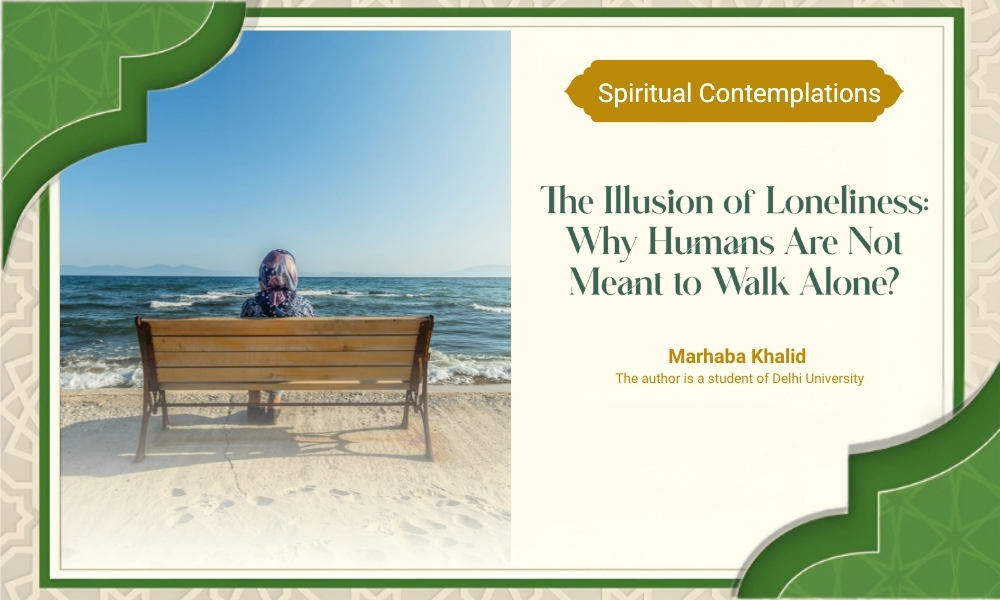
The author is a student of Delhi University

Loneliness and independence are increasingly portrayed as the highest forms of self-growth in today’s world. This generation has romanticised these ideas so intensely that isolation is often mistaken for enlightenment.
We are repeatedly told that genius is born in silence, healing happens alone, and truth lies in cutting oneself off from the world.
Quiet lives, lonely rooms, and solitary movements are projected as symbols of intelligence and depth.
But what reality does this narrative truly contain?
When a moment—like healthy solitude—is turned into a permanent model of living, something deep within the human spirit is damaged.
The truth is simple: human beings were not created to walk alone. Absolute independence is a flawed idea. Dependence is not weakness; rather, it is a beautiful and essential part of human nature.
Across civilisations, traditions, and faiths, wisdom has never glorified isolation. Instead, unity, empathy, and togetherness have always been celebrated. Religions speak of interdependence as a moral and spiritual principle. Islam, in particular, places community at its very core. Prophet Muhammad ﷺ did not teach withdrawal from society; he built an Ummah—a living, breathing community rooted in mutual care, responsibility, and compassion.
This truth echoes beyond Islam. In the Mahabharata, Arjuna—the great warrior—breaks down on the battlefield. Clarity does not emerge in isolation, but through the presence, guidance, and companionship of Krishna. Strength, here, is born not from separation, but from connection. Christianity echoes a similar message through fellowship and shared faith. Sikhism emphasises Sangat—holy company—as a spiritual necessity.
Across religions, one subtle yet profound truth resounds: the path of God is collective, and faith is not a solitary journey behind closed doors.
So why have we begun to treat being alone as a virtue in itself?
When the mask of self-sufficiency is glorified, loneliness becomes normalised. We are taught that suffering alone is noble and asking for help is a failure. The World Health Organisation recognises loneliness as a growing global public health concern—one that silently erodes mental, emotional, and social well-being.
What we must understand today is this: solitude is medicine, not a meal. It heals, but only in doses. It cannot sustain us, though it may calm us. As beautifully captured in a simple metaphor:
“A single lamp may glow brightly, but many lamps together illuminate the world. One flute can produce a lovely tune, but an orchestra lifts the soul.”
Dear readers, we thrive in connection. Our joys bloom in togetherness. Burdens grow lighter when shared, and even grief becomes bearable when someone sits beside us in silence.
So let us change the narrative. Let us make space for moments of solitude, honour self-reflection, and listen to our inner voice. But let us not glorify isolation at the cost of mental health and the relationships we cherish. A world that values unity will always be richer, kinder, and more humane than one that worships isolation.
[7907]Wipwin | Link vào tải app và chơi nổ hũ baccarat uy tín,Truy cập wipwin để trải nghiệm game slot nổ hũ uy tín, tìm hiểu cách chơi baccarat online và nạp tiền casino qua Momo nhanh chóng. Tham gia ngay hôm nay! visit: wipwin