
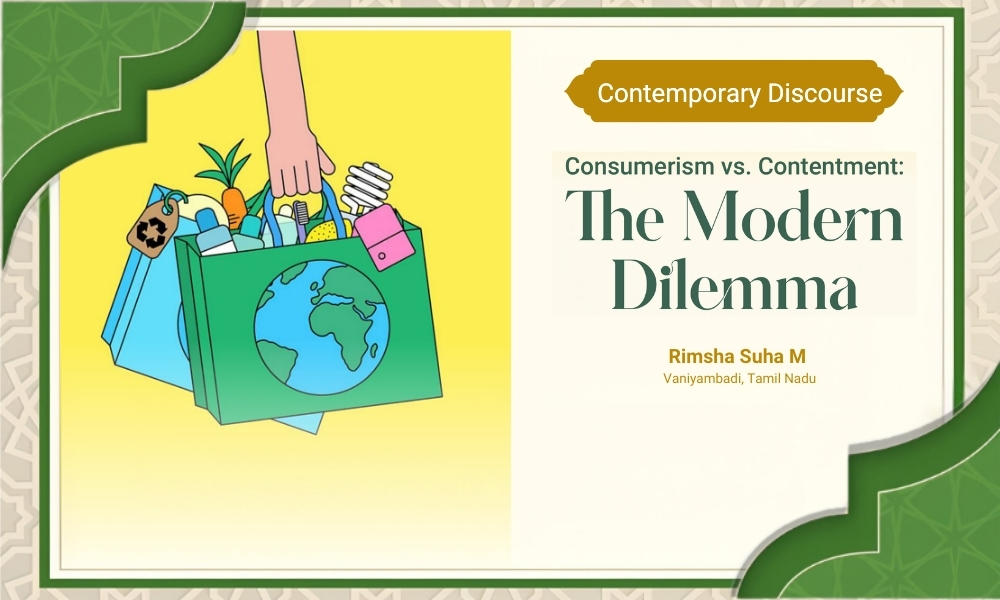
Vaniyambadi, Tamil Nadu

Have you ever wondered why many people like us feel restless and unsatisfied, yet find peace despite living in an age of abundance, where we have almost everything at our fingertips? Why does happiness seem fleeting even when comfort, convenience, and choice are readily available, almost at any time? It looks like it is packed, labelled, convinced and sold to people who keep finding it? Isn’t it?
In this era, consumerism has quietly shaped how success is defined. Possessions, lifestyle, and outward achievements have become markers of worth! Luxury goods, aesthetically designed homes, branded clothing, and curated social media feeds constantly reinforce the idea that happiness lies in having more and more, as if we are trapped in a never-ending loop. Yet beneath this polished surface lies a contradiction that cannot be ignored: increased consumption has not brought lasting peace to individuals.
Consumerism is not merely about buying things that have been fed to us; it is a mindset that links self-worth to material acquisition. It trains us individuals to believe that fulfilment is always one step away, one purchase, one upgrade, one experience more. Contentment, by contrast, is the ability to find peace in what already exists, what we as an individual have. It is an inner state of satisfaction that never depends on constant collection!
From an Islamic perspective, this contrast is deeply significant. Islam does not reject lawful comfort or enjoyment, but it strongly warns against excess and attachment to this temporary dunya. The Qur’an reminds us:
ٱعْلَمُوٓا۟ أَنَّمَا ٱلْحَيَوٰةُ ٱلدُّنْيَا لَعِبٌۭ وَلَهْوٌۭ وَزِينَةٌۭ وَتَفَاخُرٌۢ بَيْنَكُمْ وَتَكَاثُرٌۭ فِى ٱلْأَمْوَٰلِ وَٱلْأَوْلَـٰدِ
“Know that the life of this world is but amusement and diversion and adornment and boasting to one another, and competition in increase of wealth and children.” (Qur’an 57:20)
This verse captures the essence of consumerism: competition, comparison, and the constant pursuit of more often simply comes at the cost of inner peace. The life of the Prophet ﷺ offers a clear alternative! Despite his wealth, he chose simplicity and restraint. He ﷺ said:
“Richness is not having many possessions, but richness is the contentment of the soul.”
(Sahih al-Bukhari & Sahih Muslim)
Modern psychology supports this insight. Studies show that material gains bring only temporary pleasure. The human mind quickly adapts, leading to a recurring cycle of desire known as the “hedonic treadmill.” As soon as one desire is fulfilled, another replaces it, leaving individuals trapped in a pattern of continuous dissatisfaction.
Social media further intensifies this pattern. Consumerism no longer exists only in marketplaces; it now resides in digital spaces. Endless scrolling exposes individuals to carefully curated lives, creating constant comparison with others. Lifestyles which appear better, achievements which seem greater, and the satisfaction we individuals have begins to feel insufficient. The Qur’an warns against this tendency:
وَلَا تَمُدَّنَّ عَيْنَيْكَ إِلَىٰ مَا مَتَّعْنَا بِهِۦٓ أَزْوَٰجًۭا مِّنْهُمْ زَهْرَةَ ٱلْحَيَوٰةِ ٱلدُّنْيَا لِنَفْتِنَهُمْ فِيهِ
“Do not extend your eyes toward that by which We have given enjoyment to some categories of them.” (Qur’an 20:131)
We really need to understand that social media often functions like a glass wall, transparent yet misleading. What is visible appears complete, while the reality behind it remains hidden, and we might not know what exactly the play is. As a result, we individuals compare our full lives with others’ highlights, overlooking our own blessings.
The consequences are not limited to the emotional realm. Excessive digital consumption disrupts focus and rest, overstimulates the mind, and distances the heart from remembrance! Allah reminds us:
أَلَا بِذِكْرِ ٱللَّهِ تَطْمَئِنُّ ٱلْقُلُوبُ
“Verily, in the remembrance of Allah do hearts find rest.” (Qur’an 13:28)
Consumerism has also expanded beyond material possessions to experiences. Many people fear living an “incomplete” life, measuring fulfilment by places visited or milestones achieved. Peace is postponed: I will be content when I reach there, this and that. But Islam very gently redirects this mindset. The Prophet ﷺ advised:
“Look at those who are lower than you and do not look at those who are above you, for that is more suitable that you do not belittle the blessings of Allah upon you.” (Sahih Muslim)
Aspiration and effort are not discouraged in Islam. However, when fulfilment is tied entirely to future achievement, the present is emptied of meaning. Then, consumerism becomes the pursuit of a projected self, one that is endlessly prepared for but never fully reached.
Now, understand this with Islamic wisdom and psychology. Fulfilment simply cannot be endlessly pursued, because pursuit itself creates a sense of lack. A heart attached to what it does not yet possess definitely struggles to find rest, peace! For this reason, qana‘ah (contentment) is regarded as a great blessing in Islam. The Prophet ﷺ said:
“Successful is the one who is guided to Islam, given sufficient provision, and made content with what Allah has given him.” (Sahih Muslim)
Contentment is cultivated through conscious practice, such as pausing before consumption, limiting comparison, expressing gratitude, and spending more time in moderation. The Qur’an cautions:
كُلُوا۟ وَٱشْرَبُوا۟ وَلَا تُسْرِفُوٓا۟ ۚ إِنَّهُۥ لَا يُحِبُّ ٱلْمُسْرِفِينَ
“Eat and drink, but do not be excessive. Indeed, He does not like those who commit excess.”
(Qur’an 7:31)
Charity beautifully transforms wealth into purpose, while spiritual awareness awakens our hearts to the reality that this world is nothing but temporary:
يَوْمَ لَا يَنفَعُ مَالٌۭ وَلَا بَنُونَ
إِلَّا مَنْ أَتَى ٱللَّهَ بِقَلْبٍۢ سَلِيمٍۢ
“The Day when wealth and children will not benefit, except one who comes to Allah with a sound heart.” (Qur’an 26:88–89)
This is very basic to understand that choosing contentment does not require rejecting comfort or progress. It literally requires awareness: recognising how desire is shaped and how peace is often unnecessarily delayed. Contentment does not mean having nothing; it means not allowing possessions or pursuits to dominate our hearts.
مَا عِندَكُمْ يَنفَدُ ۖ وَمَا عِندَ ٱللَّهِ بَاقٍۢ
“And whatever you have will end, but what Allah has is everlasting.” (Qur’an 16:96)
In a world that constantly encourages excess, contentment simply offers clarity! It allows us individuals to live without the pressure of constant comparison and consumption.
Perhaps the real question, then, is not how much we will own or experience in this lifetime, but how present we are while living it. Are we postponing peace for a future version of ourselves, or are we willing to recognize that enough has already been given by being grateful and enjoying the present to the fullest?
So, my dear readers, keep reminding yourself that this world is temporary, and stay reminded of the importance of living a balanced life by ultimately enjoying the present.
References
Psychological & Contemporary Thought
3. Brickman, Philip, and Donald T. Campbell.
“Hedonic Relativism and Planning the Good Society.”
In Adaptation-Level Theory, Academic Press, 1971.
(Foundation of the “hedonic treadmill” concept.)
4. Schwartz, Barry.
The Paradox of Choice: Why More Is Less.
Harper Perennial, 2004.
5. Fromm, Erich.
To Have or To Be?
Harper & Row, 1976.

A mind awakening article indeed!
A mind awakening article indeed
Really impressed with the payout speed here. It is definitely one of the most reliable platforms I have used lately. Highly recommend bdtakbat to everyone.